

TL;DR:
- Most wellness subscription programs are canceled within three months due to poor retention and lack of motivation. Effective models integrate human or AI coaching, progress tracking, and flexibility to foster long-term behavior change. Choosing transparent, personalized programs that fit your lifestyle can help avoid fatigue and achieve genuine wellness outcomes.
Most people who try a wellness subscription cancel it within three months. That statistic feels almost ironic when you consider how many of us sign up with the very best intentions, imagining that a structured program will be the thing that finally anchors a healthy routine. So what separates the subscriptions that genuinely move the needle from the ones that quietly drain your bank account? The answer has less to do with the wellness modality itself and more to do with how the program is built, and how well it fits the way you actually live.
Table of Contents
- How subscription models work in the wellness industry
- Do subscriptions actually improve wellness outcomes?
- The downside: Subscription fatigue and overcoming pitfalls
- Choosing the right wellness subscription for you
- Why most subscriptions fail—and what really enables sustained holistic change
- Take your next step with holistic health support
- Frequently asked questions
Key Takeaways
| Point | Details |
|---|---|
| Habit change enabler | Subscription models can help establish healthier routines by reducing barriers and supporting consistency. |
| Evidence matters | Strong subscription programs show measurable improvements in behavior and wellness when they include coaching and progress tracking. |
| Subscription fatigue risk | Inflexible or poorly explained plans can lead to burnout and high dropout, so flexibility and clarity are essential. |
| Choose for fit | Look for programs that align with your goals, track your progress, and allow easy adjustments. |
| Real change needs support | Subscriptions are most effective when they offer ongoing engagement and personalized strategies, not just recurring products. |
How subscription models work in the wellness industry
Wellness subscriptions come in more shapes than most people realize. At one end, you have digital coaching apps and meditation platforms that deliver guided content on demand. At the other, you have curated supplement kits, Ayurveda care boxes, and integrative therapy memberships that connect you with licensed practitioners on a recurring basis. Each model sits somewhere on a spectrum between pure information delivery and hands-on, relationship-based care.
The core idea behind all of them is what researchers call a "habit-enabler." In wellness, subscription models primarily function as habit-enablers by reducing friction and encouraging ongoing engagement. Think of it like having a gym membership that automatically renews: the barrier to showing up is lower because the decision has already been made. When the access is always there, you are more likely to use it.
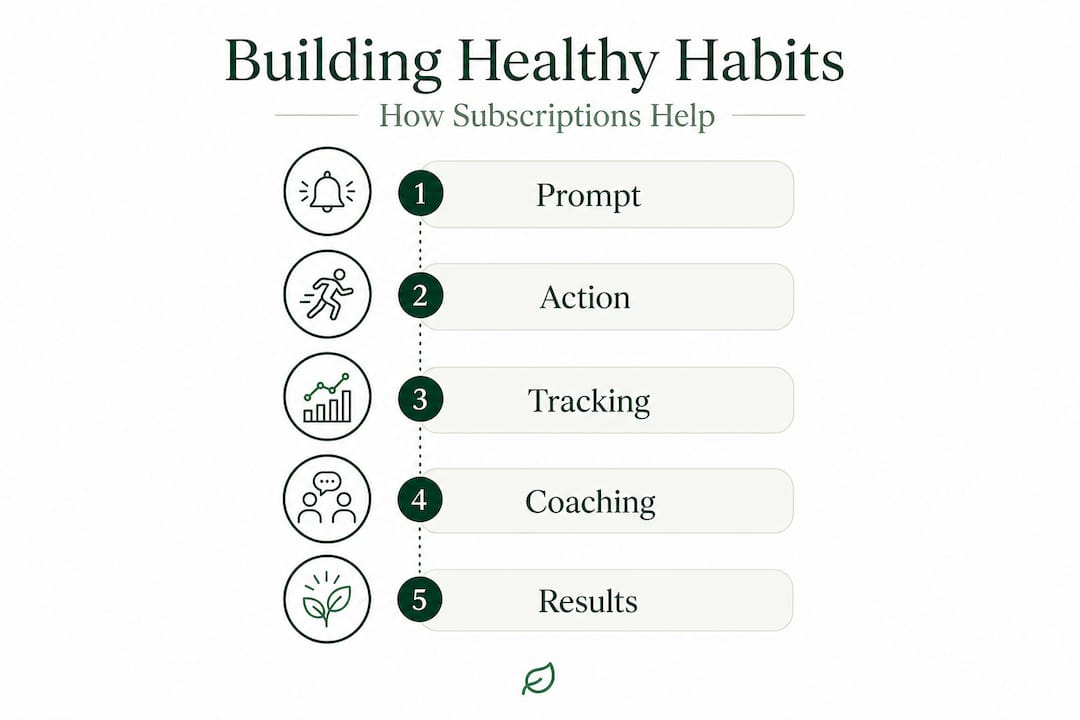
A large and growing segment of these services operate as DTC (direct-to-consumer) digital health companies, delivering recurring content and support without the traditional clinical gatekeeping. That shift has opened up access, but it has also flooded the market with options that vary wildly in quality. Understanding the core categories helps you compare them fairly.
| Subscription type | Primary delivery | Best for |
|---|---|---|
| Meditation and mindfulness apps | Digital content, audio/video | Stress reduction, sleep |
| Supplement kits | Physical product, recurring ship | Nutritional support |
| Digital health coaching | Video, chat, AI | Behavior change, weight, habits |
| Integrative therapy memberships | Practitioner bookings, directory access | Acupuncture, massage, Ayurveda |
| Oral health subscriptions | Physical product plus guidance | Subscription-based healthy routines |
Understanding what you are actually buying in each category is the first step toward getting real value. For example, a meditation app subscription gives you tools, but you still have to show up and use them. An integrative therapy membership, on the other hand, connects you with a practitioner who provides a relational layer of accountability. The personalized wellness benefits of that practitioner relationship are hard to replicate with content alone.
Key categories in the wellness subscription space:
- Mental health and mindfulness: apps, therapist platforms, guided programs
- Nutritional supplements: monthly boxes, customized protocol kits
- Fitness and movement: streaming classes, wearable-linked programs
- Integrative and alternative therapies: acupuncture, massage, chiropractic access plans
- Holistic coaching: AI-powered or human-guided personalized plans
Do subscriptions actually improve wellness outcomes?
With so many options available, the real question is whether these programs actually work. The short answer is: yes, but only under specific conditions.
Research on digital behavior-change programs consistently shows that structured programs over time lead to measurable outcomes and post-program maintenance. A structured, guided program delivered over weeks and months creates the repetition needed for new behaviors to stick. One-off appointments rarely do the same thing, because they lack the follow-through component that real change requires.
"The most effective wellness interventions aren't the most intensive ones. They're the ones people actually stay with long enough to see results."
That insight points directly to the biggest challenge in the subscription wellness world: retention. Monthly churn rates across supplement, fitness, and meditation subscriptions are notably high, often running between 8 and 10% per month. For reference, that means a program starting with 1,000 members could lose 80 to 100 per month through simple disengagement.
Here is a snapshot of typical churn benchmarks across wellness subscription categories:
| Category | Average monthly churn |
|---|---|
| Supplement subscriptions | ~9.5% |
| Fitness apps | ~8–10% |
| Meditation platforms | ~7–9% |
| Digital health coaching | ~5–7% |
| Integrative therapy memberships | ~4–6% |

The lower churn rates in coaching and integrative therapy memberships tell a meaningful story. When a human relationship or a clear accountability structure is part of the program, people tend to stay longer. That staying power is what enables the outcomes the science describes.
For subscriptions to genuinely improve your wellness, four factors seem to matter most:
- Measurable tracking: You need to see progress, even in small increments, to stay motivated.
- Coaching or practitioner contact: Human or AI-guided feedback creates accountability that content alone cannot.
- Structured follow-through: A program with milestones and check-ins is far more effective than an open-ended library of resources.
- Domain fit: Subscriptions work best for evidence-based wellness practices that require ongoing support, like mental health care, nutritional guidance, or regular bodywork.
For conditions or goals where a single intervention is genuinely enough, a one-off appointment may serve you better. But for most holistic health treatments that involve building new patterns over time, the subscription model's ongoing rhythm is a real advantage. Interestingly, even areas like holistic gum health demonstrate that ongoing, consistent care outperforms occasional, reactive treatment.
The downside: Subscription fatigue and overcoming pitfalls
Here is where things get honest. Subscription fatigue is real, and it is spreading. When you carry five or six recurring memberships across streaming, fitness, meal kits, and supplements, the cognitive and financial weight adds up fast. Adding another wellness subscription to that pile can feel like planting a seed in overcrowded soil.
Subscription fatigue reduces retention, especially when programs involve rigid commitments or produce unclear results that are slow to perceive. This is not just about budget. It is about attention, motivation, and mental bandwidth. When a subscription feels like another item on your to-do list, it stops being a wellness tool and starts being a source of low-level stress.
The most common pitfalls include:
- Rigid structures that do not allow you to pause or adjust when life changes
- No visible progress tracking, leaving you unsure whether anything is actually working
- Vague value propositions, where you pay monthly but never quite understand what you're getting
- Too many programs at once, diluting focus and creating financial guilt
- Auto-renewal without reminders, which erodes trust and feels manipulative
Fortunately, programs with flexible options and clearer value consistently outperform rigid, set-and-forget models. The solution is not to avoid subscriptions entirely. It is to choose them more carefully.
Transparency in subscription services is a key signal of a trustworthy provider. Before you commit, look for clear communication about what you receive each billing cycle, how progress is measured, and exactly how to pause or cancel if you need to. This kind of clarity reflects a provider's confidence in the value they offer. Similarly, streamlined wellness support should feel effortless to navigate, not like a maze designed to keep you subscribed against your will.
Strategies to protect yourself from fatigue:
- Choose one primary wellness subscription focus at a time
- Set a 60-day review date on your calendar when you sign up
- Track at least one concrete metric from the start (sleep quality, pain levels, energy)
- Always read the cancellation and pause policy before purchasing
- Prioritize programs with responsive customer support
Pro Tip: Before committing to any wellness subscription, navigate directly to the cancellation page and read the full policy. If it is buried, confusing, or requires a phone call, that is a red flag about the provider's values and your future experience.
Choosing the right wellness subscription for you
Now that you understand both the promise and the pitfalls, here is how to move forward with confidence. Choosing the right program is less about finding the most popular option and more about matching a program's structure to your specific goals and lifestyle.
Start by getting specific about what you want to improve. "Better health" is too broad to evaluate. "Reducing chronic lower back pain through regular massage therapy" is specific enough to measure. That specificity is what lets you hold a subscription accountable.
A step-by-step evaluation process:
- Define your primary wellness goal and set a realistic timeline (60 to 90 days).
- Research whether the modality you want has evidence for ongoing, subscription-style support.
- Review what exactly is included each billing period and whether it aligns with your goal.
- Check for tracking tools, coaching access, or built-in accountability features.
- Verify the flexibility policy: can you pause, downgrade, or cancel easily?
- Look up the provider in a holistic health platform guide or practitioner directory to confirm credentials.
Your quick-check subscription evaluation list:
- Does the program clearly state what outcomes are realistic and when?
- Is there a free trial or low-commitment entry point?
- Are practitioners verified or certified?
- Can you track your own progress within the platform?
- Is the cancellation process simple and clearly described?
- Does the program offer holistic therapy options across more than one modality, giving you room to evolve?
Exploring integrative wellness tips alongside your subscription can also accelerate your results. Programs that provide educational resources alongside practitioner access tend to create more engaged, satisfied members over time.
Individuals benefit most from providers that specify timelines, offer tracking or coaching, and provide genuine flexibility. That combination is the clearest predictor of both satisfaction and lasting change.
Pro Tip: If a platform offers a free tier or a first-month trial, start there. Use that time to track your engagement honestly. If you are not logging in or booking sessions at least twice a month, a paid subscription is unlikely to change that pattern.
Why most subscriptions fail—and what really enables sustained holistic change
Here is the perspective that most subscription wellness providers would rather you not think about too deeply. The problem is not usually the modality. Acupuncture works. Massage therapy works. Mindfulness works. The problem is that wellness subscriptions are often sold as shortcuts when they are actually frameworks.
A subscription can lower the barrier to showing up. It can prompt you with reminders. It can give you access to an excellent practitioner. But it cannot manufacture your intrinsic motivation, and when programs are built around the assumption that structure alone creates behavior change, they almost always disappoint.
Behavior-change platforms that combine self-monitoring, tailoring, and reminders align closely with what actually works in sustained wellness. Notice that list does not include "charging a monthly fee" or "sending weekly newsletters." The elements that drive real change are personal, responsive, and adaptive.
The conventional wisdom in wellness says that more structure leads to better outcomes. But there is a ceiling on that logic. Beyond a certain point, structure becomes rigidity, and rigidity fuels the exact burnout it is meant to prevent. The best wellness subscriptions understand this. They build in flexibility not as a customer service feature, but as a therapeutic principle. Your life changes. Your health needs change. Your program should be able to change with you.
What we believe, after seeing countless wellness seekers navigate this landscape, is that the right subscription is one you can grow into and with, not one you have to escape from. Look for operational models in wellness that treat flexibility, individualized feedback, and transparency as non-negotiable features. Use the subscription as an anchor for real change, and keep your own motivation at the center of the process.
Take your next step with holistic health support
You now have a clear picture of what makes wellness subscriptions work and what makes them fall flat. The next natural step is finding a platform that checks all the right boxes: verified practitioners, flexible access, transparent pricing, and evidence-based treatment options.
Go Holistic is designed around exactly these principles. Whether you are ready to browse local holistic providers, take time to compare holistic providers side by side, or simply start learning by browsing the full library of holistic treatments available, the platform gives you the tools to move at your own pace. Free and premium tiers make it easy to start small, test what resonates, and build a wellness routine that actually fits your life. Get Started today and take that first, well-informed step.
Frequently asked questions
What kinds of wellness services work best with subscriptions?
Wellness domains with ongoing engagement needs are best suited for subscriptions, including mental health support, behavioral coaching, nutritional supplements, and regular integrative therapies like acupuncture or massage.
How can I avoid subscription fatigue with wellness programs?
Seek providers that offer clear pause options, visible progress tracking, and transparent value, since inflexible models add cognitive and financial burden that quickly erodes motivation and trust.
Do wellness subscriptions offer better results than one-time appointments?
For goals requiring ongoing behavior change, subscription-based coaching support consistently produces more measurable improvements than isolated sessions because the program provides the sustained feedback loop that lasting change requires.
What retention rates should I expect from wellness subscriptions?
Category-average churn for supplement subscriptions runs around 9.5% monthly, with fitness apps and meditation platforms close behind, unless strong engagement features like coaching and tracking are built in.
How do I compare different holistic health subscription platforms?
Focus on clarity of offerings, evidence of tracking or coaching, flexibility in plan management, and the platform's reputation in practitioner directories and independent review guides, as these factors reliably predict both quality and subscriber satisfaction.