

Cyclic sighing, a slow inhale followed by an even slower, extended exhale, is the quickest evidence-backed breathwork practice for anxiety, and five minutes a day is enough to notice a difference within a few weeks. It works fast because a long exhale directly calms your nervous system's stress response, not just your mood. If you feel dizzy or lightheaded while trying it, stop and breathe normally, and check with a clinician first if you have a serious respiratory or psychiatric condition.
TL;DR:
- Cyclic sighing is supported by research to improve mood and lower respiratory rate within weeks, with five minutes daily being enough for noticeable effects.
- Structured techniques like box breathing and 4-7-8 breathing can cause lightheadedness in beginners, especially during longer holds or exhalations.
- Consistent daily practice is key; starting with as little as two minutes and gradually building up to five or ten minutes over several weeks yields the best long-term results.
- Breathwork is safest when performed seated or lying down, with caution for individuals with respiratory or cardiovascular conditions, and stopping immediately if chest pain or severe fainting occurs.
- Combining breathwork with other anxiety management strategies, like therapy or lifestyle adjustments, enhances overall effectiveness and helps prevent early abandonment.
Table of Contents
- Step-By-Step Breathwork Techniques for Anxiety Relief
- How Often Should You Practice Breathwork for Anxiety?
- What Does the Research Actually Show About Breathwork and Anxiety?
- Is Breathwork Safe? Side Effects and When to Stop
- Breathwork as Part of a Complete Anxiety-Management Plan
- Why I Think Most People Give Up on Breathwork Too Early
- How Go Holistic Can Support Your Breathwork Practice
- Key Studies and Resources on Breathwork for Anxiety
- Sources
Step-By-Step Breathwork Techniques for Anxiety Relief
Every technique below works through the same basic lever: slowing and lengthening your exhale tells your nervous system the threat has passed. But the mechanics differ enough that some will fit your life better than others. Try each one for a few days before deciding which becomes your daily habit.
Cyclic sighing: the fastest mood shift
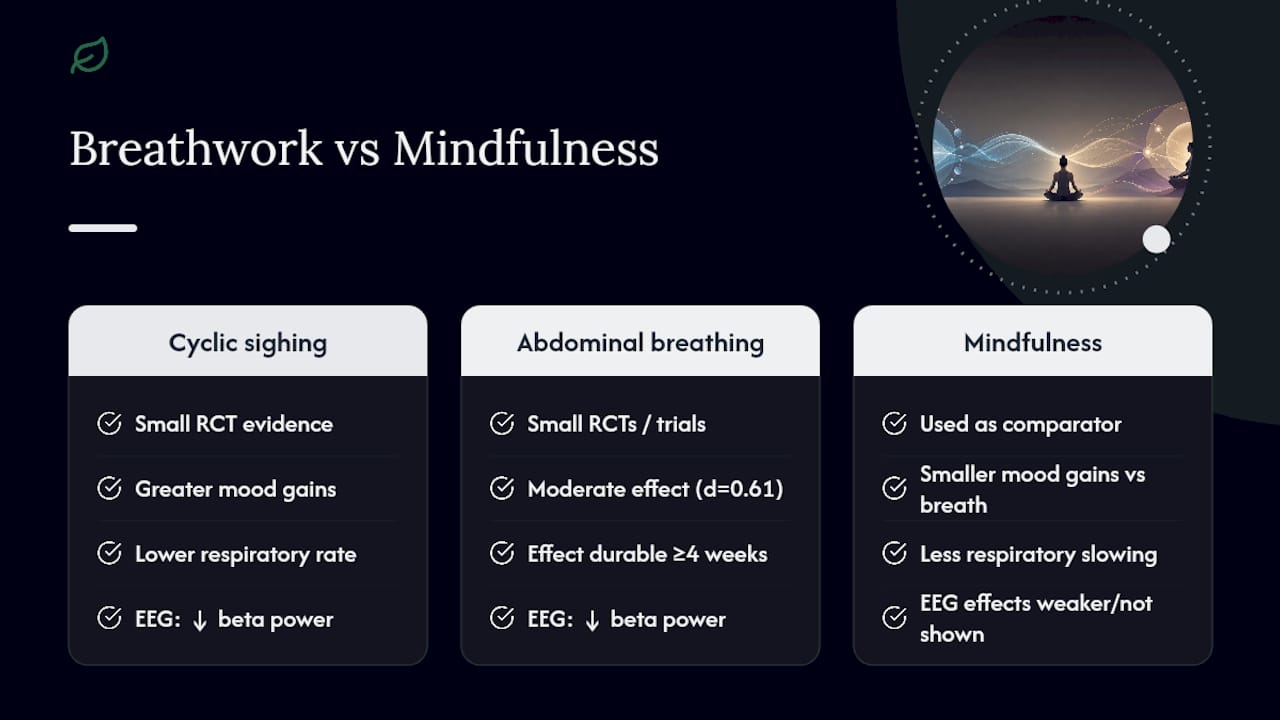
This is the technique with the strongest same-day research behind it, and it takes less time to do than to explain. A Stanford Medicine trial found that daily cyclic sighing practice over a few weeks improved mood and lowered resting respiratory rate more than an equal dose of mindfulness meditation.
Here's how to do it:
- Sit or lie down somewhere quiet, shoulders relaxed, hands resting loosely.
- Take a normal inhale through your nose, then, without exhaling, sip in a little more air to top off your lungs.
- Exhale slowly and fully through your mouth, extending the exhale until your lungs feel empty. This should take roughly twice as long as the inhale.
- Repeat for five minutes, keeping your shoulders and jaw soft the whole time.
The double inhale isn't a gimmick. It re-inflates collapsed air sacs in your lungs before the long exhale does its work, which is part of why researchers think this pattern outperforms plain slow breathing on measures like respiratory rate and physiological arousal.
Box breathing: the steady, structured option
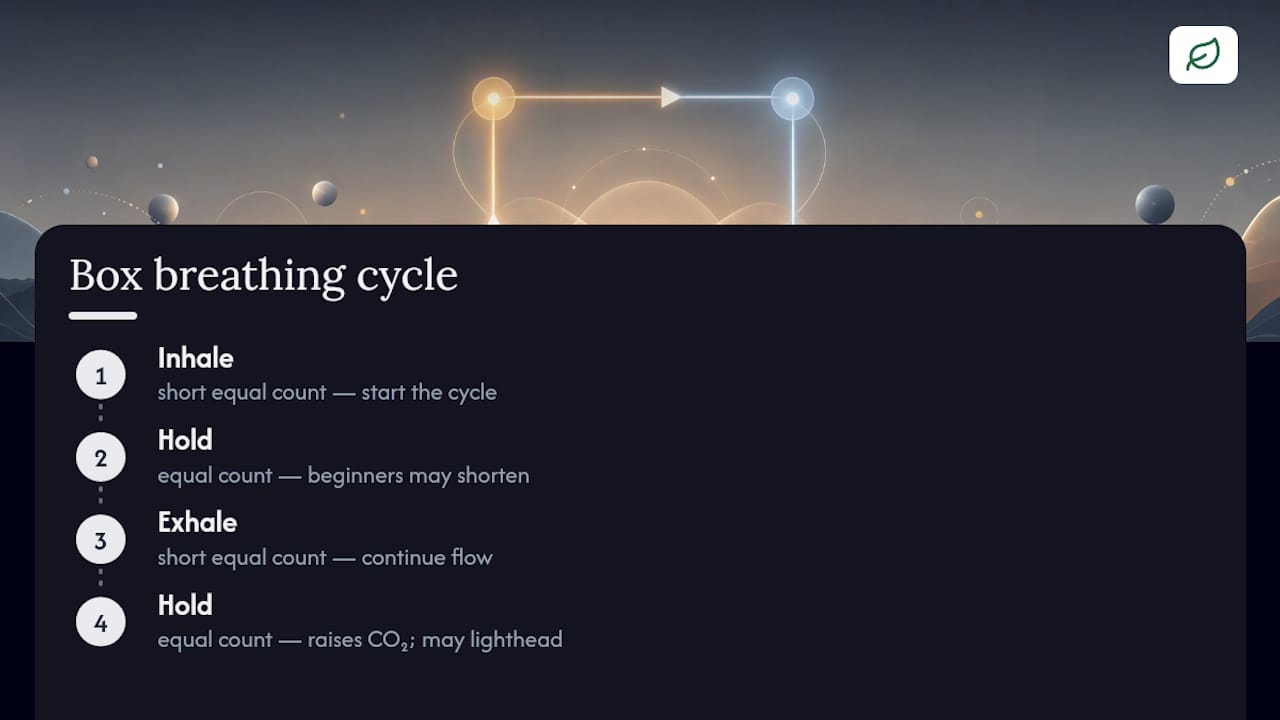
Box breathing gives your mind a simple counting task, which is exactly why it's popular before high-pressure moments. The pattern is four equal parts: inhale, hold, exhale, hold, each lasting a short count, repeated multiple times. Beginners can shorten the hold phases if they feel discomfort. The hold phases create the strongest shift in carbon dioxide levels, which is also what causes lightheadedness in beginners.
4-7-8 breathing: the bedtime wind-down
The 4-7-8 pattern, involving a slow, rhythmic breathing sequence with longer exhalation, is a commonly recognized technique for anxiety relief, largely because the extended exhale count makes it satisfying to follow. Clinical commentary suggests the specific numbers matter less than the fact that they force a slow, rhythmic pattern. The pacing mnemonic gives your mind something to focus on besides racing thoughts, and the slow exhale is the actual active ingredient.
To practice it:
- Exhale completely through your mouth first.
- Inhale quietly through your nose for four counts.
- Hold for seven counts.
- Exhale audibly through your mouth for eight counts.
- Repeat for several rounds to start. Beginners sometimes get lightheaded on longer holds, so shorter counts may be used if needed.
This one works well lying in bed with your eyes closed, since the longer exhale naturally slows your heart rate as you wind down.
Diaphragmatic (abdominal) breathing: the foundation skill
Diaphragmatic breathing anchors an eight-week randomized trial that found a significant reduction in anxiety symptoms, with a Cohen's d of 0.61, persisting at least four weeks after training ended. That's the technique with the strongest case for slow, structured practice over time rather than a one-off reset.
- Sit or lie down with one hand on your chest and one on your belly.
- Inhale slowly through your nose, letting your belly rise while your chest stays relatively still.
- Exhale slowly through pursed lips, feeling your belly fall.
- Continue for five to ten minutes, aiming for six breaths per minute or slower.
The hand-on-belly cue matters more than people expect. Most anxious breathing is shallow and chest-driven, and retraining your body to breathe from the diaphragm is a skill that takes a few sessions to feel natural.
Alternate nostril (equal) breathing: the balance practice
This one comes from yogic breath control traditions and works well as a midday reset when you have a quiet minute.
- Use your right thumb to close your right nostril and inhale through your left nostril for a count of four.
- Close your left nostril with your ring finger, release your thumb, and exhale through your right nostril for a count of four.
- Inhale through your right nostril, then switch and exhale through your left.
- Continue alternating for five to eight rounds, keeping counts even on both sides.
Paced breathing: the simplest daily option
If counting patterns feel fussy, paced breathing strips things down to one rule: breathe at roughly five to six breaths per minute, with an exhale slightly longer than your inhale. No holds, no counting nostrils, just a steady rhythm you can do while walking or sitting at your desk.
The 1-minute panic reset
When anxiety spikes hard and you don't have five minutes, use this shortened version of cyclic sighing: one long, audible sigh out, then three or four rounds of slow nasal inhale followed by a double-length mouth exhale. It won't resolve everything, but it interrupts the upward spiral long enough to think clearly again.
A 5-minute daily protocol to start with
Pick one technique, ideally cyclic sighing or diaphragmatic breathing, and do it at the same time each day for five minutes. Morning or right before bed both work; consistency matters more than timing.
Pro Tip: Practice your chosen technique when you're already calm, not just when anxiety hits. Building the pattern into muscle memory during low-stress moments means your body can access it automatically during a real panic spike, without you having to think through the steps.
How Often Should You Practice Breathwork for Anxiety?
Start smaller than you think you need to. Two to three minutes a day for the first week beats an ambitious ten minutes that you abandon after three days. Build up gradually from there.
A reasonable progression looks like this:
- Week 1 to 2: Two to three minutes daily, any technique, same time each day.
- Week 3 to 4: Five minutes daily, ideally cyclic sighing or paced breathing.
- Week 5 to 8: Stick with five to ten minutes daily if you're using a structured program like diaphragmatic training, since the eight-week abdominal breathing trial that produced its Cohen's d of 0.61 improvement used consistent daily sessions over that full stretch, not sporadic practice.
The Stanford trial's five-minute daily dose over a month is a useful floor for how little time this actually requires. You don't need an hour of practice to see a shift in mood and respiratory rate. You need five focused minutes, repeated.
A few habit tips that make the difference between practicing for a week and practicing for a year:
- Anchor it to something you already do. Right after brushing your teeth, right before opening your laptop, right when you sit down for lunch. Attaching the practice to an existing habit removes the need to remember it cold.
- Set one reminder, not five. A single daily alert works better than a barrage that gets swiped away.
- Start smaller than feels meaningful. Two minutes you actually do beats ten minutes you plan to do.
- Escalate only after a full week of consistency. Add a minute once the shorter version feels automatic, not before.
- Track it simply. A one-line mood rating (1 to 10) logged right after each session, plus an occasional check of your resting heart rate or breathing rate using a phone app or basic stopwatch count, gives you real feedback without turning practice into a chore.
If you miss a day, don't restart some imaginary streak counter in your head. Just do it the next day. The research behind these techniques comes from consistent daily practice over weeks, not perfect unbroken streaks.
What Does the Research Actually Show About Breathwork and Anxiety?
The strongest evidence for breathwork and anxiety comes from a small number of well-designed trials, not a mountain of studies, and it's worth being precise about what they found. A remote randomized controlled trial comparing several breathing styles against mindfulness meditation found that daily 5-minute breathwork, especially cyclic sighing, produced greater improvements in positive mood and larger reductions in respiratory rate than an equivalent dose of mindfulness over one month.
That's a meaningful finding because respiratory rate is a physiological marker, not just a self-reported feeling. Participants weren't only saying they felt calmer; their bodies showed measurable slowing.
Daily practice of cyclic sighing was associated with greater improvement in mood and reduction in respiratory rate compared to an equal-duration mindfulness meditation practice, suggesting breath-focused techniques may offer advantages over passive attention-based practices for some outcomes.
Effect size in plain terms: The eight-week abdominal breathing trial reported a Cohen's d of 0.61, a moderate effect by the field's usual benchmarks, roughly on par with what many talk-therapy interventions produce over a similar timeframe. That effect held for at least four weeks after the training program ended.
EEG research adds a mechanistic piece to this picture. Studies measuring brain electrical activity during slow breathing found reduced beta-band power, a marker linked to lower subjective arousal, especially during moments of uncertainty. That gives a physiological explanation for why slowing your breath changes how anxious you feel, not just how you describe feeling.
Not every study agrees on how strong the effect is or which technique wins. A 2024 systematic review of brief respiratory and mindfulness interventions for state anxiety found mixed effect sizes across studies, with substantial heterogeneity depending on which breathing technique was tested and how it was delivered. Some trials show large effects, others show modest or inconsistent ones, and the honest takeaway is that technique choice and individual response both matter more than any single study can capture.
It's also worth being clear about who these trials studied. Most of the research behind cyclic sighing and abdominal breathing training involved healthy adults or people with mild to moderate anxiety symptoms, recruited largely online or from university settings. There's far less controlled data on breathwork for severe anxiety disorders, panic disorder with frequent attacks, or coexisting psychiatric conditions. That gap doesn't mean breathwork won't help in those cases. It means the strongest evidence applies most directly to everyday stress and mild-to-moderate anxiety, and anyone with more severe symptoms should treat breathwork as a complement to professional care rather than a replacement for it.
Is Breathwork Safe? Side Effects and When to Stop
Breathwork is low-risk for most people, but it isn't consequence-free, and knowing the warning signs matters more than knowing another breathing pattern.
The most common side effect is lightheadedness, caused by shifting carbon dioxide levels faster than your body is used to. Sitting or lying down during your first several sessions reduces the risk of feeling unsteady, and shortening any hold phases (as in box breathing or 4-7-8) usually resolves mild dizziness right away.
Common, manageable reactions include:
- Lightheadedness or a floaty feeling. Slow down your pace and shorten holds; sit or lie down if it happens.
- Tingling in fingers or lips. A sign you're breathing a bit too fast or too deeply; ease off the intensity.
- Mild yawning or watery eyes. Harmless and common, especially during your first few sessions.
Certain people should get clearance from a clinician before starting a regular breathwork practice: anyone with severe asthma or COPD, unstable cardiovascular disease, a history of fainting spells, or a serious psychiatric condition where altered arousal states could be destabilizing. Pregnancy isn't a blanket contraindication, but breath-holding patterns should generally be gentler, and checking with your doctor first is the sensible move.
Red flags that mean stop immediately and seek care:
- Chest pain or pressure during or after practice.
- Fainting or near-fainting, not just brief lightheadedness.
- Severe shortness of breath that doesn't resolve within a minute of breathing normally.
If any of these happen, stop the exercise, return to normal breathing, sit or lie down, and seek emergency care for chest pain or fainting. For everyone else, starting seated, keeping holds short, and building up gradually keeps the risk close to negligible.
Breathwork as Part of a Complete Anxiety-Management Plan
Breathwork works best as one tool among several, not a stand-alone fix. For everyday stress, occasional panic spikes, or mild anxiety, five to ten minutes of daily practice can be genuinely enough on its own. For anxiety that's interfering with work, relationships, or sleep on a regular basis, breathwork functions better as a supplement to therapy or, when appropriate, medication rather than a replacement for either.
Cognitive-behavioral strategies and progressive muscle relaxation target anxiety through different mechanisms; breathwork changes your physiological state directly and fast, while CBT reshapes the thought patterns that generate anxiety in the first place, and progressive muscle relaxation works through the body from a different angle, releasing physical tension muscle group by muscle group. Combining a physiological technique with a cognitive one tends to cover more ground than either alone.
A few ways to know whether breathwork alone is doing the job:
- Track a simple daily mood score (1 to 10) alongside your practice log for two to three weeks.
- Notice your baseline, not just practice sessions. If your resting respiratory rate or general tension seems lower even outside your five minutes, that's a good sign the practice is generalizing.
- Watch for stagnation or worsening. If symptoms aren't improving after four to six weeks of consistent daily practice, or if they're getting worse, that's your signal to bring in professional support rather than pushing harder on your own.
Pro Tip: Pair your breathwork with one other lifestyle lever, consistent sleep timing or regular movement, rather than trying to fix anxiety with breath alone. The research on structured breathing programs shows real effects, but anxiety rarely has a single cause, so it responds best to a few reinforcing changes at once.
If you're not sure whether your symptoms warrant more support, a licensed therapist or your primary care provider can help you figure out where breathwork fits into a fuller plan, and a broader look at alternative therapies for anxiety can help you see the full menu of nonpharmacological options available alongside it.
Why I Think Most People Give Up on Breathwork Too Early
Here's what the research doesn't emphasize enough: breathwork's biggest failure mode isn't picking the wrong technique. It's abandoning a good technique after three days because it didn't feel dramatic enough. The Stanford trial's effects built over a full month of daily five-minute sessions, and the abdominal breathing study ran eight weeks. Neither promised an instant fix, and neither reader expected magic on day one.
I'd also push back gently on the idea that you need to find the "perfect" technique before starting. The systematic review's finding of heterogeneity across studies tells me something practical: individual response varies enough that a test-and-keep approach beats overthinking your choice upfront. Try cyclic sighing for a week. If it doesn't click, try diaphragmatic breathing. Your nervous system will tell you which one it prefers faster than any article can predict it.
Track small wins. A slightly lower mood-log number, a session that felt easier than yesterday's, five days in a row instead of two. That's what building a real practice looks like, and it's more honest than expecting anxiety to vanish because you learned to count to four.
— Andrew
How Go Holistic Can Support Your Breathwork Practice
Breathwork gives you a fast, self-directed tool, but pairing it with the right guidance often gets you further, faster. A holistic wellness platform connects you with certified practitioners across disciplines like acupuncture, massage therapy, and Ayurveda who can build breath-focused stress relief into a fuller plan tailored to how your body actually responds, not a one-size-fits-all script.
An AI-backed recommendation tool asks about your specific anxiety patterns and points you toward relevant, research-summarized treatment options from a library covering various therapy types. If you want more structure than a solo practice can offer, you can browse the curated provider directory and book a consultation directly with someone licensed in breath-based or integrative anxiety support. Start by exploring the treatments page to see how guided breathwork sessions fit alongside other holistic options, and take the next step toward a plan built around your own response, not a generic template.
Key Studies and Resources on Breathwork for Anxiety
For readers who want to go deeper, the Stanford Medicine trial on cyclic sighing and mood, the 8-week abdominal breathing RCT on PubMed, and the PMC study comparing structured breathwork to mindfulness form the core evidence behind this article's recommendations. For additional guided technique walkthroughs, Balance Journey's breathing technique guide offers useful visual demonstrations.
This article is general information, not a substitute for advice from a qualified doctor. Consult a qualified healthcare professional about your own circumstances before acting on anything here.
Sources
- 'Cyclic sighing' can help breathe away anxiety — Stanford Medicine
- PubMed entry for 8-week abdominal breathing RCT
- Brief structured respiration practices enhance mood and reduce physiological arousal — PMC