
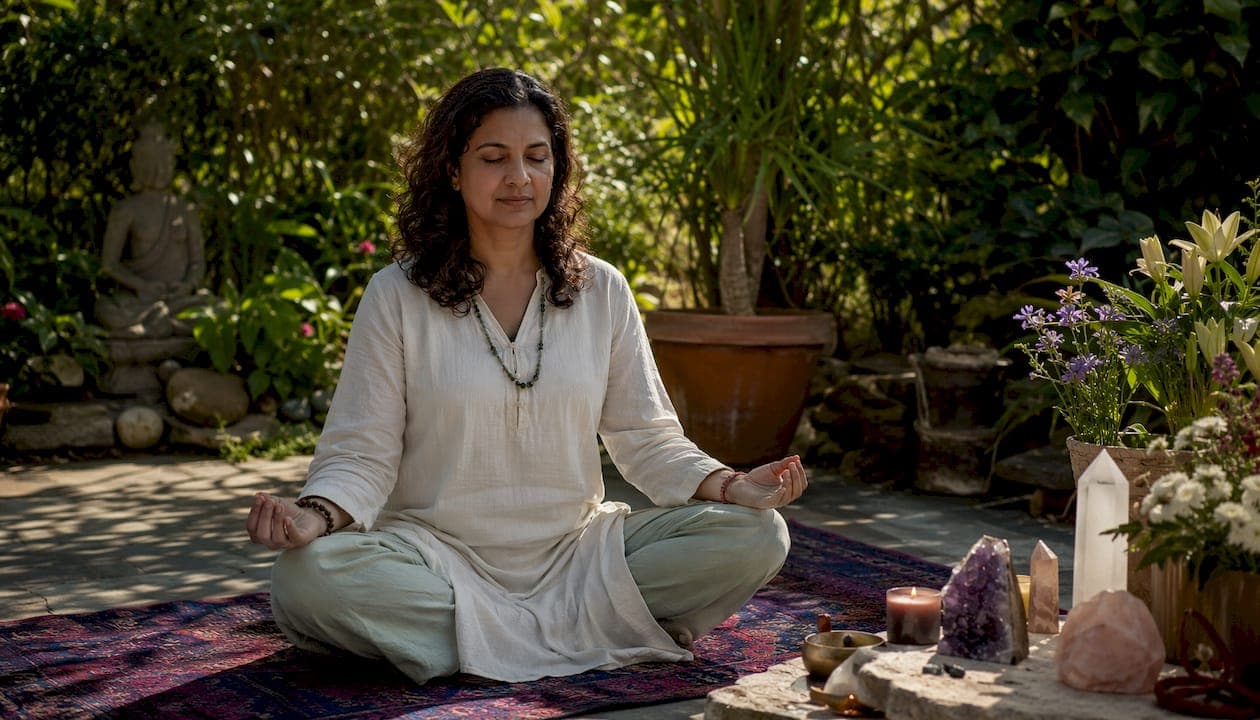
TL;DR:
- Spiritual wellness involves the intentional search for meaning, purpose, and connection to self, others, nature, and something transcendent. It offers benefits such as lower anxiety, stronger resilience, and improved quality of life, regardless of religious involvement. Regular reflection, values clarification, and community engagement help build and maintain this vital dimension of health.
Spiritual wellness is the ongoing, intentional search for meaning, purpose, and inner harmony in your life. Northwestern University describes it as expanding your sense of purpose and connection, whether or not that involves religion. When you tend to this dimension, research links it to lower anxiety, stronger resilience, and a clearer sense of direction on hard days. Mass.gov notes that cultivating purpose and meaning can reduce stress, anger, and depression. Goholistic is a natural next step for anyone ready to explore this with the support of vetted holistic practitioners.
Table of Contents
- What does spiritual wellness actually include?
- How is spiritual wellness different from religion and mental health?
- What does the research say about the benefits?
- What does healthy spiritual wellness look like?
- Practical ways to build spiritual wellness every day
- How to check in and build your own 4-step plan
- Where to find support and when to seek professional help
- Key Takeaways
- Why spiritual wellness deserves more of your attention
- Ready to explore holistic support for your whole self?
- Useful sources for further reading
What does spiritual wellness actually include?
Spiritual wellness is built from four connection dimensions that researchers and university wellness centers consistently identify:
- Connection to self: Knowing your core values and acting on them. A secular example: journaling about what matters most to you each week. A faith-based example: daily prayer or scripture reflection.
- Connection to others: Feeling genuine belonging and compassion in your relationships. This might look like volunteering, joining a community group, or simply showing up for a friend in crisis.
- Connection to nature: Finding meaning and calm through the natural world. A walk in the woods, tending a garden, or sitting near water all count.
- Connection to something transcendent: This is the "bigger picture" dimension. For some, it is God or a higher power. For others, it is a sense of universal purpose, humanity, or the cosmos.
Spirituality may or may not involve organized religion. What stays constant across definitions is that values and ethics are the connective tissue of the whole framework.
How is spiritual wellness different from religion and mental health?
These three things overlap, but they are not the same.
Organized religion offers specific beliefs, rituals, and institutional community. Spiritual wellness is broader: it is the personal search for meaning and values alignment, which can happen inside or entirely outside a religious tradition. You can be deeply spiritual without attending any service, and you can practice religion without engaging the reflective, values-based work that builds spiritual wellness.

The overlap with mental health is real. Both share outcomes like reduced distress and greater life satisfaction. But spiritual wellness is its own dimension of health, one that often supports mental health rather than substituting for it. Think of it as the "why" that makes other healthy behaviors stick.
One clear boundary: if you are experiencing suicidal thoughts, severe depression, or symptoms of psychosis, those require clinical mental-health or medical care. Spiritual practices are a complement, not a replacement, for professional treatment.
What does the research say about the benefits?
The evidence connecting spiritual health to better outcomes is consistent across populations. Studies show links to lower anxiety, reduced perceived pain in patient populations, improved quality of life, and stronger coping during serious illness like cancer. Mass.gov's public-health guidance specifically lists spiritual practices as coping strategies during treatment and recovery.
What researchers mean by "purpose" and "meaning" here is not vague positivity. These are active psychological resources: a felt sense that your life has direction and that your actions matter. That sense functions like a buffer when stress hits.
"Fostering a sense of purpose and meaning in life can reduce anxiety, stress, anger, and depression and is associated with better resilience and quality-of-life outcomes." — Mass.gov, Spiritual Wellness
Proactive daily check-ins on your values and sense of meaning, rather than waiting for a crisis, are increasingly recognized by clinicians as a way to prevent severe meaning disruption before it starts.
What does healthy spiritual wellness look like?
Use this table to get an honest read on where you stand right now.
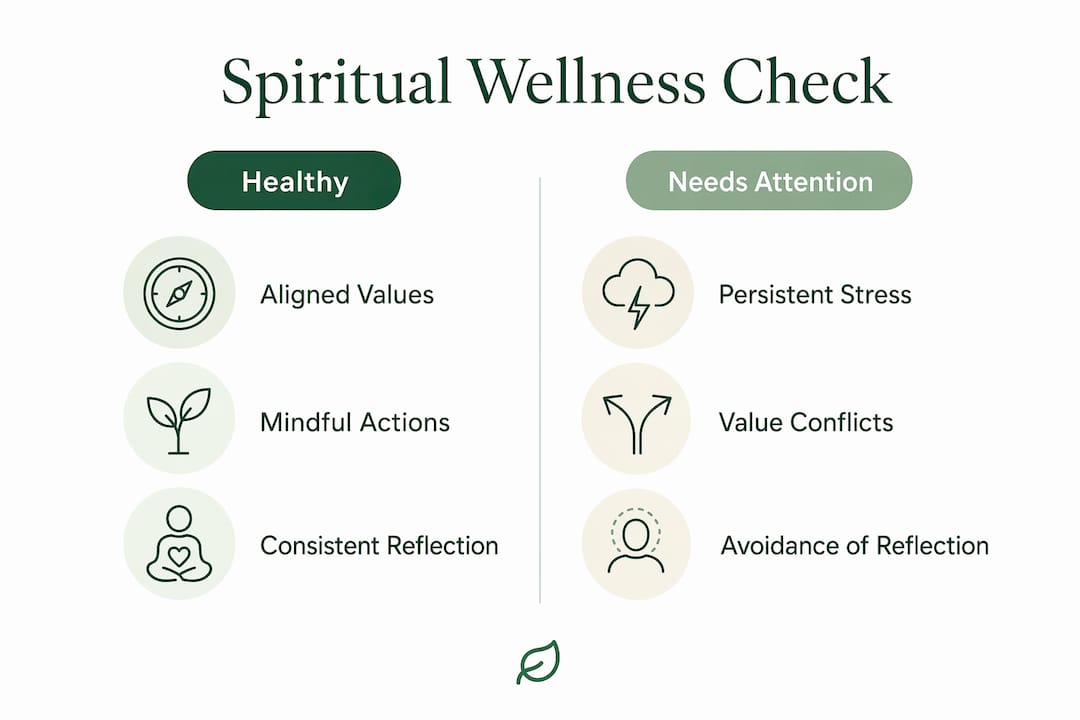
| Healthy spiritual wellness | Needs more attention |
|---|---|
| Decisions feel aligned with your values | Persistent sense of meaninglessness or emptiness |
| You feel a genuine sense of purpose | Feeling disconnected from people, nature, or anything larger than yourself |
| You make time for reflection or contemplation | Rigid worldview that increases distress when challenged |
| You feel compassion for yourself and others | Chronic cynicism or inability to find anything worth caring about |
Short goals worth setting: block 15 minutes weekly for quiet reflection, name one core value you want to live more fully this month, or join one community activity that aligns with something you care about.
Practical ways to build spiritual wellness every day
University of New Hampshire's Health & Wellness center recommends treating these practices as ongoing maintenance, not one-time fixes:
- Values clarification: Write down three things you would not compromise on, then check whether your daily choices reflect them.
- Mindfulness and meditation: Even five minutes of focused breathing shifts your nervous system and creates space for reflection.
- Time in nature: Regular outdoor time is one of the most accessible and evidence-friendly spiritual practices available.
- Community service: Acting in alignment with your values under real-world conditions is what NCHPAD calls active spiritual work, and it tends to deepen meaning faster than passive reflection alone.
- Rituals and creative expression: Prayer, music, art, or a morning routine that feels intentional all count.
- Mind-body practices: Yoga and tai chi integrate physical movement with reflective awareness, making them particularly effective for whole-person wellness.
Quick exercise 1 — Journaling prompt: Write for five minutes on this question: "What would I do differently this week if I were fully living my most important value?" No editing, just honest writing.
Quick exercise 2 — 5-minute grounding routine:
- Sit comfortably and close your eyes.
- Take three slow, deep breaths.
- Name one thing you are grateful for right now.
- Ask yourself: "What matters most to me today?"
- Open your eyes and write one word that captures your answer.
Pro Tip: You do not need to adopt any specific belief system. If you are secular, frame practices around values and meaning. If you are religious, let your tradition anchor them. If you are somewhere in between, mix freely. The practice matters more than the label.
How to check in and build your own 4-step plan

Use this self-check table before you start. Answer honestly.
If most answers are "No" or "Sometimes," that is useful information, not a verdict. Here is a simple plan:
- Clarify values (Week 1–2): Use the journaling prompt above to identify two or three values that feel genuinely yours.
- Choose one practice (Week 2–3): Pick the practice from the list above that fits your life right now.
- Schedule and try it (Weeks 3–6): Put it on your calendar like any other appointment. Aim for three times per week.
- Review and adjust (Week 7–8): Ask yourself what shifted. Keep what worked; swap what did not.
If you feel stuck or want accountability, a trusted advisor, spiritual director, or holistic practitioner can help you move forward with more structure and support.
Where to find support and when to seek professional help
Good starting points in the U.S. include university wellness centers (most offer free resources and referrals), hospital chaplaincy and pastoral care services, community meditation groups, and faith-based or secular counseling. For readers exploring the intersection of faith and relationships, resources on faith-based counseling can be a helpful complement to individual spiritual work.
Goholistic's provider directory connects you with vetted holistic practitioners across disciplines including meditation guides, Ayurvedic practitioners, and mind-body specialists, with telehealth options available.
If you are experiencing persistent hopelessness, thoughts of self-harm, or symptoms that interfere with daily functioning, contact a licensed mental-health clinician or call or text 988 (the Suicide and Crisis Lifeline) immediately. Spiritual practices support well-being; they do not replace clinical care when clinical care is what you need.
This article is general wellness information, not medical or mental-health advice. Please consult a qualified professional for guidance specific to your situation.
Key Takeaways
Spiritual wellness is a practical, evidence-backed dimension of health that you can develop through simple, repeatable daily habits, regardless of your religious background.
| Point | Details |
|---|---|
| Core definition | Spiritual wellness is the intentional search for meaning, purpose, and connection to self, others, nature, and something transcendent. |
| Research-backed benefits | Linked to lower anxiety, reduced stress and depression, stronger resilience, and better quality of life across clinical populations. |
| Top daily practice | Values clarification and short reflective routines, done consistently, build the strongest foundation for lasting spiritual health. |
| Self-check first | Use the five-question table to identify gaps before choosing a practice, so your effort goes where it is actually needed. |
| Goholistic next step | Goholistic's practitioner directory and treatment library connect you with vetted holistic providers who integrate spiritual wellness into whole-person care. |
Why spiritual wellness deserves more of your attention
Most wellness conversations start with sleep, nutrition, and exercise. Spiritual wellness tends to get treated as optional, or as something only religious people need. That framing misses something real.
What the research actually shows is that purpose and meaning function as active psychological resources, not just feel-good extras. When people lack a clear "why," gains in physical and mental health are harder to sustain. You can build the healthiest body in the room and still feel hollow if the underlying sense of direction is missing.
The other thing worth saying plainly: spiritual dissonance, those periods of doubt, confusion, or feeling like your values and your life are out of sync, is not a sign of failure. Practitioners and researchers both note that working through that tension is often what produces the deepest clarity and growth. The goal is not a permanent state of peace. It is the capacity to return to your values when things get hard.
Ready to explore holistic support for your whole self?
Knowing what spiritual wellness is and actually building it are two different things. Goholistic gives you a direct path from understanding to action: an AI-powered recommendation tool that matches your specific health concerns to evidence-based treatments, plus a curated directory of certified practitioners across acupuncture, Ayurveda, massage, meditation, and more.
Unlike searching on your own, every provider in the Goholistic directory is verified, and the platform's treatment library covers over 200 therapy types backed by research summaries. Whether you want to book a session with a meditation guide, explore mind-body practices like yoga or tai chi, or simply browse what is available near you, the process is straightforward and pressure-free.
Browse holistic treatments to find evidence-based options that fit your beliefs and health needs, or search for a practitioner in your area and book directly. Your next step is one search away.
Useful sources for further reading
- Spiritual Wellness — Northwestern University
- Spiritual Wellness — Mass.gov
- Spiritual Wellness — University of New Hampshire Health & Wellness
- Spiritual Health Scale 2011 — PMC / National Institutes of Health
- Whole Person Health — National Center for Complementary and Integrative Health (NCCIH)
- Spiritual Wellness and the Benefits of Spiritual Practice — NCHPAD