

Insurance can cover acupuncture, but the rules shift depending on who's paying. Original Medicare covers it only for chronic low back pain, with strict visit caps and a copay attached. Private plans often cover more diagnoses, but every plan sets its own limits. Medicaid coverage depends entirely on your state. Before booking anything, pull up your plan's Summary of Benefits and Coverage, confirm your provider's credentials, and ask whether prior authorization applies.
TL;DR:
- Medicare covers acupuncture only for chronic low back pain lasting at least 12 weeks with no systemic cause, and treatment is limited to a set number of sessions per 90 days.
- Private insurers generally offer broader coverage for conditions like migraines and osteoarthritis but require prior authorization, in-network providers, and proof of medical necessity.
- Medicaid coverage for acupuncture varies by state, with some states including it for pain, while others do not, especially under traditional fee-for-service plans.
- Insurance costs after Medicare deductibles typically include 20% coinsurance per session, with additional visits beyond the cap being out-of-pocket; billing errors are a common reason for denials.
- Coverage conditions such as visit caps, provider type restrictions, and diagnosis limits significantly influence actual access, and framing acupuncture as a complementary rather than alternative treatment improves approval chances.
Table of Contents
- Does Insurance Cover Acupuncture Under Medicare?
- What About Private Insurance and Employer Plans?
- Is Acupuncture Covered by Medicaid in Your State?
- What Does Acupuncture Cost With Insurance?
- How to Get Your Acupuncture Sessions Covered, Step by Step
- What Happens When Your Claim Gets Denied?
- Where the Affordable Care Act Fits In
- Which Conditions Does Insurance Usually Cover Acupuncture For?
- What Limits Should You Expect Even When You're Covered?
- Complementary Medicine Coverage vs. Alternative Medicine Coverage
- How Go Holistic Makes Coverage Easier to Navigate
- The Real Reason Coverage Feels So Confusing
- Sources
Does Insurance Cover Acupuncture Under Medicare?
Medicare Part B covers acupuncture, but only for one diagnosis: chronic low back pain that's lasted 12 weeks or longer with no identifiable systemic cause like cancer, infection, or fracture. If your pain doesn't fit that specific clinical picture, Medicare won't pay for the needles, regardless of how much they might help.
The visit limits are exact. You get a fixed number of sessions in a 90-day window. If your clinician documents real improvement, Medicare allows additional sessions, but never more than a set maximum total in a 12-month period. Treatment stops if you fail to improve or if your pain gets worse.
Pro Tip: Track your own pain scores session by session. If your acupuncturist needs to justify those extra 8 visits to Medicare, your notes on what changed and when can support their documentation.
Here's the part that surprises most people: a licensed acupuncturist usually can't bill Medicare directly. Coverage requires the service to come from a physician, nurse practitioner, or physician assistant who meets specific training requirements, or from an auxiliary personnel working under one of them. The CMS decision memo that created this policy explains why coverage was narrowed this tightly: the evidence reviewed supported chronic low back pain specifically, not acupuncture as a general pain treatment.
Once you qualify, the money side works like any other Part B service:
- You pay your annual Part B deductible first if you haven't met it yet.
- After that, you owe 20% coinsurance on the Medicare-approved amount.
- Medicare picks up the remaining 80%.
What About Private Insurance and Employer Plans?
Private insurers cover acupuncture far more often than Original Medicare does, and usually for a broader list of conditions, migraines, fibromyalgia, and post-surgical pain among them. But "covered" rarely means unlimited. Every plan sets its own rules, and those rules can look completely different from one employer's plan to the next.
Common requirements you'll run into:
- Medical necessity documentation from your treating clinician, not just a request for treatment.
- Prior authorization or step therapy, meaning you may need to try another treatment first.
- In-network practitioner requirements, since seeing someone outside the network can wipe out your benefit entirely.
Research tracking coverage trends from 2010 to 2019 found real inconsistency across insurers, alongside a gradual rise in the number of acupuncture visits insurance actually paid for. That's the story of private coverage in one line: better than it used to be, still a patchwork.
Pro Tip: Call member services and ask them to read you the exact acupuncture language from your Evidence of Coverage document. Reps sometimes summarize benefits loosely over the phone. Get the specific session cap and diagnosis list in writing if you can.
Your Summary of Benefits and Coverage (SBC) is the fastest way to check this yourself. Federal rules require plans to categorize benefits clearly, so acupuncture coverage should be listed as included or excluded, not buried in vague wellness language.
Is Acupuncture Covered by Medicaid in Your State?
Medicaid handles acupuncture completely differently from Medicare. Federal law treats it as an optional benefit, which means each state decides for itself whether to include it. Some states cover acupuncture for pain conditions. Many don't cover it at all under traditional fee-for-service Medicaid.
It gets more complicated with managed care. A state's Medicaid managed care organization might offer acupuncture as an extra benefit, even when the state's standard Medicaid plan doesn't. That gap catches a lot of people off guard.
To find your actual answer:
- Check your state's Medicaid website for a covered-services list.
- Read the evidence-of-coverage document from your specific managed care plan.
- Call your state insurance department if the online information is unclear or outdated.
Don't assume your neighbor's Medicaid coverage in a different state tells you anything about yours.
What Does Acupuncture Cost With Insurance?
Without insurance, acupuncture typically runs somewhere in the range most clinics post for a standard session, and that price varies by region and practitioner. Insurance changes your math significantly, but not always in your favor.
Under Medicare, once you've hit your deductible, you're paying 20% coinsurance per approved session. That adds up fast if you need the full course of treatment, and if you go beyond your 20-session annual cap, every additional visit comes entirely out of pocket. Our breakdown of acupuncture costs walks through typical session pricing if you want the fuller picture.
Billing mistakes cause a surprising share of denials. The most common ones:
- The provider isn't the clinician type your plan requires (a licensed acupuncturist billing directly to Medicare, for instance).
- Your acupuncturist isn't credentialed or contracted with your specific insurer.
- Claims get submitted with incorrect or mismatched billing codes.
One option a lot of people miss: the IRS lists acupuncture as an eligible medical expense under Publication 502, which means HSA or FSA funds can cover it, insurance coverage or not.
How to Get Your Acupuncture Sessions Covered, Step by Step
Getting insurance to actually pay takes some legwork before you ever sit down for treatment. Here's the order that tends to work:
- Pull your SBC or Evidence of Coverage document and look specifically for the word "acupuncture." Note any diagnosis restrictions or session caps.
- Confirm in-network status for your acupuncturist and verify their clinician type matches what your plan requires (this matters enormously for Medicare beneficiaries).
- Get a written order or prescription from your treating physician, along with documentation that establishes medical necessity, ideally noting what other treatments you've already tried.
- Request prior authorization if your plan requires it, and don't do this over the phone without a paper trail.
- Log every interaction with your insurer: names, dates, reference numbers. If you end up appealing later, this record becomes your evidence.
- Save every document, including denial letters, explanation of benefits statements, and your clinician's notes.
Pro Tip: Screenshot or print the SBC page that lists acupuncture coverage the day you check it. Plan documents get updated, and having your own dated copy protects you if a dispute comes up months later.
A written order from your clinician tends to matter more than almost anything else in this process. Plans want to see that a licensed professional determined acupuncture was appropriate for your specific condition, not that you decided to try it on your own.

What Happens When Your Claim Gets Denied?
Denials usually trace back to one of a few causes: the insurer decided the treatment wasn't medically necessary, your practitioner was out-of-network, you exceeded your visit limit, or the wrong type of provider submitted the bill.
If that happens, don't treat the first denial as final:
- Request the denial reason in writing and gather additional clinical notes that address it directly.
- Ask for a peer-to-peer review, where your clinician talks directly with the insurer's medical reviewer.
- File a formal appeal with dates, names, and every piece of documentation you've collected.
If coverage still doesn't come through, you have real options. Community clinics and sliding-scale acupuncture programs exist in most metro areas. Integrative pain programs sometimes bundle acupuncture with physical therapy under one covered umbrella. Our guide to non-invasive holistic treatments covers alternatives worth exploring, and HSA or FSA dollars remain available regardless of what your insurer decides.
Where the Affordable Care Act Fits In
The Affordable Care Act doesn't require insurers to cover acupuncture nationwide. Acupuncture isn't one of the ten essential health benefits categories that ACA marketplace plans must include, which means coverage decisions are left up to individual states and insurers rather than federal mandate.
A handful of states have added acupuncture to their own essential health benefits benchmark plans, which does create a coverage requirement, but only within that state's marketplace plans. If you bought your plan through your state's ACA exchange, that state-specific benchmark, not a federal rule, determines whether acupuncture made the list.
Outside of Medicare and Medicaid, this is really the whole federal picture: no blanket requirement, but a regulatory structure that leaves room for states and insurers to add acupuncture voluntarily. That's exactly why the answer to whether your plan covers it depends so heavily on where you live and who underwrites your policy.
Federal health agencies do shape the conversation in an indirect way. HHS guidance on pain management lists acupuncture among nonopioid options worth considering, and that kind of federal framing has nudged some insurers toward including it as they look for alternatives to opioid prescriptions. It's influence, not mandate, but it matters.
Which Conditions Does Insurance Usually Cover Acupuncture For?
Coverage tracks the evidence, and the evidence is strongest for a specific set of conditions. Chronic low back pain sits at the top of that list, it's the only diagnosis Original Medicare recognizes, and it's also the condition most private insurers cover without much resistance.
Beyond low back pain, plans commonly extend coverage to:
- Osteoarthritis pain, particularly in the knee
- Chronic neck pain
- Migraine and tension headache prevention
- Fibromyalgia-related pain
- Postoperative pain and nausea in some surgical contexts
The National Center for Complementary and Integrative Health maintains research summaries on these applications, and insurers frequently point to that kind of federal evidence review when deciding what to include in their own policies. Conditions with thinner research behind them, anxiety or general wellness maintenance, for example, rarely make an insurer's covered list, even when acupuncturists report good outcomes anecdotally.
If your diagnosis falls outside this evidence-backed cluster, don't assume you're automatically excluded. It just means you'll need stronger documentation of medical necessity to get a plan to say yes.
What Limits Should You Expect Even When You're Covered?
Coverage rarely means unlimited access. Even generous plans build in restrictions, and knowing them ahead of time saves you from an unpleasant surprise mid-treatment.
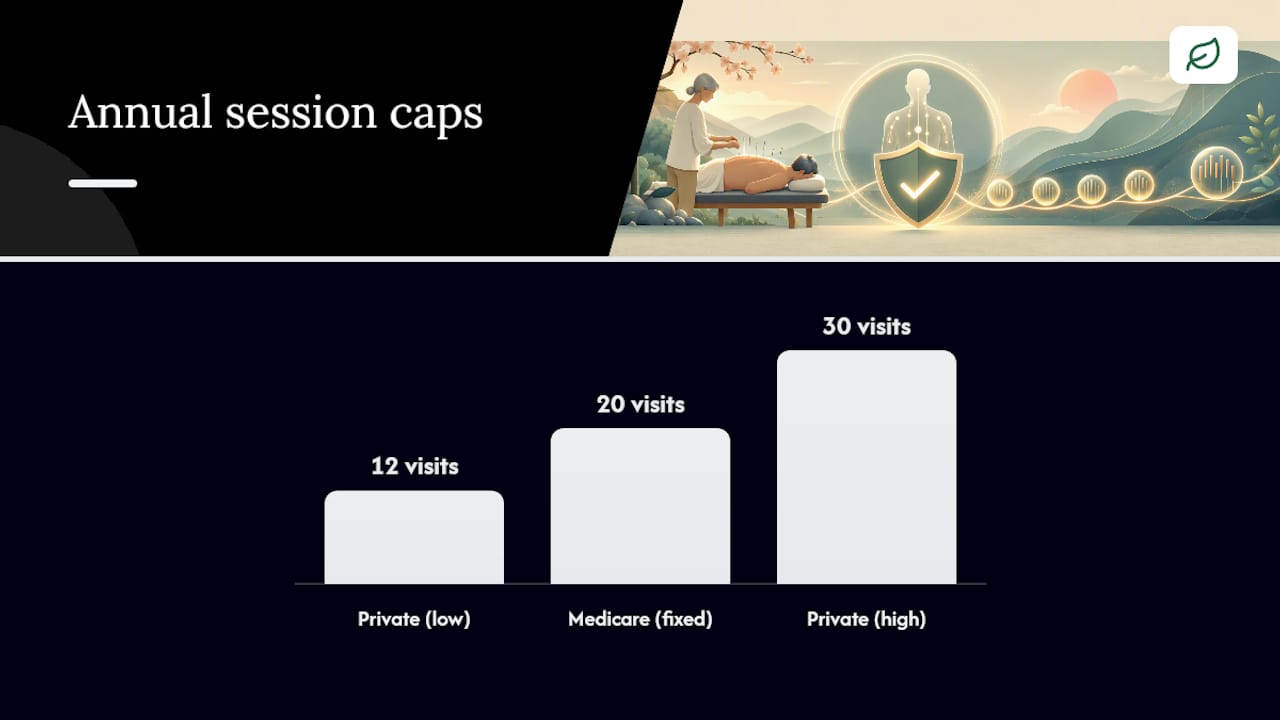
Session caps are the most universal limit. Medicare's 20-visit annual ceiling is one version of this, but private plans set their own numbers too, often somewhere between 12 and 30 visits per year depending on the diagnosis.
Technique restrictions show up less often but do exist. Some plans cover traditional needle acupuncture but exclude electroacupuncture or auricular (ear) acupuncture, treating them as separate, non-covered services. Always check whether your plan's language names a specific technique.
Other common limitations include:
- Diagnosis restrictions that exclude anything outside a short approved list
- Provider-type requirements that exclude licensed acupuncturists who aren't supervised by a physician
- Annual dollar caps instead of, or in addition to, visit caps
- Exclusion of maintenance or wellness visits once your documented condition has improved
The BlueCrossMN guidance on acupuncture coverage walks through how insurers typically define medical necessity, which is the single biggest factor determining whether any of these limits get waived or enforced in practice.
Complementary Medicine Coverage vs. Alternative Medicine Coverage
Insurers draw a real distinction between "complementary" and "alternative" framing, and it affects coverage decisions more than most patients realize. Complementary medicine describes treatments used alongside conventional care, acupuncture paired with physical therapy for back pain, for example. Alternative medicine implies using acupuncture instead of standard treatment.
Insurers overwhelmingly favor the complementary framing. When your clinician documents acupuncture as part of a broader pain-management plan that includes conventional approaches, you're working with the model insurers actually built their coverage policies around. When acupuncture gets positioned as a replacement for medical treatment you're declining, approval gets much harder.
This distinction explains why the same treatment, same practitioner, same technique, can get approved for one patient and denied for another. The paperwork frames it differently. A clinician who documents acupuncture as complementary to an ongoing treatment plan, rather than a standalone alternative, gives you a real head start on approval.
How Go Holistic Makes Coverage Easier to Navigate
You've just read a lot of fine print, and that's the point: coverage depends on details most people never think to check. Goholistic built its provider directory around exactly this problem. Every listed practitioner has verified credentials, so you can confirm someone meets your plan's provider-type requirements before you ever book a session.
You can filter by insurance acceptance and specialty, narrowing your search to acupuncturists who already work within Medicare's provider constraints or your specific insurer's network. That cuts out a lot of the phone-tag and guesswork described above.
Goholistic also centralizes documentation and booking in one place, so you're not juggling separate systems to confirm a provider, check credentials, and schedule your visit. If you're ready to find a verified acupuncture practitioner who fits your coverage requirements, or want to browse holistic treatments that pair well with a pain-management plan, that's exactly what the directory is built for.
The Real Reason Coverage Feels So Confusing
Most articles on this topic treat insurance coverage like a yes-or-no switch. It isn't. It's a set of overlapping decisions, federal policy for Medicare, state discretion for Medicaid, and dozens of individual insurer choices for everyone else, and each layer was built for different reasons at different times.
What frustrates people most isn't that coverage is limited. It's that the limits are so unevenly applied. A patient with the exact same diagnosis on a private plan might get generous coverage, or none, depending entirely on which employer picked their benefits package. That's not a flaw in acupuncture as a treatment. It's a flaw in how fragmented American insurance policy treats nonpharmacologic care in general.
If there's one thing worth pushing back on, it's the assumption that "insurance doesn't usually cover this" should end the conversation. The research on coverage trends shows real, if uneven, movement toward more insurers paying for acupuncture visits over time. Policies are shifting as pain-management priorities shift, particularly as agencies steer providers away from opioids. Checking your specific plan today, rather than assuming based on what you heard years ago, is the only way to know where you actually stand.
The administrative burden is real, but it's not permanent. As credentialing and billing systems mature and more clinicians document acupuncture as complementary care within larger treatment plans, approvals should get easier, not harder, for the conditions with the strongest evidence behind them.
— Andrew
This article is general information, not a substitute for advice from a qualified doctor. Consult a qualified healthcare professional about your own circumstances before acting on anything here.