

The fastest path to board certification runs through one door for most candidates: the National Certification Commission for Acupuncture and Oriental Medicine (NCCAOM). A smaller number of candidates go through the National Certification Board for Acupuncture & Herbal Medicine (NCBAHM) instead. Either way, the two documents that unlock your Authorization to Test Letter (ATTL) are your final transcript and your Clean Needle Technique (CNT) certificate. Get those moving today, and you're already ahead of most applicants.
Start with these:
- Request your final graduation transcript now, even before your last semester ends.
- Complete or verify your CNT certificate through your program.
- Create your online account with NCCAOM or NCBAHM to see your personalized checklist.
Key Takeaways
Board certification through NCCAOM or NCBAHM requires a clean transcript, a CNT certificate, and passed exams, but state licensure demands separate, state-specific verification every time.
| Point | Details |
|---|---|
| Choose your national board | Most candidates certify through NCCAOM; NCBAHM offers a valid alternative pathway. |
| Fix the bottleneck early | Request your final transcript and CNT certificate before your ATTL is delayed. |
| Certification isn't licensure | Every state, including Massachusetts and Arizona, layers its own requirements on top. |
| Budget for stacked fees | Application, exam, verification, and state license fees add up separately, not once. |
| Verify directly with your state | Call your state board before assuming any national credential transfers automatically. |
Where to Verify Requirements Right Now
- NCCAOM's board examination process page for application steps and CNT rules.
- NCBAHM's state licensure map for state-by-state notes and contacts.
- Massachusetts and Arizona licensing pages as real-world state examples.
Table of Contents
- Which Organizations Issue Acupuncture Board Certification?
- Who's Eligible and What Training Counts?
- How Do You Become Board Certified, Step by Step?
- Does National Certification Guarantee a State License?
- What Will Certification and Licensure Actually Cost?
- How Often Do You Need to Renew Your Certification?
- How Do You Confirm Requirements With Your Own State Board?
- Ready to Practice? Let Patients Find You
- Frequently Asked Questions
- Sources
Which Organizations Issue Acupuncture Board Certification?
NCCAOM issues the credential most state boards recognize by name, covering Acupuncture, Oriental Medicine, and Chinese Herbology as separate certification tracks. NCBAHM offers a parallel national pathway, also requiring an application, transcript, and CNT certificate, with a validity period for applications.
Here's why this matters beyond the paperwork: NCCAOM certification functions as documented proof of competency in 45 states plus Washington, D.C. Hospitals, VA facilities, and insurance panels lean on that same credential when deciding who they'll credential for referrals. Neither certifying body operates in a vacuum, either. Your education has to come from a program accredited by the Accreditation Commission for Acupuncture and Herbal Medicine (ACAHM), and your needle safety training has to trace back to a recognized CNT course.
- NCCAOM: national certification across three tracks, widely accepted.
- NCBAHM: alternative national pathway, four-year application validity.
- ACAHM: accredits the schools whose diplomas both boards accept.
Who's Eligible and What Training Counts?
Three main routes get you to the application stage, and each one wants different proof in hand.
The formal education route is the most common: graduate from an ACAHM-accredited program and submit your official transcript directly to the certifying body. The international evaluation route applies if you trained outside the U.S.; you'll need a credential evaluation service to translate your coursework into equivalent hours. The apprenticeship or combination route exists in a handful of states but is increasingly rare, and it usually demands far more documentation of supervised clinical hours.
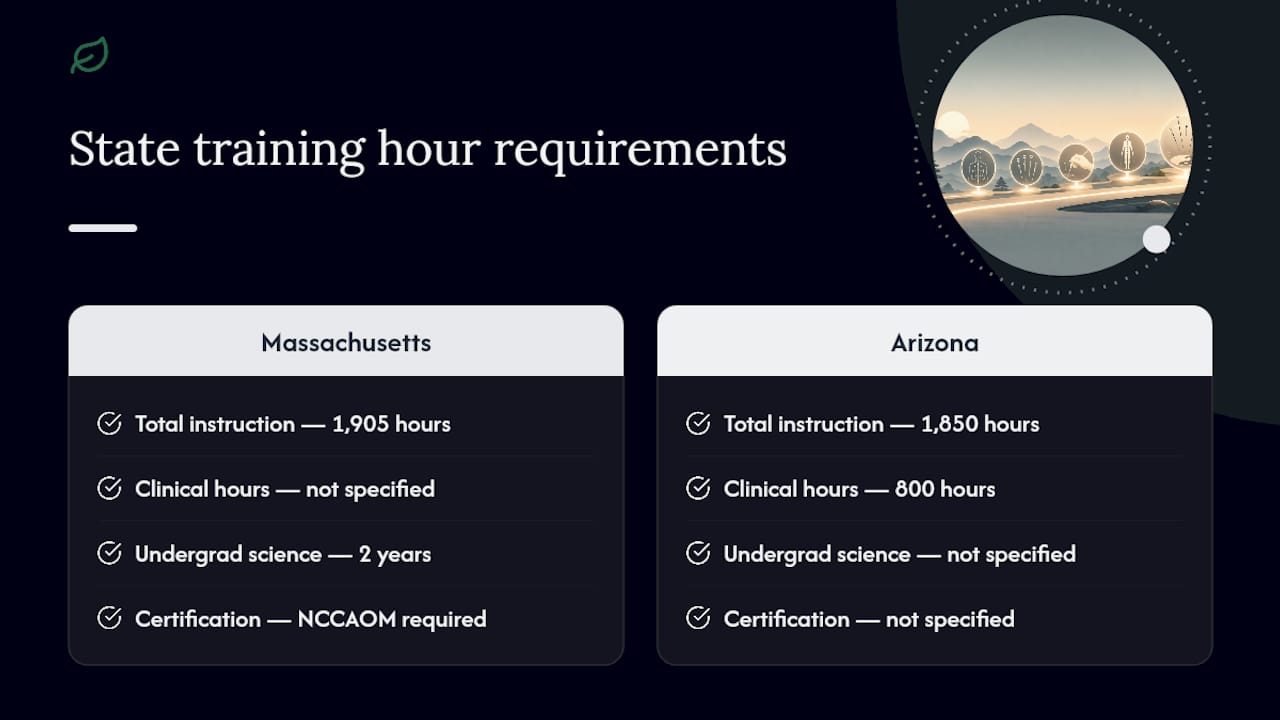
State-specific hour requirements vary more than most applicants expect. Massachusetts requires 1,905 hours of professional instruction plus two years of undergraduate coursework in the sciences, on top of NCCAOM certification for first-time applicants. Arizona sets its bar at a minimum of 1,850 hours, including 800 clinical hours.
Pro Tip: Request your transcript the moment your final grades post, not after graduation ceremonies. Registrar offices process these in batches, and a two-week delay here can push your entire testing timeline back a full exam cycle.
How Do You Become Board Certified, Step by Step?
Think of this as a relay, where each document hands off to the next.
- Gather your foundation documents. Final transcript and CNT certificate, requested early.
- Submit your application to NCCAOM or NCBAHM through their online portal.
- Wait for your Authorization to Test Letter (ATTL). This confirms you're cleared to schedule exams, typically once transcripts and CNT verification clear review.
- Schedule your exams at an approved testing center once your ATTL arrives.
- Pass your exams in your chosen track (Acupuncture, Herbology, or both).
- Receive your certification and set up direct verification requests to any state board that needs them.
Processing windows shift by season, with application review often taking several weeks and exam scheduling adding more time depending on testing center availability. Certification mailings and state verification requests typically add another stretch on top of that.
Pro Tip: If you're eyeing a multi-state career, request NCCAOM verification to every state board you might practice in during the same window. Ordering one verification now costs far less time than reordering three separately next year.
Does National Certification Guarantee a State License?
No. Certification and licensure are two different things, and confusing them is the single most common mistake new practitioners make. Certification proves you passed a national standard. Licensure is the state's legal permission to practice, and every state runs its own rulebook.
Massachusetts requires NCCAOM certification as a baseline, then layers on its own hour and coursework prerequisites. Arizona adds a $425 application and license fee, a fingerprint clearance card, and proof of a qualifying education program. California runs its own state-specific exam structure separate from the national boards entirely. Indiana references ACAHM accreditation and active diplomate status directly in its renewal verification process.
Watch for these assumptions before they cost you time:
- Don't assume passing NCCAOM exams automatically grants a license anywhere.
- Don't assume all states accept NCBAHM the same way they accept NCCAOM.
- Don't assume your CNT certificate transfers without separate state verification.
- Physicians pursuing limited acupuncture privileges often follow a shorter path, commonly 200 to 300 hours of approved training, but that route still requires medical board registration.
What Will Certification and Licensure Actually Cost?
Budget for layered fees, not a single payment. Application fees, exam fees, and verification fees stack up before you ever touch a state license fee.
Arizona's $425 application and license fee is a useful benchmark for what a full state license can run once you add fingerprinting and background check costs. Beyond that baseline, expect:
- National certification application fees paid once per track (Acupuncture, Herbology, or combined).
- Exam fees charged separately from the application itself.
- Direct verification fees each time you ask a certifying body to send your credentials to a new state board.
- State license fees, which vary widely and often renew annually or biennially.
Verification requests to a state board can take roughly a week or more to process, so build that lag into any relocation timeline rather than assuming instant turnaround.
How Often Do You Need to Renew Your Certification?
NCCAOM Diplomates renew on a recurring cycle that requires maintaining active status and reporting continuing education (CE) credits, not just paying a fee and moving on.
What renewal typically demands:
- Proof of active diplomate status, not lapsed certification.
- Documented CE hours completed within the renewal cycle.
- Renewal fees paid on schedule.
- A fresh verification request if your state board needs updated confirmation of your standing.
Pro Tip: Line up your national certification renewal date with your state license renewal date if your state allows it. Chasing two separate cycles doubles your paperwork for no real benefit.
How Do You Confirm Requirements With Your Own State Board?
Never rely on a national certifying body's general guidance alone. State rules shift, and the Association of Schools of Acupuncture and Oriental Medicine notes that practitioners need to verify directly with their state board rather than assume consistency across jurisdictions.
- Locate your state's acupuncture licensing board page.
- Read the current statute or licensing checklist, not a summary from a third party.
- Confirm whether your board accepts NCCAOM, NCBAHM, or both.
- Ask how direct verification requests get routed and how long they take.
Have these questions ready when you call: Does this board accept my certification track? Is a background check required? Is there a language proficiency requirement, such as TOEFL? Are there local coursework additions I haven't seen elsewhere?
A Note on Avoiding the Most Common Delay
The transcript and CNT bottleneck catches nearly everyone once. Request both the moment you're eligible, and set up your NCCAOM or NCBAHM account early so you can see exactly what's missing before it becomes a problem, especially if a move across state lines is part of your plan.
Ready to Practice? Let Patients Find You
Board certification and state licensure prove you're qualified. The next challenge is getting in front of the patients who need what you offer. Goholistic's provider directory connects verified, certified acupuncturists with wellness seekers actively searching for licensed care, and listing your credentials there puts your certification to work the moment your state license clears.

Frequently Asked Questions
Is acupuncture board certification the same as a state license? No. Certification is a national credential proving competency; licensure is the state's legal permission to practice, and it varies by jurisdiction.
How long does the acupuncture certification process take? It depends on transcript processing, CNT verification, and exam scheduling, but the transcript and CNT steps are the most common source of delay.
Which acupuncture certification exam should I take, NCCAOM or NCBAHM? Most candidates choose NCCAOM because more state boards recognize it by name, but NCBAHM is a legitimate alternative accepted in several states.
What happens if my acupuncture certification lapses? You'll typically need to reinstate active diplomate status, which can involve back fees and updated CE documentation before your credential is valid again for state verification.
Can I use one national certification to get licensed in multiple states? Often, yes, but each state board requires its own direct verification request and may add extra requirements like fingerprinting or coursework.
This article is general information, not a substitute for advice from a qualified doctor. Consult a qualified healthcare professional about your own circumstances before acting on anything here.
Sources
- Board examination process — NCCAOM
- Becoming certified — NCBAHM
- Acupuncture licensing requirements — Massachusetts Executive Office of Health and Human Services
- Acupuncture licensing information — Arizona State Board
- Acupuncture licensing information — Indiana Professional Licensing Agency