

The fastest path to a full pipeline combines two moves: systematize your referrals first, then layer in one targeted outbound or content channel. Formalizing the referral channel alone typically produces 2–3x more new clients within 12 months than adding a brand-new channel from scratch. Start there. Then pick one amplifier.
Your TL;DR starter plan:
- Referral program (Week 1–4): Ask your five best clients for one introduction each. Metric to watch: referrals requested vs. introductions received. Expect your first new conversation within two weeks.
- Targeted outbound (Week 2–6): Send personalized, single-action LinkedIn messages per week to your ideal client profile (ICP). Metric: reply rate. A healthy baseline is moderate.
- Content SEO (Month 2–3+): Publish two ICP-specific articles per month optimized for search and AI answer engines. Metric: organic sessions from target keywords. Expect meaningful traffic in 60–90 days.
- Paid ads (Month 2+): Run a small test budget on one platform where your ICP spends time. Metric: cost per qualified lead.
- Partnerships (Month 3+): Identify complementary service providers for co-referral agreements. Metric: introductions per partner per quarter.
Your next step (do this in the next 24–72 hours): Write a list of your five strongest client relationships and draft a one-sentence ask for each. Send it before the week ends.
Key Takeaways
The most reliable client acquisition system combines a formalized referral program with one fast channel and one long-term compound channel, measured weekly against CAC, LTV, and conversion rates at every funnel stage.
| Point | Details |
|---|---|
| Start with referrals | Formalizing referrals produces 2–3x more new clients within 12 months than adding a new channel. |
| Run 2–3 channels deeply | Depth and consistency compound results; spreading effort across six channels dilutes all of them. |
| Track CAC and LTV:CAC | A healthy LTV:CAC ratio of 3:1 or higher signals a channel worth scaling. |
| Use the 90-day template | Days 1–14 for foundation, 15–45 for launch, 46–90 for optimization and first scaling decisions. |
| Goholistic accelerates visibility | Practitioners on Goholistic gain immediate access to in-market clients through AI-powered matching and direct booking. |
Table of Contents
- What is client acquisition and why does it matter for your business?
- How does the client acquisition process actually work?
- Which client acquisition strategies actually deliver results?
- How do you measure client acquisition effectively?
- How do you build a continuous client-acquisition engine?
- How do you choose the right acquisition channels for your business?
- What timelines and budgets should you realistically expect?
- What practitioners actually see work, and where most businesses go wrong
- How a marketplace can complement your acquisition engine
- Sources
What is client acquisition and why does it matter for your business?
Customer acquisition, the formal industry term, is the process of identifying, attracting, and converting prospects into paying clients through a repeatable, measurable system. For service-driven and B2B businesses, it goes beyond a single transaction: you are building relationships that carry LTV (lifetime value), referral potential, and long-term revenue predictability. A client acquisition blueprint built around a defined ICP, chosen channels, funnel mapping, and weekly metrics turns what most businesses treat as guesswork into a predictable growth system.
Why it matters in practice:
- Revenue growth: A steady acquisition engine fills your pipeline before you need it, not after a slow quarter forces panic.
- Pipeline predictability: When you know your CAC (customer acquisition cost) and average sales cycle, you can forecast revenue with confidence.
- Client quality: A defined ICP filter means fewer mismatched engagements and higher LTV per client.
- LTV impact: Clients acquired through referrals or content tend to stay longer and spend more than those from cold outreach alone.
- Business resilience: Diversified acquisition channels protect you when one source dries up.
One quick distinction worth keeping clear: acquisition solves the problem of finding and converting new clients; retention solves the problem of keeping the ones you already have. Both matter, but they require different investments, different metrics, and different conversations.
How does the client acquisition process actually work?
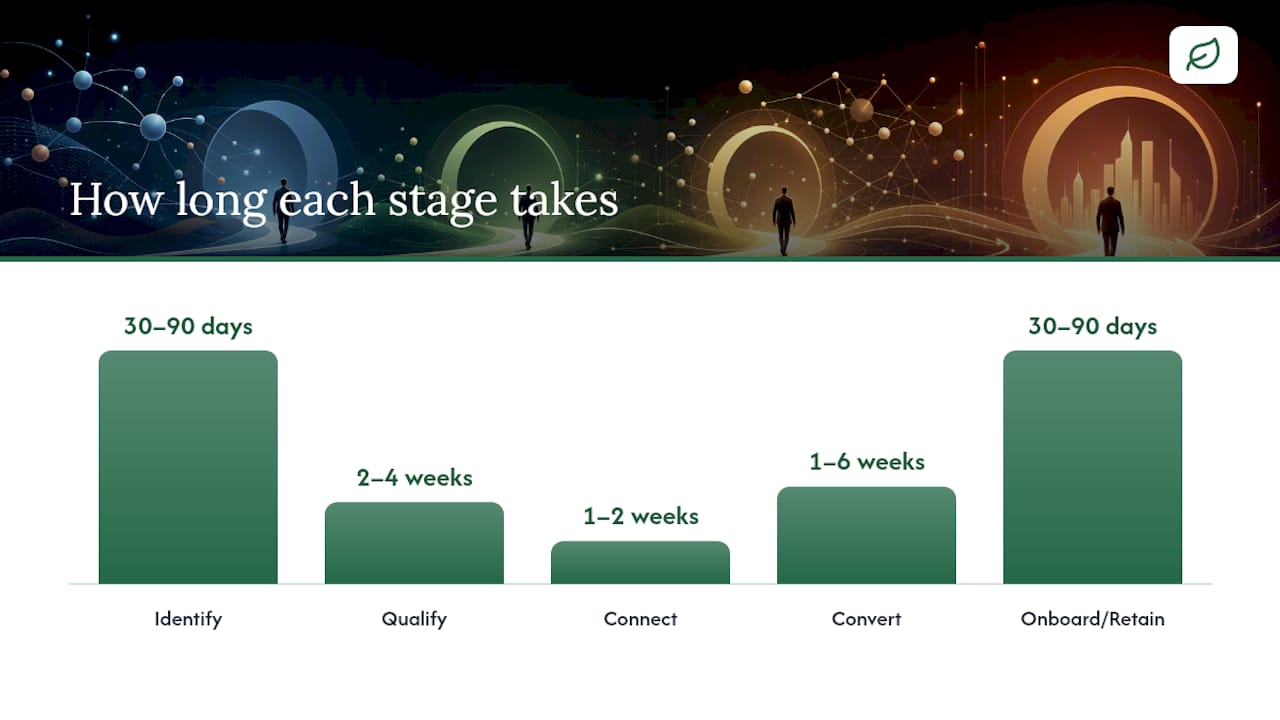
The customer acquisition funnel maps to six stages: awareness, interest, consideration, intent, conversion, and loyalty. For practical planning, most service businesses compress these into five working stages: identify, qualify, connect, convert, and onboard/retain. Mapping your channels to these stages tells you exactly which activity moves which needle and which KPI to track at each step.
| Stage | Channel examples | Primary KPI | Typical time to movement |
|---|---|---|---|
| Identify (Awareness) | SEO, paid ads, social content, PR | Impressions, reach, organic sessions | 30–90 days for content; immediate for paid |
| Qualify (Interest) | Lead magnets, webinars, email nurture | Lead-to-MQL rate, email open rate | 2–4 weeks after capture |
| Connect (Consideration) | Outbound outreach, referrals, events | Reply rate, meeting booked rate | 1–2 weeks for outbound; days for referrals |
| Convert (Decision) | Sales calls, proposals, demos | Close rate, proposal-to-close ratio | 1–6 weeks depending on deal size |
| Onboard/Retain (Loyalty) | Onboarding sequences, check-ins, upsells | Time-to-value, churn rate, NPS | First 30–90 days post-conversion |
A few things tend to fall apart at the handoff between marketing and sales. The data that should travel with every lead: source channel, content consumed, objections raised, and BANT signals (Budget, Authority, Need, Timeline). When a sales rep receives a lead without that context, they start from zero. A CRM field for each of these takes five minutes to set up and saves hours of re-qualification.
Pro Tip: Set a shared definition of "qualified" between marketing and sales before you build any funnel. A lead that marketing calls ready and sales calls cold is a process problem, not a people problem.
For wellness and health service businesses, the onboarding stage carries particular weight. A thoughtful holistic intake process that captures the client's full picture from day one reduces churn and increases the likelihood of referrals down the line.
Which client acquisition strategies actually deliver results?
The six strategies below consistently produce results for service and B2B businesses. Run two or three deeply rather than six shallowly. Depth compounds; breadth dilutes.

Referral programs
What it is: A structured ask for introductions from existing clients, partners, and professional contacts.
Quick setup:
- Identify your top 10 clients by LTV and satisfaction
- Draft a one-sentence ask with a specific ICP description ("Do you know any marketing directors at SaaS companies with 50–200 employees?")
- Schedule quarterly "referral sprints" with a 30-day window and a simple thank-you protocol
Timeline: First conversations within 1–2 weeks. Cost shape: Low. Metric to watch: Referrals requested vs. introductions received.
Targeted outbound (LinkedIn + email)
What it is: Personalized, single-action messages sent directly to ICP-matched prospects.
Quick setup:
- Build a list of 100 ICP prospects using LinkedIn Sales Navigator or Apollo.io
- Write a three-message sequence: connection request with context, value-add follow-up, soft ask
- Keep each message under 75 words with one clear next step
Responding to inquiries within 60 seconds and keeping outreach short and single-action materially increases reply and close rates. Practitioners report close-rate lifts of up to 4x from speed-to-lead improvements alone.
Timeline: Replies within 1–3 weeks. Cost shape: Low to medium (tool subscriptions). Metric to watch: Reply rate and meetings booked per 100 messages.
Content marketing and SEO
What it is: Publishing ICP-specific articles, guides, and case studies optimized for both search engines and AI answer engines (AEO/GEO).
Quick setup:
- Identify 10 questions your ICP types into Google before hiring someone like you
- Publish two long-form answers per month, each 1,200–2,000 words
- Align content to your vertical and structure it for AI discoverability
Content aligned to industry verticals and structured for AI answer engines captures demand at multiple touchpoints. This is a long-term channel: expect meaningful organic traffic in 60–90 days, compounding results in 6–12 months.
Timeline: 60–90 days to first traction. Cost shape: Low (DIY) to medium (writer + SEO tool). Metric to watch: Organic sessions from target keywords, leads from content.
Paid advertising
What it is: Targeted ads on Google, LinkedIn, or Meta to capture in-market demand or build awareness.
Quick setup:
- Start with one platform where your ICP is most active
- Run a $500–$1,000 test budget on a single offer (free consultation, lead magnet, webinar)
- Track cost per qualified lead, not cost per click
Timeline: Data within 2–4 weeks. Cost shape: Medium to high. Metric to watch: Cost per qualified lead and lead-to-meeting conversion rate.
Partnerships and co-referrals
What it is: Formal agreements with complementary service providers to exchange introductions.
Quick setup:
- List 10 businesses that serve your ICP but don't compete with you
- Propose a simple co-referral agreement: one introduction per quarter, tracked in a shared doc
- Review quarterly and replace inactive partners
Timeline: First introductions in 30–60 days. Cost shape: Low. Metric to watch: Introductions per partner per quarter.
Events and webinars
What it is: Live or virtual sessions that demonstrate expertise and generate warm leads.
Quick setup:
- Host a 45-minute webinar on a specific ICP pain point
- Promote to your email list and LinkedIn connections
- Follow up with every attendee within 48 hours with a single-action ask
Timeline: Leads within the week of the event. Cost shape: Low to medium. Metric to watch: Attendee-to-meeting conversion rate.
Pro Tip: For small teams, automate the post-event follow-up sequence in your CRM the day before the event goes live. A same-day manual follow-up to your top 10 attendees outperforms a generic blast to all 200.
How do you measure client acquisition effectively?
Measuring acquisition well comes down to five core metrics. Know these numbers, and you know exactly which channels to scale and which to cut.
The essential formulas:
- CAC (Customer Acquisition Cost): Total sales + marketing spend ÷ number of new clients acquired in the same period
- LTV (Lifetime Value): Average contract value × average client lifespan (in months or years)
- LTV:CAC ratio: LTV ÷ CAC. A ratio of 3:1 or higher is generally healthy for service businesses.
- Payback period: CAC ÷ monthly gross margin per client. This tells you how long before a new client pays back what it cost to acquire them.
- Conversion rate by stage: Leads → qualified leads → meetings → proposals → closed clients. Track each transition.
Worked example for a small consulting firm:
- Monthly marketing spend: $2,000
- New clients acquired: 4
- CAC = $500
- Average contract value: $6,000/year, average client stays 2.5 years
- LTV = $15,000
- LTV:CAC = 30:1 (strong)
- Monthly gross margin per client: $400
- Payback period = 1.25 months
Benchmark context: Shifting from MQL volume to BANT-qualified appointments can increase conversion rates roughly 3x and lower cost per customer by approximately 60%. If your CAC feels high, the first question to ask is whether your leads are truly qualified before they enter your sales process.
| Metric | Formula | Healthy benchmark (service businesses) |
|---|---|---|
| CAC | Total spend ÷ new clients | Varies by industry; aim for LTV:CAC ≥ 3:1 |
| LTV | Avg. contract value × avg. lifespan | 3–5x CAC minimum |
| LTV:CAC ratio | LTV ÷ CAC | 3:1 to 5:1 |
| Payback period | CAC ÷ monthly gross margin | Under 12 months |
| Lead-to-close rate | Closed clients ÷ total leads | 10–30% for qualified pipelines |
Attribution basics: For most small and mid-size service businesses, a simple first-touch or last-touch attribution model is enough to start. Multi-touch attribution is worth adding once you have three or more active channels and at least six months of clean CRM data. The most important habit: ask every new client "How did you first hear about us?" and log it in your CRM. No tool replaces that one question.
How do you build a continuous client-acquisition engine?
The single most important shift is treating acquisition as one continuous engine rather than a set of disconnected tactics. A unified lead generation system routes every lead, whether inbound, outbound, or signal-based, through the same enrichment and scoring process before any human touches it. The flow: source → enrich → score → route → act.
Step-by-step workflow:
- Source: Capture leads from all active channels (website forms, LinkedIn, referrals, events) into one CRM.
- Enrich: Automatically append firmographic and contact data (company size, role, industry) using a tool like Clay or Apollo.io.
- Score: Apply a simple lead score based on ICP fit (industry, size, role) and engagement signals (email opens, page visits, content downloads).
- Route: Send high-score leads to a sales rep immediately; place mid-score leads into a nurture sequence; deprioritize low-score leads.
- Act: The rep receives a lead card with source, score, and context. First action: respond within 60 minutes.
Automation checklist (what to automate first):
- Lead capture to CRM (zero manual entry)
- Enrichment on new contact creation
- Initial nurture email sequence (3–5 emails over 14 days)
- Meeting reminder and follow-up sequences
- Weekly pipeline report to your inbox
A compact tech stack that works for most small teams:
- CRM: HubSpot (free tier to start) or Pipedrive for pipeline management
- Sequencing: Apollo.io or Outreach for outbound email and LinkedIn
- Enrichment: Clay or Clearbit for contact and firmographic data
- Analytics: Google Analytics 4 + your CRM's built-in reporting
AI personalization is increasingly central to this stack. AI in wellness platforms and service marketplaces demonstrates how AI-driven matching and recommendations can surface the right offer to the right prospect at the right moment, a model that applies equally well to B2B service acquisition.
Privacy and data hygiene note: Collect only the PII your workflow actually needs. Use first-party intent signals (form fills, content downloads, booking requests) over third-party data wherever possible. Document consent at the point of capture, and audit your CRM fields quarterly to remove stale or unnecessary data.
Pro Tip: Build your automation in layers. Start with lead capture and one nurture sequence. Add scoring in month two, enrichment in month three. A system you actually use beats a perfect system you never finish building.
How do you choose the right acquisition channels for your business?
The one-line rubric: pick referrals + one fast channel + one long-term compound channel. That combination gives you near-term pipeline, a quick feedback loop, and a growing asset.
Decision checklist before committing to a channel:
- Does this channel reach your ICP where they actually spend time?
- Can you run a meaningful test in 30–60 days for under $1,000?
- Do you have the skills in-house, or will you need to hire or learn?
- What does success look like at 30 days, 60 days, and 90 days?
- What is the minimum weekly time commitment to run this channel properly?
Red flags that mean "stop or pivot" within the first 90 days:
- Zero replies after 200 outbound messages (copy or targeting problem)
- Cost per qualified lead is more than 50% of your CAC target after 60 days of paid ads
- Content producing traffic but zero leads after 90 days (ICP mismatch or weak CTA)
- A partner sending zero introductions after two quarters (replace the partner)
Channel mix by business stage:
- Solo consultant or freelancer: Referrals + LinkedIn outbound. Low cost, high leverage, no team required. Add content SEO in month three once outbound is running.
- Small agency (2–10 people): Referrals + content SEO + one paid channel. Assign one person to own each channel. Review metrics monthly.
- Growth-stage firm (10+ people): Referrals + content + paid + partnerships + events. Run each channel with a dedicated owner and a shared attribution dashboard. Running 2–3 channels deeply consistently outperforms spreading effort across six channels shallowly.
The wellness lead generation workflow for health and wellness businesses offers a useful parallel: the same principle of depth over breadth applies whether you are a consulting firm or a holistic health practice.
What timelines and budgets should you realistically expect?
Most businesses underestimate how long channels take to produce results and overestimate how much budget they need to start. The honest picture: referrals and outbound can produce conversations in days; content and SEO take months; paid ads give you data fast but cost money to learn.
Ballpark expectations by tactic:
- Referrals: Time to first conversation: 1–14 days. Monthly cost: $0–$200 (thank-you gifts, CRM). First qualified pipeline: within 30 days.
- LinkedIn outbound: Time to first reply: 7–21 days. Monthly cost: $100–$400 (Sales Navigator + time). First meeting: within 30 days.
- Content SEO: Time to first organic lead: 60–120 days. Monthly cost: $200–$2,000 (writer + tools). Compounding results: 6–12 months.
- Paid ads: Time to first data: 7–14 days. Monthly cost: $500–$5,000+. Profitable CAC: 30–90 days of optimization.
- Events/webinars: Time to first lead: day of event. Monthly cost: $100–$500 (platform + promotion). Repeatable pipeline: after 2–3 events.
- Partnerships: Time to first introduction: 30–60 days. Monthly cost: $0–$100. Steady flow: after 90 days of active relationship management.
Your 90-day experiment template:
Days 1–14 (Foundation):
- Define or refine your ICP in writing (industry, company size, role, pain point, budget signal)
- Identify your top 10 referral sources and send personalized asks
- Set up your CRM with five core fields: source, ICP fit score, stage, next action, close date
- Choose your second channel and complete the setup (list built, copy drafted, landing page live)
Days 15–45 (Launch and learn):
- Run your referral sprint: 10 asks per week, track every response
- Send your first 100 outbound messages or publish your first two content pieces
- Log every lead in the CRM with source and ICP fit score
- Hold a weekly 30-minute pipeline review: what moved, what stalled, why
Days 46–90 (Optimize and scale):
- Double down on the channel producing the lowest cost per qualified conversation
- Pause or pivot any channel with zero qualified leads after 45 days
- Add one automation (nurture sequence or meeting reminder)
- Calculate your CAC and LTV:CAC ratio for the first time
A 90-day launch combining referrals and one outbound or content channel typically produces 2–4 qualified conversations per week when run consistently. That is enough to build a real pipeline picture and make data-driven decisions about where to invest next.
Scaling budgets: Once a channel produces a repeatable LTV:CAC ratio of 3:1 or better for two consecutive months, increase its budget by 25–50%. Do not scale a channel that has not yet proven its unit economics, no matter how promising it feels.
What practitioners actually see work, and where most businesses go wrong
The single claim that holds up across every business type: systematize your referrals before you add any new channel. Most business owners know referrals are their best source of clients. Almost none of them have a written process for generating them consistently. That gap is where most acquisition budgets get wasted.
The second consistent finding: appointment quality beats lead volume every time. A pipeline of 50 unqualified leads is harder to manage and less profitable than a pipeline of 10 BANT-qualified conversations. The businesses that shift their focus from "how many leads did we get?" to "how many qualified appointments did we book?" tend to see conversion rates climb and CAC drop, often significantly.
Here is a pattern worth recognizing: a small consulting firm spends three months building a content calendar, a paid ad account, and a LinkedIn outreach sequence simultaneously. None of them get enough attention to produce results. The owner concludes "acquisition is hard." The real problem was running three channels at 30% effort instead of one channel at 100%. When they paused everything and ran a focused referral sprint for 30 days, they booked more qualified meetings in that month than in the previous quarter combined.
Common mistakes and how to avoid them:
- Skipping ICP definition: Sending outreach to anyone who might say yes wastes time and produces low-quality clients. Write your ICP before you send a single message.
- Measuring vanity metrics: Impressions, followers, and email opens feel good but don't pay invoices. Track meetings booked, proposals sent, and clients closed.
- Abandoning channels too early: Content SEO takes 60–90 days minimum. Paid ads need 30–60 days of data before optimization. Give channels a fair test window before pulling the plug.
- No follow-up system: Most deals close on the fourth to eighth touchpoint. A CRM sequence that follows up automatically means you never lose a deal to forgetting.
- Treating acquisition as a one-time project: The businesses with the healthiest pipelines run acquisition as a weekly operational rhythm, not a quarterly campaign.
How a marketplace can complement your acquisition engine
When your owned channels are running but you want to shorten the time between "set up" and "first client," a marketplace or platform can fill the gap faster than building visibility from scratch.
Goholistic is built for exactly this moment. Rather than waiting months for SEO to compound or spending weeks warming up a cold outbound list, practitioners listed on Goholistic's platform get immediate visibility to wellness seekers who are already in-market and ready to book. The platform's AI-powered matching connects clients with verified practitioners based on their specific health concerns, which means the leads arriving at your profile are pre-qualified by intent, not just by demographics.
Three practical ways Goholistic shortens time-to-first-client: the curated practitioner directory puts your profile in front of active searchers without requiring you to build your own audience; the direct booking infrastructure removes the friction of back-and-forth scheduling; and the AI recommendation engine surfaces your practice to clients whose needs align with your specialty. For practitioners optimizing their digital presence, a well-built practitioner profile on the platform functions as a conversion asset that works around the clock.
If you are a holistic health practitioner looking to grow your client base while your owned channels mature, get started on Goholistic and let the platform's matching engine do the heavy lifting on visibility.
Sources
These sources informed the playbook above. Each one is worth bookmarking for deeper implementation.
- How to Generate B2B Leads: The Complete Playbook for 2026
- How to Get Clients: 50+ Proven Strategies That Work in 2026
- Client Acquisition Strategy: A Practical Playbook for B2B Services
- Client Acquisition Blueprint: 4 Pillars to Scale
- Customer Acquisition Funnel: The Complete Guide to Build & Optimize