

TL;DR:
- Evaluation of massage types should focus on pressure, tissue target, and client goals.
- Evidence shows benefits vary significantly across styles, with myofascial release having strong support for pain relief.
- Personalized, communicative therapy tailored to individual needs is more effective than fixed routines or branded labels.
Choosing a massage therapy style can feel like standing in front of a menu written in a foreign language. You know you want something that helps, but between Swedish, deep tissue, myofascial release, sports massage, and a dozen trademarked variations, the options can easily blur together. What makes it more confusing is that marketing language often overpromises while the actual science tells a more nuanced story. This article walks you through the key criteria for evaluating massage types, breaks down how the most popular styles work, and gives you practical guidance to match the right technique to your specific wellness goals.
Table of Contents
- How to evaluate massage therapy types: Key criteria
- Popular types of massage therapy and what they're best for
- Comparing massage therapy types: Benefits, limitations, and evidence
- Tailored approaches: How therapists personalize massage for you
- Our perspective: Beyond labels, what really matters in choosing massage therapy
- Explore holistic health and find the right practitioner
- Frequently asked questions
Key Takeaways
| Point | Details |
|---|---|
| Match style to goal | Choose massage therapy types based on your health needs and whether you want relaxation or targeted relief. |
| Evidence varies by condition | Some techniques may benefit certain issues more—check research and consult practitioners for guidance. |
| Therapist skill matters | Outcomes depend as much on your therapist’s approach and communication as on the named style. |
| Be an active participant | Share your goals and comfort levels openly to help your massage therapist create the right session for you. |
How to evaluate massage therapy types: Key criteria
Before you book a session, it helps to have a clear framework in mind. Not all massage styles are built the same, and not every technique suits every person or condition. The good news is that a few core criteria can cut through the noise quickly.
The first thing to consider is pressure and tissue focus. Some styles work on surface-level muscle tension and stress, while others target deeper tissue layers or specific problem areas. A helpful way to think about it is this: choose styles by pressure and tissue target, whether you want surface relaxation, deeper localized work, or gentle fluid-focused techniques. This single distinction eliminates a lot of confusion right away.
The second criterion is your goal. Are you looking for full-body relaxation after a stressful week, or do you have a specific symptom you want addressed, like chronic neck pain or limited range of motion after an injury? Whole-body relaxation calls for different techniques than targeted, problem-area sessions.
Third, pay attention to evidence quality. This is where many people get surprised. Research shows that benefit is condition and style dependent, and results can vary meaningfully between techniques even for the same condition. A style that works beautifully for one person's fibromyalgia may not be the strongest choice for another person's post-surgical recovery. That's not a failure of massage therapy overall. It's just an honest reflection of how nuanced the body is.
Here are the key criteria worth evaluating before you choose:
- Pressure level: Light, moderate, or firm? Your comfort threshold matters.
- Tissue target: Surface muscles and fascia, or deeper connective tissue?
- Session goal: Relaxation, pain management, recovery, or mobility?
- Evidence base: Is there research supporting this style for your specific condition?
- Therapist flexibility: Can the therapist adapt the session to your individual needs?
- Terminology familiarity: Do you understand what you're booking, or is the language vague?
"Massage therapists tailor their approach based on your goals and feedback, not a fixed script. The same stroke applied at different depths and durations can serve entirely different purposes."
This point matters more than most people realize. A skilled therapist does not simply run through a predetermined sequence. They listen, observe, and adjust in real time. That's a sign of quality, not improvisation.
Pro Tip: Before your first session with a new therapist, write down two or three specific goals. Share them at the start of the appointment. This simple step dramatically improves how well the session is tailored to you. Also consider exploring science-backed pain relief methods to understand how massage fits into a broader wellness picture.
With evaluation criteria in mind, we can explore the most recognized massage therapy types and what makes each unique.
Popular types of massage therapy and what they're best for
Now equipped with core selection criteria, let's see how popular massage types stack up in technique and purpose.
Understanding massage therapy benefits starts with knowing what each major style actually does at the tissue level. Massage techniques are not interchangeable. The classic core strokes that form the foundation of most styles include effleurage (long, gliding strokes), petrissage (kneading and lifting), friction (deep circular pressure), compression, jostling or shaking, and percussion. These core strokes can be combined and weighted differently to create entirely distinct therapeutic experiences.
Here's a breakdown of the most widely practiced styles:
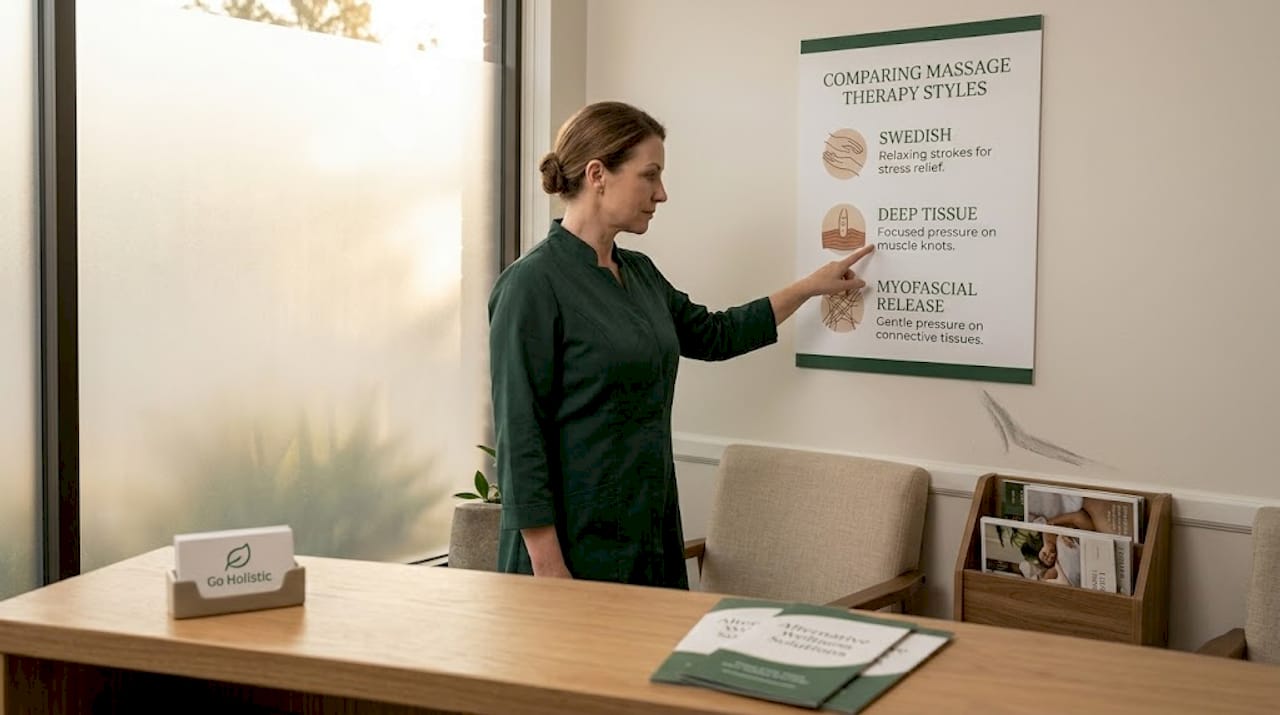
- Swedish massage: Uses long, flowing effleurage and petrissage strokes at lighter to moderate pressure. Best for general relaxation, stress reduction, and first-time massage clients.
- Deep tissue massage: Applies sustained, slow pressure to reach deeper muscle layers and fascia. Best for chronic muscle tension, postural issues, and areas of significant tightness.
- Sports massage: Blends techniques from Swedish and deep tissue, often incorporating stretching. Best for athletes before or after events, or for anyone managing activity-related muscle fatigue.
- Myofascial release: Uses gentle, sustained pressure applied to the fascia (the connective tissue surrounding muscles). Best for chronic pain conditions, movement restrictions, and conditions like fibromyalgia.
- Trigger point therapy: Focuses direct pressure on specific "knots" in muscle tissue. Best for localized pain patterns that refer discomfort to other areas of the body.
- Lymphatic drainage: Very light, rhythmic strokes designed to move fluid through the lymphatic system. Best for swelling, post-surgical recovery, and immune support.
| Massage type | Key techniques | Intended use | Evidence highlights |
|---|---|---|---|
| Swedish | Effleurage, petrissage | Relaxation, stress relief | Moderate support for mood and short-term relaxation |
| Deep tissue | Slow friction, sustained pressure | Chronic tension, posture | Some support for musculoskeletal pain |
| Sports | Blended strokes, stretching | Athletic recovery, performance | Mixed results in human studies |
| Myofascial release | Sustained fascia pressure | Chronic pain, fibromyalgia | Large positive effects on pain in fibromyalgia reviews |
| Trigger point | Focused compression | Localized pain patterns | Limited but promising clinical data |
| Lymphatic drainage | Light rhythmic strokes | Swelling, post-surgical care | Some evidence for specific clinical populations |
One finding worth highlighting: for people living with fibromyalgia, myofascial release showed large positive effects on pain and medium effects on anxiety and depression, while Swedish massage showed no measurable improvement in that same evidence synthesis. This is a great example of why technique specificity matters more than general massage popularity.
Comparing massage therapy types: Benefits, limitations, and evidence
To help you make an informed decision, let's place these massage therapy types side by side and see where the strongest evidence lies.
The overall evidence landscape for massage therapy is genuinely promising but still developing. A U.S. evidence map covering research from 2018 to 2023 found that massage therapy has potential benefit for pain conditions with moderate certainty across several reviews. However, the overall evidence base is still limited and more high-quality trials are needed before definitive conclusions can be drawn for many conditions.
One area where expectations often exceed evidence is post-exercise muscle recovery. Many people assume that getting a massage after an intense workout will speed up recovery. But research paints a more complex picture. A narrative review found that massage has not been consistently effective for recovery from exercise-induced muscle damage in humans, even though animal-model studies tend to show more positive results. Factors like timing, pressure, duration, and technique may all influence outcomes, but a clear "window of effectiveness" has not yet been defined.
Here's a practical summary of how the major types compare:
| Massage type | Evidence strength | Key limitations |
|---|---|---|
| Swedish | Moderate for relaxation/mood | Limited evidence for specific pain conditions |
| Deep tissue | Moderate for musculoskeletal pain | Can cause temporary soreness; not suitable for all |
| Sports | Mixed in human trials | Timing and protocol inconsistencies in research |
| Myofascial release | Stronger for fibromyalgia pain | Fewer studies across diverse conditions |
| Trigger point | Promising but limited | Small study sizes; technique variability |
| Lymphatic drainage | Condition-specific support | Requires specialized training to be effective |
Here are some common health scenarios and which massage type to consider first:
- Chronic low back pain: Deep tissue or myofascial release, depending on whether tension or fascial restriction is the primary issue.
- Generalized stress and anxiety: Swedish massage for its proven relaxation and mood-lifting effects.
- Fibromyalgia: Myofascial release, based on the strongest available evidence for this condition.
- Post-surgical swelling: Lymphatic drainage, ideally with a therapist trained specifically in this method.
- Athletic performance and recovery: Sports massage, with realistic expectations about recovery speed.
- Neck and shoulder tension from desk work: A combination of trigger point therapy and Swedish techniques often works well.
One important caution: marketing language can make it hard to separate evidence from enthusiasm. A modality branded with a compelling name is not necessarily more effective than a straightforward, well-applied technique. Focus on what a style actually does to tissue, not what the brochure says.
Pro Tip: When researching therapists, look for those who reference evidence-based practice or continuing education in their specialty area. This signals that they update their approach based on research, not just tradition. Pairing massage with non-invasive therapies can also strengthen your overall wellness plan.
Tailored approaches: How therapists personalize massage for you
Even with the strongest evidence, the real difference often comes from tailoring. The next section explores how this works and how you can prepare.
Here's something that surprises many people: two sessions labeled "deep tissue massage" at different clinics can feel almost nothing alike. That's because labels like deep tissue are subjective, and experienced therapists adjust their techniques based on what they observe and what you communicate, not a fixed template. What counts as "deep" for one client's body is surface-level for another.
This is why client-centered communication is one of the most powerful tools you have going into a massage appointment. A skilled therapist will ask questions, check in during the session, and modify their approach based on your responses. The relationship between you and your therapist is genuinely collaborative.
To get the most from a tailored session, consider sharing and asking the following:
- Share your main concern: Is this about pain, stress, a specific injury, or general wellness?
- Describe your pain: Where is it, what does it feel like, and what makes it better or worse?
- Mention any medical conditions: Certain techniques may be contraindicated for specific health situations.
- State your pressure preference: Light, medium, or firm. You can also say "let me know before you go deeper."
- Ask what to expect: A good therapist will walk you through their plan before starting.
- Give feedback during the session: If something feels uncomfortable or unhelpful, say so. This is not rude. It's essential.
"No two sessions should be identical. The goal of client-centered massage is not to deliver a standardized product but to respond to the individual in front of you, session by session."
Good outcomes in massage therapy are rarely accidental. They happen when there's honest, ongoing communication between you and your practitioner. If you leave a session feeling like the therapist was running through a checklist rather than listening to you, that's worth reflecting on.
Exploring personalized wellness outcomes can also help you think through how to make every appointment more effective. And if you're still building out your broader approach, browsing holistic health treatments gives you a wider view of what's available alongside massage therapy.
Our perspective: Beyond labels, what really matters in choosing massage therapy
Stepping back from specific techniques, here's a candid take on what really counts.
We've seen a lot of wellness trends come and go, and massage therapy is no exception to the branding game. Some modalities arrive with trademarked names, certification programs, and bold outcome claims that outpace what the research actually supports. It's worth being honest about that. As one analysis of the massage industry notes, modality branding may overpromise relative to the testable, underlying tissue and pressure methods that actually drive results.
What we believe matters most is not the name on the menu. It's the skill, curiosity, and communication of the therapist applying the technique. Two practitioners can both offer "Swedish massage," and one session can feel transformative while the other feels forgettable. The difference is almost never the label. It's the human behind it.
Our advice is to invest your energy in finding a therapist who explains their reasoning, welcomes your questions, and adjusts based on what you share. That's worth far more than a stylishly branded modality. You can also explore mind-body therapy effectiveness to see how massage fits within a broader, evidence-grounded approach to well-being.
Explore holistic health and find the right practitioner
Whether you're ready to book your first session or simply want to learn more, trusted holistic resources are available to support your journey.
At Go Holistic, we've built a space where finding the right practitioner is straightforward and grounded in real information. Our platform uses AI to match your specific health concerns with evidence-backed treatment options, so you're never left guessing. You can explore all holistic treatments in our library of over 200 therapy types, or browse our verified provider directory to find wellness practitioners near you.
Every practitioner in our directory is certified and vetted, so you can book with confidence. Whether you're drawn to myofascial release for chronic pain or want to start simply with a Swedish session, we'll help you take that next step at your own pace. Get started today and let us help you build a wellness journey that's truly your own.
Frequently asked questions
Which type of massage therapy is best for pain relief?
Evidence suggests myofascial release may be most effective for conditions like fibromyalgia, with research showing large positive effects on pain compared to Swedish massage, which showed no measurable improvement in that same review. The best choice depends heavily on your specific condition.
Can massage therapy help with recovery after exercise?
Human studies have not shown consistent benefits for muscle recovery after exercise-induced damage, though timing, pressure, and technique may all influence outcomes. It's a promising area, but expectations should remain realistic for now.
Do massage therapists always follow the same routine for clients?
No. Skilled therapists tailor techniques to goals rather than following a fixed routine, adjusting pressure, stroke selection, and focus areas based on your individual needs and feedback during the session.
How can I know if a massage type is right for my specific condition?
Consult a qualified therapist who understands both the evidence for each style and how to adapt techniques to your situation. Bringing a list of your symptoms and health history to the first appointment helps enormously.
Are modality labels like "deep tissue" or "Swedish" always clear and consistent?
Not always. These labels can be subjective and vary across clinics, so describing your comfort level and specific goals to your therapist will get you much further than relying on style names alone.