

TL;DR:
- AI enhances holistic health by providing personalized, evidence-based tools like acupuncture support, herbal medicine validation, and wellness coaching. It improves care accuracy, reduces dropout, and shifts treatment from reactive to preventive, all while supporting practitioner judgment and patient trust. Thoughtful use of transparent AI systems can significantly advance integrative health outcomes without replacing human care.
AI applications in holistic care are defined as machine learning systems, predictive algorithms, and intelligent digital tools that enhance natural healing practices by adding accuracy, personalization, and evidence-based support to traditional wellness methods. From AI-guided acupuncture point selection to Stanford's Bloom app coaching users through behavior change, these technologies are reshaping how you experience integrative health. The shift is not about replacing your practitioner or your herbal tea. It is about giving both of you better information, faster. This guide breaks down the most impactful uses of AI across holistic health today, with real evidence behind every claim.
1. AI applications in holistic care: how it all fits together
AI in holistic care sits at the intersection of two worlds that once seemed incompatible: ancient healing traditions and modern data science. The industry term for this convergence is integrative health technology, and it covers everything from clinical decision support tools for licensed acupuncturists to consumer-facing wellness apps that adapt to your stress levels in real time. What makes this moment significant is that AI is not flattening traditional practices into generic protocols. It is doing the opposite. By processing large volumes of patient data, symptom patterns, and treatment outcomes, AI helps practitioners and platforms deliver care that is more specific to you as an individual. That is the core promise of holistic health technology in 2026.

2. AI-guided acupuncture and point selection
Acupuncture has always required deep practitioner knowledge to select the right points for each patient's condition. AI is now supporting that process with measurable precision. Neural network models predict appropriate acupoint selection with an 86.5% accuracy rate, a result that supports clinical standardization without removing the practitioner from the equation. That level of accuracy matters because inconsistent point selection is one of the main barriers to acupuncture being taken seriously in evidence-based medicine.
Beyond selection, AI tools now assist with acupoint localization using image recognition and body mapping software. Safety monitoring systems flag contraindicated points based on a patient's current medications or conditions. The result is a layer of protection that even experienced practitioners welcome, especially in complex cases.
- AI neural networks analyze thousands of documented treatment outcomes to suggest optimal point combinations
- Image-based localization tools reduce human error in point placement
- Safety algorithms cross-reference patient health records before each session
Pro Tip: If you work with an acupuncturist, ask whether their practice uses any AI-assisted decision support tools. Practitioners using these systems tend to have more consistent, documented outcomes.
3. Machine learning in herbal medicine and TCM
Traditional Chinese Medicine (TCM) has accumulated thousands of years of clinical observation, but much of that knowledge has lived in practitioner memory and handwritten texts. Machine learning is now converting that experience into structured, searchable, evidence-based frameworks. AI integrated with synthetic biology modernizes TCM from experience-based to evidence-based practice, improving sustainability and quality control across herbal formulas and diagnostics.
One of the most practical applications is herbal medicine quality control. ML models analyze chemical composition data to detect adulteration, verify potency, and flag unsafe batches before they reach patients. Formula optimization tools suggest ingredient combinations based on a patient's specific symptom profile, drawing from databases of documented outcomes. You can read more about how this is changing the field in Goholistic's overview of herbal medicine's impact.
Tool-augmented AI agents that access structured herbal databases consistently outperform standard language models when providing traditional medicine recommendations. This means the AI tools most worth trusting are the ones connected to verified, specialized knowledge bases, not general-purpose chatbots.
4. AI health coaches and personalized wellness programs
AI health coaching is one of the fastest-growing areas of digital health solutions, and the evidence for its effectiveness is building quickly. Stanford's Bloom app uses motivational interviewing techniques to tailor wellness conversations to each user's mindset, and AI coaching improves user motivation through personalized, adaptive conversations. Motivational interviewing is a clinically validated communication style that meets people where they are rather than prescribing behavior from above. Applying it through AI makes personalized coaching available at a scale no human team could match.
AI chatbots now support stress management, sleep improvement, and mental health maintenance between practitioner visits. They ask follow-up questions, adjust recommendations based on your responses, and flag patterns that suggest you may need professional support. The key differentiator between effective and ineffective tools is explainability. Explainable AI wellness systems yield higher user satisfaction and more actionable lifestyle changes because users understand why a recommendation is being made, not just what it is.
Pro Tip: When evaluating an AI wellness app, look for one that shows you the reasoning behind its suggestions. If the app just gives you a score or a task without context, you are working with a black-box system that limits your ability to make informed choices.
- Bloom app (Stanford) uses motivational interviewing to personalize physical activity plans
- AI chatbots provide between-session mental health support and stress coaching
- Explainable AI tools link recommendations directly to your lifestyle data
5. Predicting and reducing dropout in digital wellness programs
One of the quieter problems in digital wellness is dropout. People start programs with real intention and then stop. Machine learning is addressing this directly. ML models predict dropout risk in digital wellness programs with up to 89% accuracy, allowing platforms to intervene with targeted support before a user disengages. That kind of proactive outreach changes the economics and the outcomes of digital wellness entirely.
The same research identifies which factors drive dropout most strongly. Socioeconomic and psychosocial factors including education level, emotional support networks, and life satisfaction are the strongest predictors of adherence. This means effective AI wellness tools do not just track your steps. They account for the full context of your life. That is genuinely holistic thinking, applied through data.
Platforms that use these models can send personalized check-ins, adjust program difficulty, or connect users with peer support at exactly the right moment. The difference between a program you finish and one you abandon often comes down to whether the system noticed you were struggling before you gave up.
6. AI in chronic disease management and predictive analytics
Managing a chronic condition with a holistic approach requires continuous monitoring, not just periodic appointments. AI makes that continuous care possible by integrating data from wearables, electronic health records, and patient-reported outcomes into a single, real-time picture. Taiwan's Healthy Taiwan initiative demonstrates AI's capacity to drive proactive, person-centered care models at a national scale, combining unified digital health infrastructure with AI-driven risk prediction.
The shift this enables is from reactive to preventive care. Instead of waiting for a symptom to worsen, AI flags risk patterns early and prompts intervention. For people managing conditions like diabetes, hypertension, or autoimmune disorders alongside holistic therapies, this kind of early warning is genuinely life-changing. Goholistic's guide on AI in wellness platforms covers how these national and platform-level models translate into practical tools for individuals.
Federated learning, a method where AI models train on distributed data without centralizing sensitive records, is becoming the standard for secure health data sharing. This protects your privacy while still allowing the system to learn from population-wide patterns. For holistic care, where patient trust is foundational, that balance matters enormously.
7. Comparing AI tools: clinical support vs. consumer wellness apps
Not all AI tools for holistic care serve the same purpose, and choosing the right one depends on what you actually need. The table below maps the two main categories against the features that matter most.
| Feature | Clinical AI support tools | Consumer wellness apps |
|---|---|---|
| Primary user | Licensed holistic practitioners | Individual wellness seekers |
| Data sources | Patient records, clinical databases | Self-reported data, wearables |
| Accuracy standard | Validated against clinical outcomes | Varies widely by platform |
| Explainability | Required for clinical use | Optional, often absent |
| Regulatory oversight | Healthcare regulations apply | Consumer app standards |
| Best use case | Acupoint selection, herbal safety, diagnostics | Coaching, habit tracking, stress management |
Clinical AI tools like neural network acupoint selectors are built to meet healthcare standards and are validated against documented patient outcomes. Consumer apps like AI wellness coaches prioritize accessibility and engagement. Both have real value, but using a consumer app to manage a serious chronic condition without practitioner involvement is a gap that AI cannot yet fill responsibly. The evidence-based alternative treatments framework Goholistic uses helps clarify which tools belong in which context.
Key takeaways
AI in holistic care works best when it combines explainable, evidence-backed technology with the irreplaceable judgment of a trained practitioner.
| Point | Details |
|---|---|
| Acupuncture AI accuracy | Neural networks reach 86.5% accuracy in acupoint selection, supporting clinical standardization. |
| Dropout prediction | ML models predict wellness program dropout with up to 89% accuracy, enabling timely intervention. |
| Explainability drives results | AI wellness tools with transparent reasoning produce higher user satisfaction and real behavior change. |
| TCM modernization | AI converts traditional herbal and diagnostic knowledge into structured, evidence-based frameworks. |
| Proactive chronic care | Integrated AI platforms shift holistic care from reactive treatment to preventive, continuous monitoring. |
Why I think we are still underestimating AI's role in holistic care
I have spent years watching the wellness world treat technology with suspicion, and I understand why. Holistic care is built on relationship, intuition, and the kind of whole-person attention that no algorithm fully replicates. But I think the conversation has been framed wrong. The question is not whether AI belongs in holistic care. It is whether we use it thoughtfully or let it drift toward shortcuts.
The 86.5% acupoint accuracy figure is impressive, but what strikes me more is what it implies about the 13.5% where human judgment still wins. That gap is where practitioner expertise, patient rapport, and clinical intuition live. AI should be filling in the standardization gaps, not the human ones. The tools that earn trust are the ones that show their work, connect recommendations to your actual data, and defer to your practitioner when the situation calls for it.
My honest recommendation: start with one AI tool that addresses a specific gap in your wellness routine, whether that is adherence, stress tracking, or finding a verified practitioner through a platform like Goholistic. Evaluate it for transparency. If it cannot explain why it is suggesting something, treat that as a warning sign. The verified holistic providers model that platforms like Goholistic use is a good example of AI governance done right. Technology in service of trust, not in place of it.
— Andrew
Discover AI-powered holistic care at Goholistic
Goholistic brings together over 200 therapy types, a curated directory of verified practitioners, and AI-powered treatment recommendations in one place. Whether you are exploring acupuncture, Ayurveda, massage therapy, or herbal medicine, the platform matches your health concerns to evidence-backed options and connects you directly with licensed professionals.
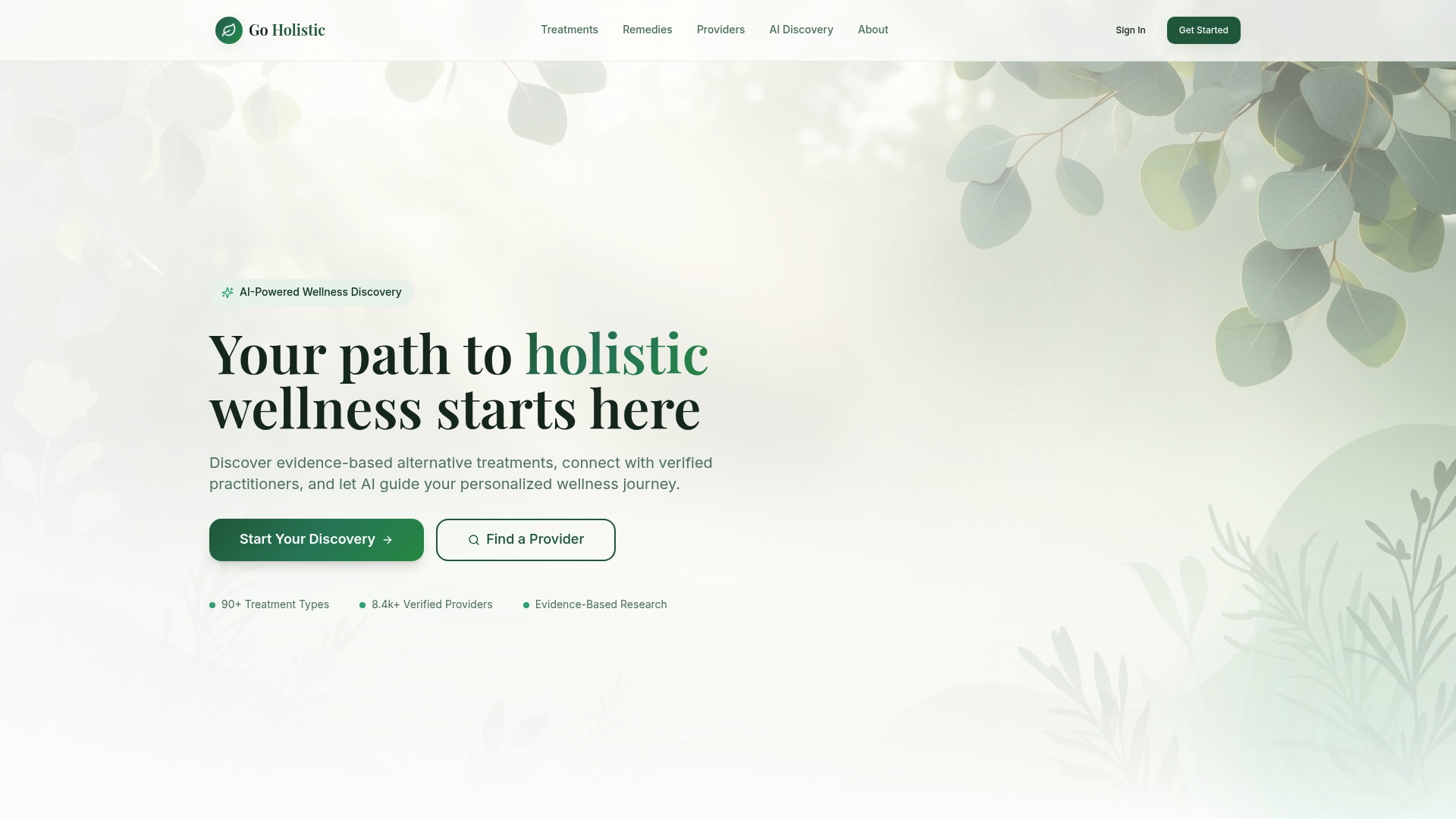
Browse holistic health treatments across every major modality, or use the practitioner directory to find a verified specialist near you. Goholistic offers both free and premium access, so you can start exploring at your own pace. Get started today and take the first step toward a more informed, personalized wellness path.
FAQ
What are AI applications in holistic care?
AI applications in holistic care are digital tools that use machine learning and predictive algorithms to support natural healing practices, including acupuncture guidance, herbal medicine quality control, and personalized wellness coaching.
How accurate is AI in supporting acupuncture treatment?
Neural network models predict appropriate acupoint selection with an 86.5% accuracy rate, making AI a reliable support tool for clinical acupuncture standardization alongside practitioner expertise.
Can AI replace a holistic health practitioner?
AI supports and enhances practitioner decisions but does not replace the clinical judgment, patient rapport, and whole-person assessment that trained holistic practitioners provide. The most effective models combine both.
How does machine learning improve wellness program adherence?
ML models identify dropout risk with up to 89% accuracy by analyzing socioeconomic and psychosocial factors, allowing platforms to deliver personalized interventions before a user disengages from their program.
What should I look for in an AI wellness tool?
Prioritize tools that offer explainable recommendations linked to your personal data. Explainable AI systems produce higher user satisfaction and more meaningful lifestyle changes than black-box platforms that deliver scores without context.