
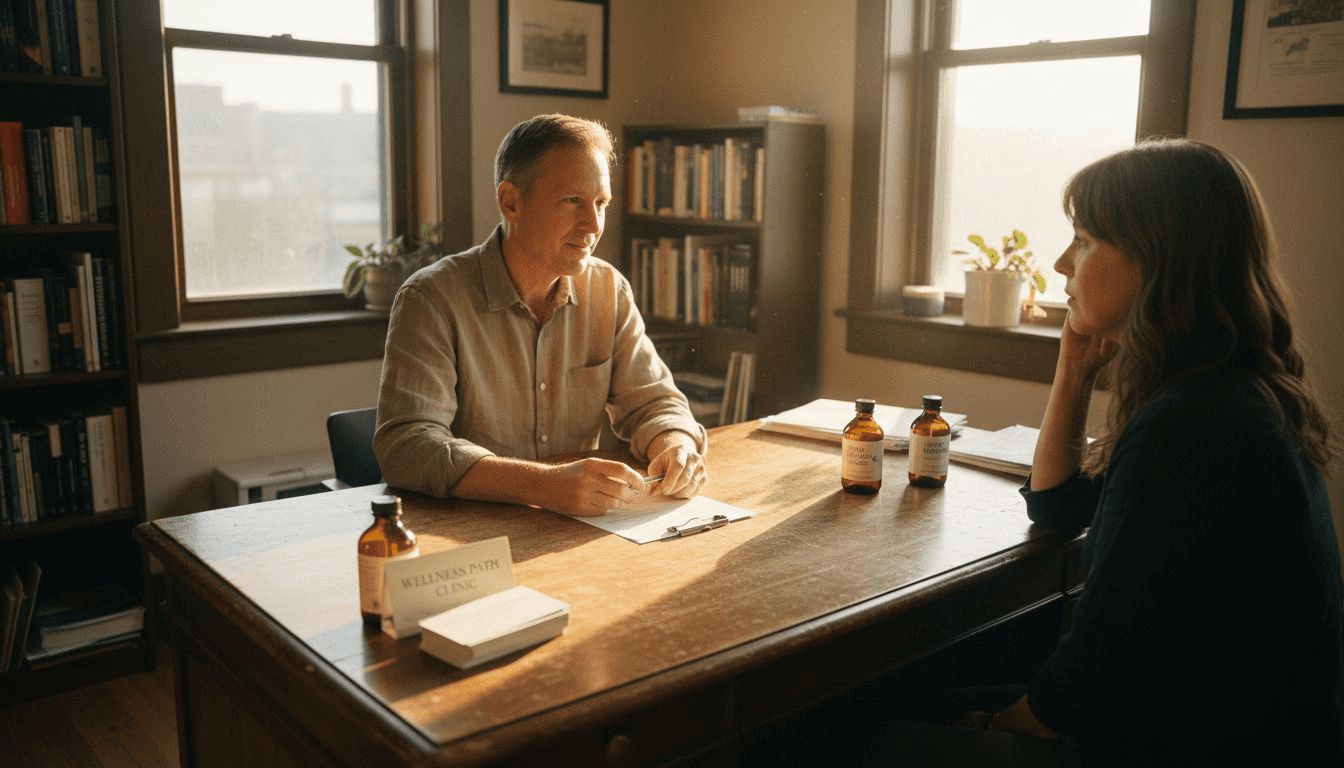
Searching for a trustworthy holistic practitioner can feel confusing when each title, credential, and claim looks different. The confusion often begins with unclear terminology and broad misconceptions about what holistic practitioners actually do. Holistic care combines physical, emotional, social, and spiritual elements, focusing on you as a complete person. Understanding the true meaning and verifying your practitioner's credentials protects your health and ensures that your treatments are safe, effective, and genuinely personalized.
Table of Contents
- Defining Holistic Practitioners and Common Misconceptions
- Accreditation and Certification in Holistic Health
- Understanding State Variations
- The Verification Process
- Risks of Unverified Practitioners and Patient Safety Issues
- Red Flags to Watch For
- Protecting Yourself
- How Verification Protects Personal Wellness and Legal Rights
- Building Your Protection Strategy
- Comparing Verified and Non-Verified Holistic Providers
Key Takeaways
| Point | Details |
|---|---|
| Holistic practitioners focus on comprehensive care | They address physical, emotional, social, and spiritual health aspects rather than just treating symptoms. |
| Verify credentials and training | Ensure practitioners are properly licensed and have credible certifications to avoid ineffective or unsafe treatments. |
| Understand limitations of holistic care | Holistic practitioners have defined scopes of practice; they should integrate with conventional medicine when necessary. |
| Insurance and legal protections are important | Verified practitioners typically carry liability insurance and maintain detailed records, providing recourse if harm occurs. |
Defining Holistic Practitioners and Common Misconceptions
When you're searching for a holistic practitioner, you might feel like you're navigating unfamiliar territory. The term "holistic" gets thrown around so much that its real meaning has become blurry. A holistic practitioner is a healthcare professional who applies comprehensive care that integrates physical, emotional, social, and spiritual elements to address your health. This isn't just about treating symptoms—it's about understanding you as a complete person. These practitioners could specialize in acupuncture, massage therapy, herbal medicine, Ayurveda, nutritional counseling, or dozens of other modalities. The key distinguishing factor is their commitment to looking at your whole health picture, not isolated complaints.
Here's where the confusion starts. Many people think holistic care means rejecting conventional medicine entirely, but that's a fundamental misconception. Holistic practitioners work across the full spectrum of care approaches. Some integrate with mainstream medicine, while others specialize exclusively in natural treatments. The real definition focuses on the approach, not the specific therapies used. Think of it this way: a cardiologist who only looks at your heart is treating one system in isolation. A holistic practitioner treating a cardiac patient would also consider your stress levels, sleep quality, diet, emotional well-being, and life circumstances that contribute to your heart health.
Another common misunderstanding centers on credentials and training. Not all holistic practitioners have the same level of education or licensing requirements. This varies dramatically depending on the discipline and location. Some states regulate massage therapists and acupuncturists with strict licensing standards, while others have minimal oversight. This creates a landscape where you'll find everything from rigorously trained practitioners with years of education to people with weekend certifications claiming expertise. This is precisely why verification matters so much—the title "holistic practitioner" alone tells you almost nothing about someone's actual qualifications.
There's also widespread confusion about what holistic care can and cannot do. People sometimes assume that because something is natural or holistic, it will work for any condition without risk. This isn't accurate. Holistic practitioners have scope limitations just like conventional doctors do. A skilled acupuncturist can help with chronic pain and nausea, but they cannot diagnose cancer or prescribe insulin for diabetes. Many effective holistic treatments work best alongside conventional care, not as replacements for it. Understanding these boundaries protects you from unrealistic expectations and dangerous gaps in your care.
The wellness industry has also blurred lines between different types of practitioners. Someone calling themselves a "wellness coach" might have certification from a weekend program, while a licensed acupuncturist has completed thousands of hours of training. Terms like "natural healer" or "energy worker" carry no standardized meaning whatsoever. This mix of terminology makes it easy to accidentally work with someone whose training doesn't match their claims. You're essentially trying to evaluate professionals where the basic terminology lacks definition.
Looking at holistic care through research shows it emphasizes therapeutic relationships and individual personhood, viewing health as more than simply the absence of disease. This means a genuine holistic practitioner should spend time understanding your life context, not just your symptoms. They should ask questions about your stress, relationships, diet, sleep, exercise, and emotional state. This comprehensive approach requires time and skill—red flags should go up when a practitioner spends minimal time with you or shows little interest in your broader health picture.
One final misconception worth addressing: the assumption that all holistic practitioners practice the same way. In reality, there's enormous variation in quality, training, philosophy, and effectiveness even within a single discipline. Two acupuncturists might have completely different approaches, training depths, and treatment philosophies. This diversity means you can't simply rely on someone's title or even their certification type. You need to dig deeper into their specific credentials, experience, licensing status, and track record.
Here is a summary of how common holistic practitioner titles differ in terms of training, oversight, and scope:
| Title or Role | Typical Training Level | Regulatory Oversight | Scope of Practice |
|---|---|---|---|
| Licensed Acupuncturist | 2,000-4,000 hours, exams | State licensing boards | Diagnosis, treatment limits |
| Massage Therapist | 500-1,000+ hours, exams | State licensure in many states | Non-invasive therapies |
| Certified Herbalist | 200-2,000 hours, varies | Often none or voluntary orgs | Herbal recommendations |
| Wellness Coach | Weekend-1 year certificate | No standard oversight | Lifestyle guidance |
| Energy Worker | No formal requirements | None | Non-physical modalities |
| Naturopathic Doctor | Doctoral program, licensure | Licensed in some states | Broad, varies by state |
This table highlights the variability in credentials and oversight for holistic practitioners.
- Holistic practitioners address physical, emotional, social, and spiritual health components
- They may specialize in acupuncture, massage, herbal medicine, Ayurveda, or other modalities
- Credentials and training vary widely depending on discipline and location
- Holistic care focuses on the approach to treatment, not specific therapies only
- Holistic practitioners work within defined scope limitations and should integrate appropriately with conventional care when needed
- Terms like "natural healer" or "wellness coach" lack standardized definitions
- Effective holistic practitioners spend time understanding your full health context
A true holistic practitioner views you as a complete person with interconnected physical, emotional, and spiritual dimensions—not as a collection of isolated symptoms to fix.
Pro tip: When researching a practitioner, don't stop at their title or general credentials—ask specifically about their training hours, licensing status (if applicable to their field), what conditions they treat, and how they approach integration with your other healthcare providers.
Accreditation and Certification in Holistic Health
When you're evaluating a holistic practitioner, understanding the difference between accreditation and certification can feel like decoding a secret language. Accreditation and certification sound similar, but they're fundamentally different concepts that matter enormously for your safety. Certification means a practitioner has completed training from a recognized organization and passed examinations to demonstrate competency in their specific field. Accreditation, on the other hand, refers to recognition of the organization or program itself—it's the stamp of approval that the training program meets established standards. Think of it this way: certification is what the practitioner has earned, while accreditation is the credibility of the place that trained them.
The complexity intensifies because accreditation and certification standards vary wildly across different holistic disciplines. Acupuncture and massage therapy have well-established regulatory bodies in many U.S. states with specific education hour requirements and licensing exams. Other fields like herbal medicine, energy work, or nutritional counseling operate in a much grayer zone where standards differ by state or even by city. A licensed acupuncturist in New York went through a rigorous credentialing process, but someone calling themselves a "holistic health practitioner" in another state might have credentials from sources with virtually no oversight. This fragmentation creates real safety challenges for you as a patient trying to verify someone's qualifications.
Here's what makes this confusing: organizations offering certifications in holistic health range from legitimate, rigorous programs to diploma mills that charge minimal fees for minimal education. Some programs require 500 hours of training; others require 5,000. Some accrediting bodies themselves lack credibility because they're self-created organizations with no independent oversight. You might find a practitioner with impressive-sounding credentials that actually came from a weekend workshop. The title "certified holistic practitioner" could mean someone spent years in rigorous study or three days in an online course. This is why you cannot simply see a certificate on a wall and assume competence.
The most reliable approach involves looking beyond just the certification itself. Check whether the certifying organization is accredited by a recognized body. For example, the National Accreditation Commission for Schools and Colleges of Acupuncture and Oriental Medicine (NACCAOM) sets standards that many practitioners meet. Ask specific questions: How many hours of training were required? Does the organization have independent accreditation? Are there continuing education requirements to maintain the certification? Can you verify the credentials through the issuing organization? Most legitimate organizations maintain registries where you can confirm someone's credentials directly.
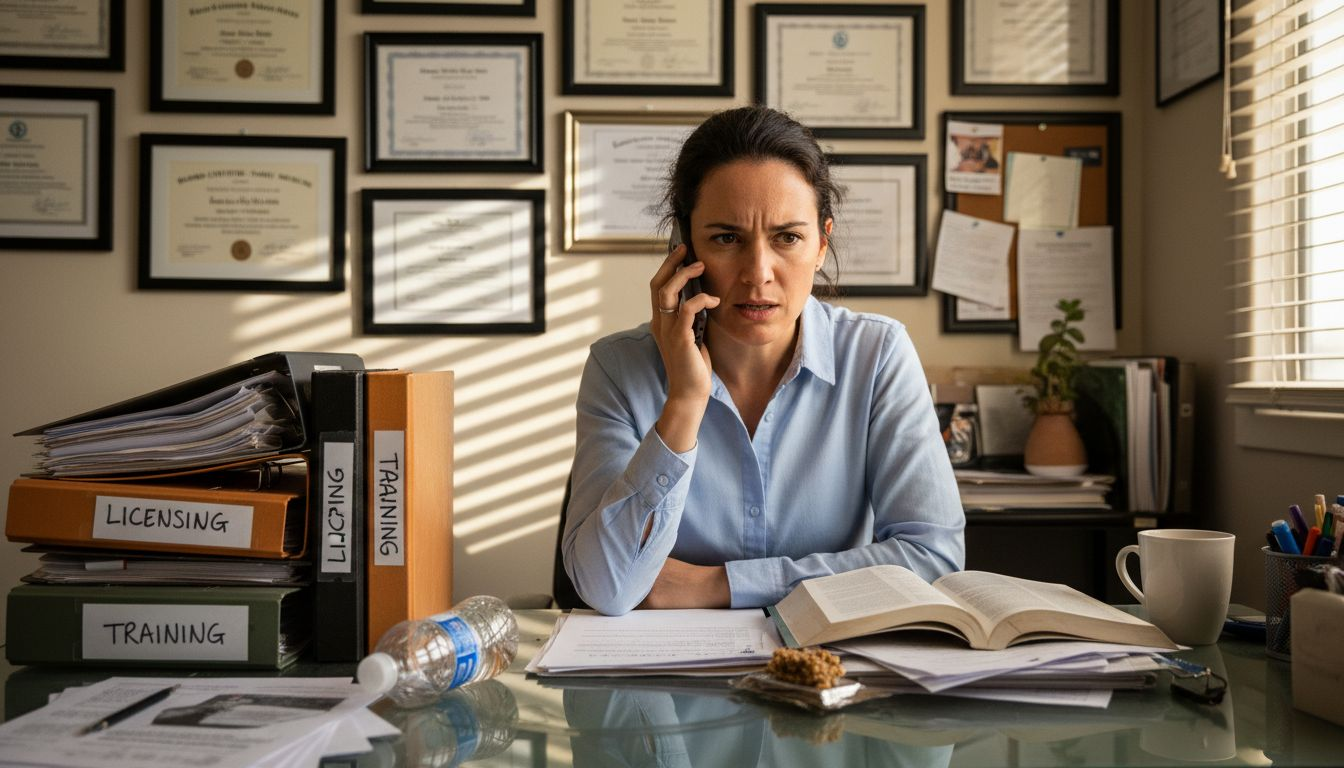
Licensing adds another layer of protection where it exists. Licensed practitioners have met government-established standards and are subject to disciplinary processes if they harm patients. However, licensing only exists for certain holistic disciplines in certain states. Acupuncturists, massage therapists, and naturopathic doctors may be licensed depending on where you live. Many holistic modalities—like reiki, herbal consultation, or coaching—exist in areas with zero licensing requirements anywhere in the United States. This means licensing, when available, is a positive indicator, but its absence doesn't automatically mean someone is unqualified.
You should also understand what credentials actually represent training versus what they represent. Someone with a Ph.D. in nutrition science has different qualifications than someone with a certificate in herbal medicine. A "Certified Nutritional Consultant" could be trained by a rigorous university program or by an online organization. The word "certified" tells you they passed something, but not necessarily what or how rigorous that something was. When researching any practitioner, look at the actual training program, not just the credential name.
Many reputable practitioners list their specific credentials and the organizations that granted them. You can typically verify these claims by contacting the credentialing organization directly. Professional associations like the American Herbalists Guild, the National Ayurvedic Medical Association, or various massage therapy boards maintain member directories. Use these directories as your starting point—if someone isn't listed by their claimed professional organization, that's a red flag.
One additional consideration: continuing education requirements. Practitioners operating in regulated fields like acupuncture and massage therapy must complete ongoing training to maintain their licenses. Those in unregulated fields may or may not stay current with new research and best practices. Ask potential practitioners what continuing education they've completed recently. Someone genuinely committed to their field typically stays engaged with new developments and research in their specialty.
- Certification demonstrates that a practitioner completed training and passed exams
- Accreditation means the training organization itself meets recognized standards
- Licensing exists for some holistic disciplines in some states, providing government oversight
- Certification standards vary enormously across different holistic health fields
- Not all certifying organizations are equally rigorous or credible
- Licensed practitioners must maintain standards and can face disciplinary action
- Unregulated fields may have no formal requirements at all
- Legitimate practitioners can typically verify their credentials through official registries
The credential hanging on a wall matters far less than what training, oversight, and ongoing education stand behind it.
Understanding State Variations
Your location dramatically affects what credentials mean and what protection exists. States that regulate acupuncture require practitioners to pass the NCCAOM (National Certification Commission for Acupuncture and Oriental Medicine) exam, complete specific training hours, and maintain active licensure. States without acupuncture licensing have no such requirements. Some states license naturopathic doctors with rigorous standards; others allow anyone to use that title. You cannot assume that because a credential exists in one state, it represents the same standard elsewhere. Always research your specific state's regulations for the field you're interested in.
The Verification Process
When you find a practitioner whose approach interests you, follow this verification path: First, ask directly about their credentials and training. Second, contact the certifying or licensing organization to confirm the credential is current and in good standing. Third, ask about their continuing education and professional memberships. Fourth, check if any disciplinary actions exist through your state's licensing board (if applicable to their field). You can also explore holistic treatment options and verified practitioners to understand better which modalities align with your health goals and which practitioners have strong backgrounds.
Pro tip: When contacting a practitioner's credentialing organization to verify their credentials, ask whether the certification is active and current—many organizations only list practitioners who maintain their credentials through continuing education, providing you an additional layer of assurance about their ongoing competence.
The following table compares methods for verifying a holistic practitioner's qualifications:
| Verification Step | Why It Matters | Example Action |
|---|---|---|
| Confirm credential with issuer | Ensures certificate is legitimate | Call licensing board |
| Review education hours required | Reveals training depth | Request transcript |
| Check continuing education | Shows up-to-date knowledge | Ask for recent courses |
| Search disciplinary actions | Alerts to past complaints | Check state database |
| Confirm insurance coverage | Ensures protection in disputes | Request proof of liability |
These steps help you safeguard your health when selecting a holistic practitioner.
Risks of Unverified Practitioners and Patient Safety Issues
Working with an unverified holistic practitioner carries real dangers that extend far beyond wasting money on ineffective treatment. When you visit someone without checking their credentials, you're essentially gambling with your health. An unverified practitioner might lack fundamental knowledge about contraindications, drug interactions, anatomical safety, or when a condition requires conventional medical intervention. They may not understand the scope of their practice or recognize when a patient needs referral to an emergency room. A practitioner who skipped formal training might miss red flags that indicate a serious underlying condition requiring immediate medical attention.
One of the most insidious risks involves delayed diagnosis of serious conditions. Imagine you have persistent chest pain and see an unverified wellness practitioner who diagnoses it as an energy blockage and recommends herbal supplements. While receiving alternative treatment, you ignore the actual cardiac condition developing. By the time you seek conventional medical care months later, the problem has progressed significantly. This scenario isn't hypothetical—people delay critical diagnoses every year because they trusted unverified practitioners who confidently assured them the problem was minor. Verified practitioners with proper training understand when to refer patients to medical doctors and what conditions fall outside their scope.
Another serious risk involves harmful drug interactions and contraindications. An unverified herbal practitioner might recommend an herb that seems harmless but interacts dangerously with your blood pressure medication or blood thinner. Someone without pharmacology training won't know that certain supplements can thin your blood, increase bleeding risk during surgery, or interfere with anesthesia. Verified practitioners with rigorous training learn these interactions thoroughly. They ask detailed questions about your medications, medical history, and other treatments. They understand which populations—like pregnant women, children, or people with specific conditions—need modified approaches or should avoid certain treatments entirely.
Liability and legal protection represent additional concerns. If a verified, licensed practitioner injures you through negligence, you have recourse. You can file complaints with licensing boards, report them to professional organizations, and potentially pursue legal action with documented standards of care to reference. If an unverified practitioner harms you, your legal options become murky. No licensing board oversees them. No professional standards apply. Proving negligence becomes exponentially harder when the person claimed no formal credentials from the beginning. You're essentially left with limited options for accountability or compensation.
Unverified practitioners also present financial risks beyond the cost of their services. You might spend thousands on ineffective treatments when evidence-based approaches would have solved your problem in weeks. Worse, you might lose time pursuing treatments that allow a serious condition to advance, leading to more expensive and invasive conventional treatment later. Someone seeking help for chronic pain might spend $5,000 annually on unverified practitioners when a qualified physical therapist and acupuncturist could resolve the issue for $2,000.
Infection and injury risks represent physical safety concerns. An unverified acupuncturist who hasn't learned proper needle sterilization can transmit blood-borne infections. Someone without anatomical training might hit a nerve or organ during treatment. An untrained massage therapist could injure someone with osteoporosis or certain medical conditions. A practitioner lacking training in sterile technique when dealing with any invasive procedure creates serious infection risks including sepsis. Verified practitioners complete extensive training on safety protocols specifically to prevent these complications.
There's also the risk of false hope and psychological harm. Someone promoting unproven treatments with absolute certainty can create false hope that prevents people from accepting realistic diagnoses or pursuing effective treatments. This creates emotional trauma when the promised cure doesn't materialize. People with terminal diagnoses sometimes spend their final months and financial resources pursuing unproven treatments from unverified practitioners instead of spending quality time with loved ones.
- Delayed diagnosis of serious conditions while pursuing ineffective alternative treatment
- Drug interactions and contraindications unknown to unverified practitioners
- Infection risks from improper sterilization or unsafe techniques
- Anatomical injuries from practitioners lacking proper training
- Limited legal recourse if an unverified practitioner causes harm
- Financial waste on ineffective treatments and delayed proper care
- Psychological harm from false hope and unrealistic promises
- Scope violations where practitioners treat conditions beyond their expertise
An unverified practitioner's confidence in their abilities may exceed their actual competence—and you bear the consequences of that gap.
Red Flags to Watch For
Certain warning signs indicate you should avoid a practitioner. Someone who claims to cure serious diseases with guaranteed results, refuses to work with conventional doctors, becomes defensive when you ask about credentials, or discourages you from seeking second opinions represents a major risk. Practitioners who pressure you to buy expensive products from them, claim their training is superior to medical schools, or suggest stopping prescribed medications without medical supervision are operating outside safe practice boundaries. Trust your instincts if something feels off or if a practitioner dismisses your concerns.
Protecting Yourself
Verification protects you in tangible ways. Verified practitioners carry liability insurance, maintain professional standards, participate in continuing education, and face accountability mechanisms. You can research them, check references, and pursue complaints through established channels. Licensed practitioners must follow scope-of-practice laws defining what they can and cannot do. They understand referral protocols for serious conditions. They communicate with other healthcare providers. These safeguards exist because of decades of patient harm that led to regulatory improvements.
Pro tip: Before your first appointment, call the practitioner's credentialing organization directly to verify their credentials are current and active—this five-minute phone call provides critical assurance that you're working with someone who maintains professional standards and stays current with their field.
How Verification Protects Personal Wellness and Legal Rights
Verification is not just an administrative checkbox—it's your primary defense against serious harm. When you work with a verified practitioner, you gain concrete protections that an unverified relationship simply cannot offer. Legal protections strengthened through licensure and certification create mechanisms for complaint management, disciplinary actions, and regulatory oversight that protect you if something goes wrong. This system exists because decades of patient harm led to regulations designed to prevent future injuries. A verified practitioner operates within a framework of accountability that matters the moment a problem occurs.
Consider what happens if an unverified practitioner injures you. You cannot file a complaint with a licensing board because no board oversees them. You cannot report them to a professional organization because they don't belong to one. Your legal options become limited to civil court, where you must prove negligence without established standards of care to reference. A verified practitioner, by contrast, operates under documented standards. If they violate those standards and harm you, you have clear evidence of negligence. You can file complaints through official channels. Their license can be suspended or revoked. These mechanisms provide real accountability and give you leverage in legal disputes.
Verification also protects your wellness through enforced competency standards. Verified practitioners must maintain specific education levels, stay current through continuing education, and demonstrate ongoing competence. They cannot simply practice the same way for forty years without updating their knowledge. They face consequences if they fall below professional standards. This creates ongoing incentive to provide safe, effective care. An unverified practitioner has no such requirements. They might never update their training after initial certification, missing decades of research advances and safety improvements.
Standards that prevent unqualified individuals from practicing create safer treatment environments where patients can trust their practitioners have met rigorous requirements. This matters profoundly for conditions requiring deep anatomical or pharmacological knowledge. Someone performing acupuncture needs to understand exactly where nerves, blood vessels, and organs exist. Someone recommending herbs needs to know drug interactions. Someone performing massage therapy needs to recognize contraindications and when someone should not receive that treatment. Verification ensures practitioners have this knowledge before they ever treat patients.
Verification also protects you financially in ways you might not immediately recognize. If a verified, licensed practitioner provides you with a treatment plan and insurance covers part of it, you have documentation and accountability. If something goes wrong, you have insurance claim documentation and professional records. If an unverified practitioner takes your money and provides no benefit, you have minimal recourse. Many people don't realize that working with verified practitioners sometimes allows insurance coverage, reducing your out-of-pocket costs significantly.
Insurance protection represents another critical benefit. Licensed practitioners typically carry malpractice insurance. If they harm you, their insurance may cover damages. An unverified practitioner carries no such insurance. Even if you win a lawsuit against them, they may have no assets to collect from. The judgment becomes meaningless. Verified practitioners' insurance exists specifically to protect patients when harm occurs.
Verification also creates documented records and communication chains that protect your overall health. Verified practitioners maintain detailed notes about treatments, responses, and recommendations. If you later see a medical doctor, these records exist and can be shared. If something goes wrong, medical professionals can review exactly what happened during holistic treatment. Unverified practitioners may keep no records at all, making it impossible to determine what happened if problems develop. You're left with your word against theirs.
Another subtle but important protection involves scope-of-practice enforcement. Verified practitioners operate within defined legal boundaries about what they can diagnose, treat, and prescribe. Someone licensed as a massage therapist cannot diagnose conditions—they can only provide massage therapy. Someone licensed as an acupuncturist cannot prescribe conventional medication. These boundaries protect you because they prevent practitioners from overstepping into areas where they lack expertise. An unverified practitioner has no such boundaries. They might attempt treatments far beyond their actual training.
Verification also provides regulatory oversight mechanisms that catch problems before they harm many people. If a verified practitioner develops a pattern of harming patients, the licensing board can investigate and take action. This prevents ongoing harm. Unverified practitioners can harm person after person with no consequences or oversight. The only way to stop them is through individual lawsuits, which require money and legal resources most patients lack.
- Complaint mechanisms through licensing boards and professional organizations
- Disciplinary actions that can suspend or revoke credentials
- Enforced continuing education requirements keeping practitioners current
- Documented standards of care making negligence provable in legal disputes
- Malpractice insurance protecting you if harm occurs
- Detailed medical records documenting all treatments and responses
- Scope-of-practice limits preventing practitioners from overstepping expertise
- Regulatory oversight that catches patterns of harm
- Professional accountability creating incentive for quality care
- Legal recourse options when harm occurs
Verification transforms your relationship with a practitioner from a gamble into a protected transaction with clear recourse if something goes wrong.
Building Your Protection Strategy
Verification alone isn't enough—you also need to actively engage in your own protection. Ask your verified practitioner detailed questions about their specific experience with your condition, their approach to integrating with your other healthcare, and how they handle situations outside their scope. Request copies of your treatment records. Ask how they stay current with new research. Verify they maintain liability insurance. Give yourself the full benefit of verification systems by engaging thoughtfully with verified practitioners.
Understanding what verification provides helps you recognize when something is missing. If a practitioner cannot document their credentials, has no insurance, keeps no records, and operates with no oversight, you're essentially unprotected regardless of their individual skill. That doesn't mean they're definitely harmful, but it means you've eliminated every safety system designed to protect you.
Pro tip: Before choosing a practitioner, ask specifically: "Are you licensed or certified by [credentialing organization]?" "Can you provide proof?" "What is your malpractice insurance coverage?" "Do you maintain detailed treatment records?" Practitioners who answer these questions directly and transparently are likely operating within proper verification systems.
Comparing Verified and Non-Verified Holistic Providers
The differences between verified and non-verified holistic providers extend far deeper than credentials hanging on a wall. When you sit across from a verified practitioner versus an unverified one, you're entering two fundamentally different types of professional relationships with vastly different protections, standards, and outcomes. Understanding these differences helps you make informed choices about your health and safety. A side-by-side comparison reveals why verification matters so profoundly for your wellness journey.
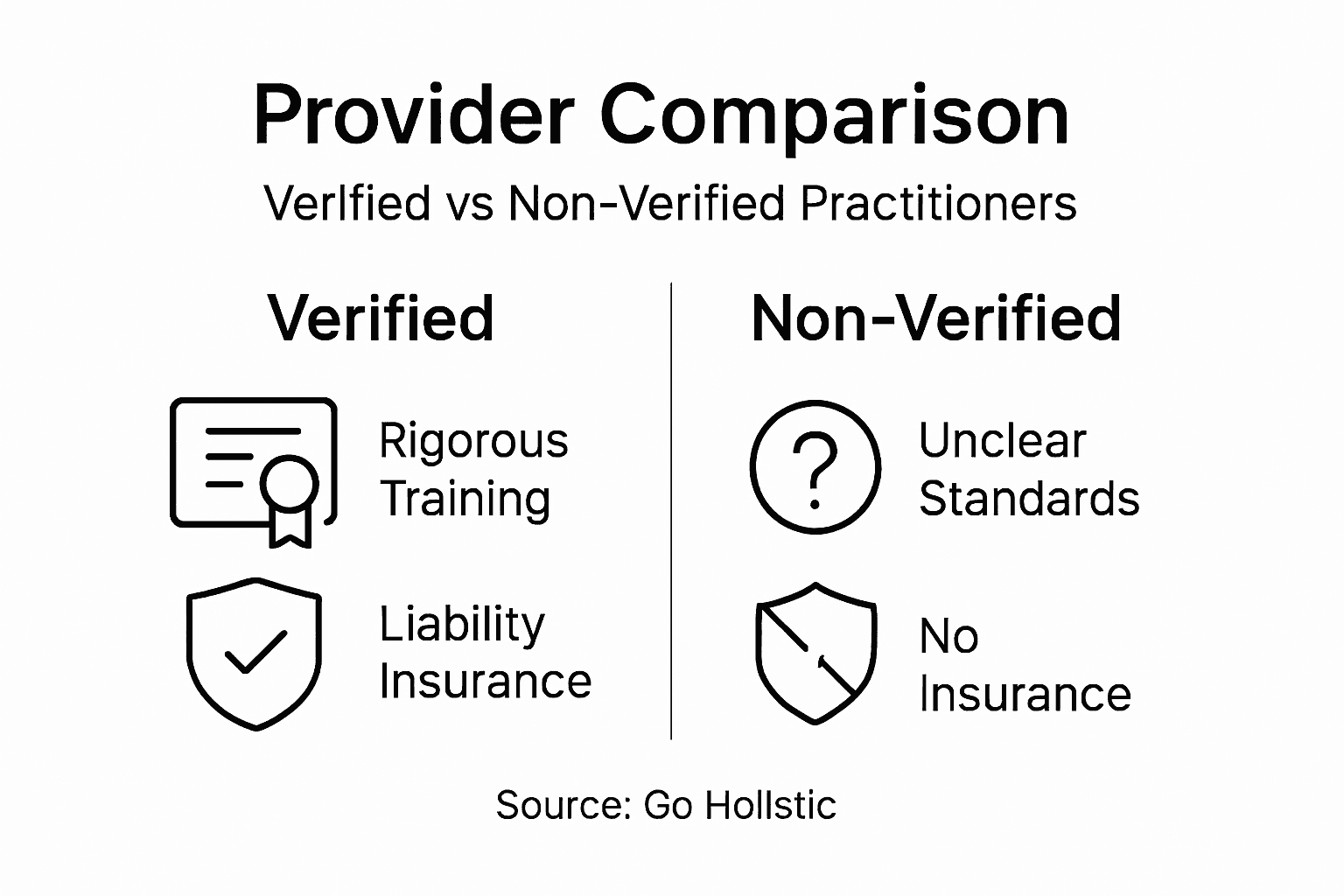
Verified providers have completed rigorous training programs, passed examinations, and maintain active credentials through continuing education and professional oversight. They operate within defined scope-of-practice boundaries that prevent them from overstepping their expertise. They maintain detailed treatment records, carry liability insurance, and participate in professional communities with ethical standards. Their practices are subject to regulatory review, and they face real consequences for violations. An unverified provider, by contrast, may have completed an online weekend course or operated entirely on self-taught knowledge. They maintain no formal records, carry no insurance, and answer to no oversight body.
Let's examine the practical differences you'd experience as a patient. When you visit a verified acupuncturist, you receive a detailed intake asking about your medical history, medications, surgeries, and current health conditions. They take time to understand your complete health picture. They document everything carefully. They follow sterile protocols. They understand exactly which conditions they can treat and which require referral to a medical doctor. An unverified acupuncturist might skip most of these steps, ask minimal questions, and lack knowledge about dangerous contraindications.
The training depth represents another crucial distinction. A licensed acupuncturist in most U.S. states completes 2,000 to 4,000 hours of training including anatomy, physiology, pharmacology, and hands-on clinical experience. They study how herbs interact with medications, how different body types respond to treatment, and when acupuncture is contraindicated. An unverified acupuncturist might complete 100 hours of online training covering basic needle insertion techniques. The difference in actual competence is staggering.
Communication with your other healthcare providers represents another key distinction. Verified practitioners understand the importance of coordinating care. They ask about your doctors, medications, and other treatments. They communicate findings when appropriate. An unverified practitioner might actively discourage you from seeing medical doctors or fail to mention important interactions with your current care.
Consider how each type handles complications. A verified practitioner who causes an injury has liability insurance, detailed documentation, and professional accountability mechanisms. You have clear pathways for complaint and compensation. An unverified practitioner caused harm leaves you with minimal recourse. You must prove negligence in court without documented standards of care to reference.
The Cost-Benefit Reality
Many people assume unverified providers cost less, but this calculation often proves misleading. A verified massage therapist might charge $80 per hour while an unverified one charges $40. However, the verified therapist's 5-10 sessions might resolve your chronic pain permanently, while the unverified provider's cheaper sessions provide only temporary relief requiring ongoing payments. You might spend $2,000 over two years with an unverified provider versus $400 for permanent results with a verified one.
Insurance coverage also affects true costs. Insurance often covers verified practitioners' services but rarely covers unverified ones. Your out-of-pocket costs with a verified, insured provider might actually be lower than paying cash to an unverified provider.
Quality of Care Comparison
Verified providers must stay current with evolving research and best practices. Continuing education requirements ensure they learn new techniques, understand emerging evidence, and adapt their practices accordingly. An unverified provider might practice the same way for decades, completely unaware of research breakthroughs that could help you more effectively.
You can research verified providers' reputations through professional organizations, licensing boards, and public records. You can verify their credentials directly. You can read authentic reviews and check complaint histories. With unverified providers, you're essentially relying on word-of-mouth and their personal representations.
Exploring verified practitioners across different holistic specialties allows you to compare qualifications, experience, and specialization areas directly, making informed choices about which provider matches your specific health needs and condition.
| Aspect | Verified Providers | Non-Verified Providers |
|---|---|---|
| Training Hours | 500-4,000+ hours | 0-500 hours |
| Credentials | Licensed or certified | No formal credentials |
| Continuing Education | Required and documented | No requirement |
| Liability Insurance | Typically yes | Rarely |
| Treatment Records | Detailed and maintained | May not exist |
| Professional Oversight | Yes, through boards/organizations | None |
| Legal Recourse | Clear complaint mechanisms | Limited options |
| Scope of Practice | Defined and enforced | Undefined |
| Referral Protocols | Understands when to refer | May not refer |
| Research Currency | Updated regularly | May be outdated |
- Verified providers complete rigorous training with documented hours and ongoing education
- Non-verified providers may have minimal training or self-taught knowledge only
- Verified practitioners maintain detailed records and liability insurance
- Non-verified practitioners typically keep no records and have no insurance
- Verified providers understand scope limitations and referral protocols
- Non-verified providers may overextend into areas beyond their expertise
- Verified practitioners face professional consequences for violations
- Non-verified practitioners operate without accountability mechanisms
- Verified providers integrate with your other healthcare providers
- Non-verified practitioners may discourage medical doctor involvement
A verified provider's credentials represent not just past training, but ongoing commitment to safety, competence, and professional standards.
Making Your Choice
Your decision about which type of provider to work with directly affects your health outcomes, financial investment, and legal protections. While verified providers generally cost more upfront, they typically deliver better results, prevent complications, and provide legal recourse if problems occur. An unverified provider might seem like a bargain, but the potential costs—in health outcomes, time, and money spent on ineffective treatment—often exceed any savings.
This doesn't mean every verified provider is equally skilled or every unverified provider is harmful. Individual variation exists. But verification creates systems and incentives that protect you automatically. You don't have to hope an unverified provider is honest and competent—verification requires it.
Pro tip: When comparing potential providers, ask directly about their credentials, training hours, insurance coverage, and whether they stay current with continuing education—practitioners who answer these questions thoroughly and transparently are demonstrating the professional standards that distinguish verified practitioners.
Safeguard Your Wellness by Choosing Verified Holistic Practitioners
Navigating the holistic health landscape can feel overwhelming given the many credentials and wide-ranging standards explained in the article. You deserve care that sees you as a whole person and comes from practitioners with verified credentials, up-to-date training, and clear scope of practice. Avoid the risks of unverified providers by connecting with trusted experts who prioritize your safety through comprehensive verification and professional oversight.
Go Holistic is designed precisely to solve these challenges by providing a curated directory of licensed and certified practitioners specialized in acupuncture, massage therapy, Ayurveda, and other natural modalities. Our AI-powered platform not only matches you with verified providers but also equips you with evidence-based research summaries so you can confidently choose treatments that fit your unique health needs. With flexible subscription plans emphasizing accessibility, you can start your healing journey today knowing your wellbeing is protected.
Explore verified holistic care providers now on Go Holistic.
Take control of your health with confidence. Visit Go Holistic to browse trusted practitioners, book consultations securely, and empower your wellness with informed decisions supported by ongoing credential verification and up-to-date education. Your safest path to holistic healing starts here.
Frequently Asked Questions
Why is it important to verify holistic practitioners?
Verifying holistic practitioners ensures they have the necessary training, credentials, and experience to provide safe and effective care. This process protects you from unqualified individuals and helps prevent potential health risks.
What should I look for when verifying a holistic practitioner?
When verifying a holistic practitioner, check their credentials, training hours, licensing status, and whether they have liability insurance. Additionally, inquire about their continuing education and if they belong to any professional organizations.
How can an unverified practitioner impact my health?
An unverified practitioner may lack essential knowledge about contraindications, treatment protocols, and when to refer patients to conventional medical care. This can lead to delayed diagnoses, harmful interactions, and inadequate treatment, jeopardizing your health.
What are the potential risks of choosing an unverified holistic practitioner?
Choosing an unverified holistic practitioner may expose you to risks such as delayed diagnosis of serious health conditions, harmful drug interactions, financial waste on ineffective treatments, and limited legal recourse if harm occurs.