

So many people spend years cycling through supplements, diets, and specialist appointments without ever feeling truly well. The frustration is real, and it often comes from a fundamental mismatch: generic solutions applied to deeply individual problems. A structured wellness discovery process flips this script entirely. Instead of chasing symptoms, it starts with you, mapping your unique biology, lifestyle, and health history to build a personalized roadmap. This article breaks down exactly how the process works, what to expect at each stage, and how to use it to finally move forward.
Table of Contents
- What is the wellness discovery process?
- Why a discovery process matters: personalization and outcomes
- Breaking down the steps: what to expect
- Conventional vs holistic diagnostics: finding the right balance
- Self-guided discovery vs expert-led processes: which is right for you?
- How to get started: practical tips for your wellness journey
- Ready to start your personalized wellness journey?
- Frequently asked questions
Key Takeaways
| Point | Details |
|---|---|
| Personalized insights | The wellness discovery process uncovers root causes and customizes your wellness plan. |
| Integrated approach | Combining holistic and conventional diagnostics gives a comprehensive view of your health. |
| Expert guidance matters | Professional support is critical when health issues are complex or persistent. |
| Start prepared | Gather your records, establish goals, and verify provider credentials to maximize your results. |
What is the wellness discovery process?
The wellness discovery process is a step-by-step method for understanding your individual health needs at a deeper level than a standard checkup ever could. A routine medical visit typically lasts 15 minutes and focuses on diagnosing a specific complaint. The discovery process, by contrast, looks at the whole person, including sleep, stress, nutrition, emotional patterns, and environmental factors.
According to the holistic wellness overview, this approach is designed to uncover the underlying drivers of your health concerns rather than simply treating surface-level symptoms. It draws on personal history, lifestyle analysis, in-depth dialog with practitioners, and integrative assessments to build a complete picture.
Here are the core elements found in most wellness discovery processes:
- Personal and family health history (chronic conditions, medications, genetic patterns)
- Lifestyle audit (sleep quality, diet, movement, stress levels)
- Emotional and mental wellness review
- Integrative assessments (functional labs, body composition, energy mapping)
- Goal-setting dialog to align care with what matters most to you
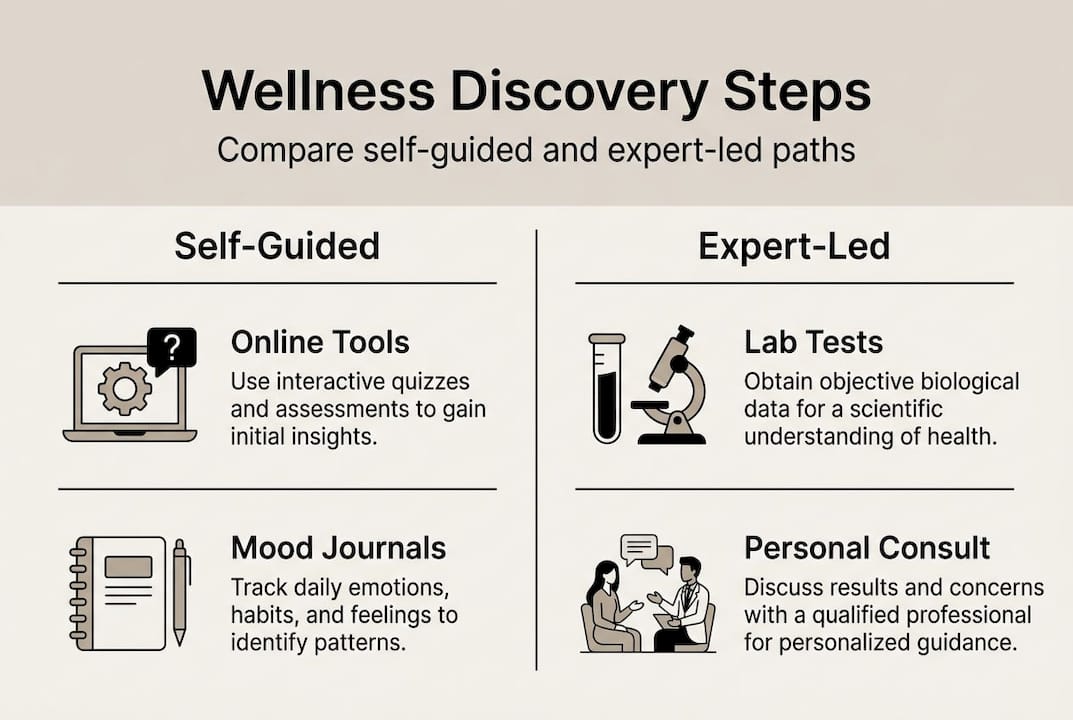
The table below shows how expert-led and self-guided discovery approaches differ:
| Feature | Expert-led discovery | Self-guided discovery |
|---|---|---|
| Depth of assessment | High | Moderate |
| Personalization | Tailored to individual | Based on questionnaire |
| Diagnostic tools | Clinical and holistic | Wellness wheels, apps |
| Accountability | Practitioner-supported | Self-managed |
| Best for | Complex or chronic issues | General wellness goals |
Both paths have real value. The right one depends on where you are in your health journey.
Why a discovery process matters: personalization and outcomes
One-size-fits-all wellness advice fails most people because bodies, histories, and lifestyles are not interchangeable. A discovery process works because it treats you as a unique case, not a category. The result is a protocol that fits your actual life rather than a generic template.
Personalized wellness benefits include faster identification of root causes, more targeted treatment selection, and better long-term adherence. When a plan reflects your real preferences and constraints, you are far more likely to stick with it.
Research supports this direction. As noted in a peer-reviewed analysis, holistic discovery provides a more comprehensive perspective than symptom-based medicine alone. This matters because many chronic issues, like fatigue, digestive problems, and anxiety, have multiple overlapping causes that a single-system approach simply misses.
"Personalized care that addresses the whole person consistently outperforms reactive, symptom-focused treatment for long-term wellness outcomes."
The key benefits of a discovery-based approach include:
- Root cause analysis rather than symptom suppression
- Integrated care planning that combines conventional and holistic health treatments
- Tailored protocols that evolve as your health changes
- Empowered decision-making because you understand your own health story
For a broader look at what holistic therapy involves, the holistic therapy guide from Bergen County Therapist is a solid starting point.
Pro Tip: Start tracking three things before your first discovery session: sleep hours, energy levels, and mood. Even two weeks of data gives a practitioner meaningful patterns to work with.
Breaking down the steps: what to expect
Knowing what happens at each stage removes the anxiety of starting something unfamiliar. Most wellness discovery processes follow a predictable sequence, whether you work with a practitioner or use a structured self-guided tool.
Here is a step-by-step walk-through of the typical phases:
- Initial intake assessment — You complete a detailed health history form covering symptoms, medications, lifestyle habits, and goals.
- In-depth history review — A practitioner or guided tool analyzes patterns across your physical, emotional, and environmental health.
- Lifestyle analysis — Sleep, nutrition, movement, and stress are evaluated together, not in isolation.
- Integrative diagnostics — Depending on your situation, this may include functional lab work, body composition analysis, or energy assessments.
- Goal-setting session — You and your practitioner align on priorities and define what success looks like for you.
- Personalized plan creation — A written protocol is developed with specific recommendations, timelines, and check-in points.
It is worth noting that self-assessment guides empower users but may miss the complexity that expert-led processes address. If your concerns are longstanding or involve multiple body systems, professional guidance at the diagnostic stage is especially valuable.
Pro Tip: Before your intake session, gather any recent lab results, a list of current supplements and medications, and three specific health goals you want to address. This preparation alone can cut your first session time in half and dramatically improve the quality of your plan.
Conventional vs holistic diagnostics: finding the right balance
One of the most common questions people ask is whether they need to choose between conventional medicine and holistic care. The honest answer is: you do not. The most effective discovery processes use both.
Conventional labs, like blood panels, thyroid tests, and imaging, provide objective, measurable data. Holistic tools, such as tongue diagnosis in Ayurveda, pulse assessment in Traditional Chinese Medicine, or functional nutrition analysis, add context that labs alone cannot capture. Together, they paint a fuller picture.

Here is how the two approaches compare:
| Diagnostic type | Strengths | Limitations |
|---|---|---|
| Conventional labs | Objective, measurable, widely accepted | Misses lifestyle and emotional factors |
| Functional medicine testing | Deeper metabolic insight | Less standardized |
| Holistic assessments (TCM, Ayurveda) | Whole-system perspective | Subjective, practitioner-dependent |
| Wellness questionnaires | Accessible, low-cost | Limited diagnostic depth |
| Integrative combination | Comprehensive and personalized | Requires skilled coordination |
The debate around evidence is real. As one research review notes, conventional medicine criticizes alternative diagnostics as lacking rigorous evidence, while proponents argue they complement labs for holistic insight. Both sides have valid points, which is exactly why integration matters.
"The goal is not to replace one system with another but to use each where it performs best."
For more on how these tools work in practice, explore holistic diagnostic alternatives and integrative health explained. If you are choosing a provider, it is also worth knowing how to verify holistic providers before booking.
Self-guided discovery vs expert-led processes: which is right for you?
Self-guided wellness tools have come a long way. Wellness wheels, symptom journals, online questionnaires, and AI-powered health apps can all help you identify patterns and set priorities. For someone in generally good health who wants to optimize their energy or reduce stress, these tools can be genuinely useful.
But there are real limits. Self-guided wellness tools empower users but are limited for complex or chronic conditions. If you are dealing with multiple overlapping symptoms, a long history of unresolved issues, or conditions that have not responded to standard care, a self-assessment tool is unlikely to give you the depth you need.
For a practical starting point, the emotional wellness checklist from Revive Health Therapy is a useful self-screening resource.
Self-guided discovery works best when:
- You are generally healthy and focused on prevention or optimization
- Your concerns are mild and recent
- You want to prepare for a practitioner visit
- You are exploring wellness for the first time
Expert-led discovery is the better choice when:
- You have chronic or recurring symptoms
- Multiple body systems seem affected
- Previous treatments have not worked
- You want a structured, accountable plan with professional oversight
- Your symptoms significantly affect your daily life
The good news is that these approaches are not mutually exclusive. Many people start with self-guided tools and then bring their findings to a practitioner for deeper analysis.
How to get started: practical tips for your wellness journey
Starting a wellness discovery process does not have to feel overwhelming. A few focused preparation steps make a significant difference in the quality of care you receive and the speed at which you see results.
Here is a practical checklist to get you started:
- Gather your health records — Recent labs, imaging reports, and a list of past diagnoses give any practitioner a strong foundation.
- Write down your top three health concerns — Be specific. "Fatigue" is a starting point, but "fatigue that worsens after meals and improves with sleep" is far more useful.
- List all current medications and supplements — Include dosages and how long you have been taking them.
- Define what success looks like — Is it more energy, less pain, better sleep, or reduced anxiety? Clear goals shape better plans.
- Research your practitioner options — Look for verified credentials, relevant specializations, and reviews from people with similar concerns.
- Ask about integration — A reputable practitioner will welcome collaboration with your existing medical team, not dismiss it.
For guidance on choosing safely, the verify holistic providers resource outlines what credentials and red flags to look for. Key considerations for safe engagement with holistic providers include checking licensure, asking about their diagnostic approach, and confirming they will communicate with your primary care physician if needed.
Pro Tip: Be cautious of any practitioner who promises to cure a specific condition, discourages you from conventional care, or cannot explain the evidence behind their methods. These are red flags, not signs of a more "natural" approach.
Ready to start your personalized wellness journey?
You now have a clear picture of how the wellness discovery process works and what it can do for your health. The next step is connecting with the right support to put it into action.
At Go Holistic, we make that connection simple. Our platform lets you find holistic health providers who are verified, credentialed, and matched to your specific concerns. You can browse practitioners near you across disciplines like acupuncture, Ayurveda, massage therapy, and functional nutrition. Our AI-powered tool analyzes your health concerns and surfaces personalized recommendations backed by research. Whether you are just starting out or looking to deepen an existing wellness practice, you can explore holistic treatments across more than 200 therapy types, all in one place.
Frequently asked questions
What is the main goal of the wellness discovery process?
The main goal is to uncover the root causes of your health issues and design a plan tailored to your unique needs, rather than treating isolated symptoms. As outlined by Go Holistic, this process centers on the whole person, not just the complaint.
Can I do a wellness discovery process on my own?
Self-guided assessments work well for general wellness goals, but expert support is vital for complex or chronic symptoms that involve multiple systems or have not responded to standard care.
How are holistic and conventional diagnostics combined?
Many practitioners use conventional lab tests alongside holistic techniques to get a full picture. Research confirms that both approaches complement each other when coordinated by a skilled provider.
Are holistic providers qualified to interpret medical tests?
Some holistic providers hold formal medical training and can interpret labs directly. Others work collaboratively with medical doctors, referring out for test interpretation while contributing their own integrative perspective.
How do I know if a holistic provider is reputable?
Check credentials, read reviews, and confirm they are willing to integrate care with your conventional providers. Go Holistic's provider standards include verification of licensure and professional background for every listed practitioner.