

Choosing a holistic path to wellness can feel daunting when you are unsure who to trust or what information is reliable. For those managing chronic health concerns, clarity, honest guidance, and open dialogue become more than preferences—they are necessities. This article explains the importance of transparency in holistic care, uncovering how open practitioner communication, evidence-based guidance, and credential verification can transform your healthcare experience and support your journey to complete well-being.
Table of Contents
- Transparency in Holistic Care Defined
- Key Areas Requiring Openness and Clarity
- Practitioner Verification and Credentials
- Evidence-Based Treatments and Information Sharing
- Ethical Responsibilities and Patient Safety
- Common Pitfalls of Opaque Practices
Key Takeaways
| Point | Details |
|---|---|
| Transparency Enhances Care | Open communication and collaboration between practitioners and patients significantly improve healthcare outcomes. |
| Empower Through Education | Patients should actively seek detailed explanations and engage in their treatment decisions for better wellness. |
| Verify Practitioner Credentials | Ensure to validate practitioners' qualifications to establish trust and ensure quality care. |
| Recognize Evidence-Based Approaches | Patients should prioritize understanding the quality of evidence behind treatments for informed decisions. |
Transparency in Holistic Care Defined
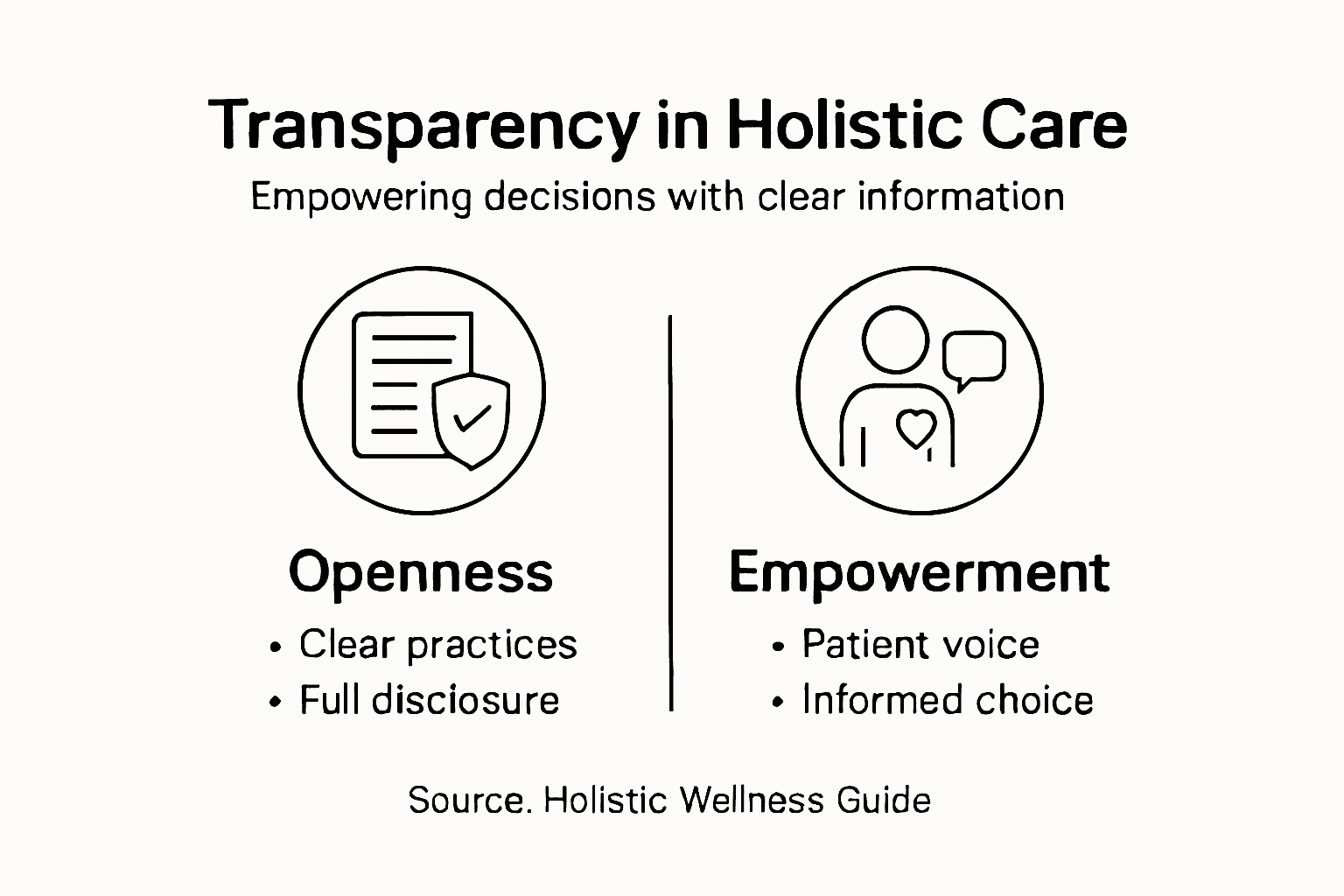
Transparency in holistic care represents a comprehensive approach to wellness that prioritizes complete patient understanding and active participation in healthcare decisions. At its core, this concept goes beyond traditional medical treatment, focusing on integrating knowledge across care processes.
Holistic care fundamentally recognizes the interconnectedness of an individual's physical, mental, and spiritual dimensions. This approach requires healthcare providers to view patients as complete beings, not merely a collection of symptoms. Key characteristics of transparent holistic care include:
- Open communication between practitioners and patients
- Comprehensive assessment of total health landscape
- Patient empowerment through education
- Detailed explanation of treatment rationales
- Collaborative decision-making processes
The interdisciplinary nature of holistic care demands empirical studies and clear communication protocols. Practitioners must bridge multiple healthcare domains, ensuring patients receive unified, cohesive guidance that addresses their comprehensive wellness needs.
Transparency transforms healthcare from a transactional experience into a collaborative wellness journey.
Holistic approaches prioritize understanding root causes rather than merely treating surface-level symptoms. This means exploring lifestyle factors, emotional states, environmental influences, and individual genetic predispositions that contribute to overall health.
Pro tip: Request detailed treatment explanations and ask practitioners to break down how different interventions interconnect to support your total wellness.
Key Areas Requiring Openness and Clarity
Transparency in holistic care demands comprehensive openness across multiple dimensions of healthcare delivery. Accountability at sociological levels becomes crucial in ensuring patients receive comprehensive, equitable treatment that addresses their total wellness needs.
Healthcare transparency encompasses several critical areas that practitioners must address openly and systematically:
- Medical history documentation
- Treatment plan explanations
- Potential intervention risks and benefits
- Cost structures and billing processes
- Practitioner credentials and specialization details
- Potential conflicts of interest
- Expected treatment outcomes
- Alternative treatment options
Interdisciplinary communication plays a pivotal role in maintaining transparency. When healthcare providers from different specialties collaborate and share information seamlessly, patients receive more integrated and holistic care.
Genuine transparency transforms patient-practitioner relationships from transactional interactions to collaborative wellness partnerships.
Personalized care context requires practitioners to go beyond traditional medical models. This means exploring not just physical symptoms, but also psychological and social factors that influence an individual's overall health landscape.
Pro tip: Request a comprehensive treatment overview that explains how different healthcare interventions interconnect and support your total wellness journey.
Practitioner Verification and Credentials
Practitioner credentials form the foundational backbone of trustworthy holistic healthcare. Credentialing processes serve as critical ethical safeguards to ensure patient safety and maintain high-quality care standards across diverse healthcare environments.
When evaluating holistic healthcare professionals, patients should consider multiple verification aspects:
- Active professional licensing status
- Advanced certifications in holistic disciplines
- Ongoing continuing education credits
- Professional association memberships
- Specialized training in integrative medicine
- Documented clinical experience
- Disciplinary record transparency
- Current malpractice insurance coverage
Comprehensive verification requires more than simply checking credentials. Holistic practitioner competence demands proficiency across biological, psychological, and social health domains, ensuring practitioners can provide truly integrated care.
Credentials are not just paperwork—they represent a commitment to professional excellence and patient well-being.
Patients should feel empowered to request and independently verify practitioner qualifications. This proactive approach helps establish trust and ensures alignment between a practitioner's claimed expertise and actual professional capabilities.

Pro tip: Request digital or printed verification of credentials, and cross-reference professional licenses through official state regulatory boards to confirm a practitioner's current standing.
Evidence-Based Treatments and Information Sharing
Evidence-based medicine represents the cornerstone of transparent holistic healthcare. Open science practices are transforming how traditional, complementary, and integrative medical treatments are researched, validated, and shared with patients worldwide.
Patients seeking holistic treatments should prioritize understanding key evidence-based information elements:
- Research methodology quality
- Statistical significance of treatment outcomes
- Peer-reviewed publication sources
- Long-term treatment effectiveness studies
- Comparative analysis with conventional treatments
- Potential treatment risks and limitations
- Reproducibility of research findings
- Interdisciplinary validation approaches
Comprehensive research assessment requires a nuanced approach. Comprehensive health assessment frameworks support patient-centered dialogue by providing transparent, validated insights into treatment rationales and potential health outcomes.
Transparent information sharing empowers patients to make informed, confident wellness decisions.
Integrative healthcare demands a collaborative approach where patients and practitioners work together, analyzing research evidence, understanding treatment complexities, and developing personalized wellness strategies that respect individual health contexts.
Pro tip: Request detailed research summaries from practitioners, focusing on peer-reviewed sources and long-term outcome studies to validate proposed holistic treatments.
Ethical Responsibilities and Patient Safety
Patient safety represents the fundamental cornerstone of ethical holistic healthcare practices. Ethical transparency in care delivery protects patients by ensuring comprehensive, honest information sharing that respects individual autonomy and promotes informed wellness decisions.
Healthcare practitioners bear critical ethical responsibilities that include:
- Maintaining complete treatment disclosure
- Protecting patient confidentiality
- Preventing potential conflicts of interest
- Ensuring informed consent processes
- Avoiding unnecessary medical interventions
- Respecting patient cultural and personal beliefs
- Providing accurate risk assessments
- Supporting patient self-determination
Research integrity demands unwavering commitment to honest clinical practices, where practitioners prioritize patient well-being over institutional or personal interests. This approach transforms healthcare from a transactional interaction to a collaborative, trust-based relationship.
Ethical responsibilities are not bureaucratic checkboxes, but fundamental promises of care and compassion.
Holistic healthcare practitioners must continually evaluate their practices, ensuring that patient safety remains the paramount concern. This requires ongoing education, self-reflection, and a commitment to transparent, patient-centered care that empowers individuals to make informed wellness choices.
Pro tip: Request a comprehensive breakdown of potential treatment risks and benefits, and never hesitate to ask practitioners about their ethical decision-making processes.
Use this reference table to empower your holistic healthcare decisions:
| Verification Step | What to Look For | Why It Matters |
|---|---|---|
| License Confirmation | Active status on state board | Legal practice and basic compliance |
| Certification Check | Advanced holistic accreditations | Specialized proficiency |
| Research Scrutiny | Peer-reviewed outcome studies | Treatment is evidence-based |
| Cost Transparency | Detailed breakdowns provided | Prevents unexpected charges |
| Risk Disclosure | Honest explanation of risks | Informs safe, informed consent |
Common Pitfalls of Opaque Practices
Healthcare opacity undermines patient trust and compromises wellness outcomes. Lack of clear communication creates significant barriers that prevent patients from making informed, empowered healthcare decisions.
Common pitfalls in holistic healthcare practices include:
- Incomplete treatment explanations
- Withholding potential intervention risks
- Using complex medical jargon
- Avoiding direct patient questions
- Presenting limited treatment options
- Minimizing patient concerns
- Concealing practitioner credentials
- Failing to discuss alternative approaches
Holistic care implementation requires more than theoretical knowledge. Practitioners often struggle to translate comprehensive wellness principles into practical, transparent patient interactions that genuinely empower individuals.
Opacity in healthcare is not just an information gap—it's a fundamental breach of patient trust.
Successful holistic care demands consistent, clear communication that demystifies treatment processes, empowers patient understanding, and creates collaborative wellness partnerships built on mutual respect and shared decision-making.
Here's a summary comparing transparent and opaque holistic care practices:
| Aspect | Transparent Holistic Care | Opaque Holistic Care |
|---|---|---|
| Patient Involvement | Actively engaged, empowered | Passive, excluded from decisions |
| Communication Style | Open, clear, two-way | Limited, jargon-heavy |
| Information Sharing | Comprehensive, evidence-based | Incomplete, often withheld |
| Treatment Rationale | Fully explained and justified | Unclear or not discussed |
| Provider Collaboration | Interdisciplinary and cooperative | Fragmented, siloed |
| Decision-Making | Collaborative and transparent | Practitioner-driven, opaque |
| Trust Level | Facilitates trust and respect | Undermines trust, creates doubt |
Pro tip: Always request a step-by-step breakdown of proposed treatments, and do not accept vague or incomplete explanations from healthcare practitioners.
Discover Transparent Holistic Care That Empowers Your Wellness Journey
The article highlights the challenge of navigating holistic healthcare when transparency is lacking. Patients often face unclear treatment rationales, hidden practitioner credentials, and incomplete risk disclosures that undermine trust and informed decision-making. At Go Holistic, we understand how vital open communication, verified practitioner credentials, and evidence-based treatment information are to your wellness decisions. Our platform bridges these gaps by connecting you to certified holistic practitioners across disciplines such as acupuncture, Ayurveda, and massage therapy, all backed by transparent research summaries and verified credentials.
Experience personalized wellness recommendations powered by AI that respect your need for clear, comprehensive information. With Go Holistic, you gain access to a curated provider directory that empowers you to book consultations confidently. Explore over 200 therapies in our evidence-based treatment library to make choices that align with your health goals. Take control of your holistic care with resources designed to foster collaboration between you and your practitioner.
Ready to step into a transparent and empowering wellness experience today?
Start your journey now at Go Holistic and unlock the benefits of trustworthy, evidence-based holistic care tailored specifically for you. Visit our platform to explore personalized options and connect with practitioners who value openness and your total well-being.
Frequently Asked Questions
What is transparency in holistic care?
Transparency in holistic care refers to a comprehensive approach to wellness that emphasizes open communication, patient empowerment, and collaborative decision-making between practitioners and patients.
Why is open communication important in holistic healthcare?
Open communication allows for better understanding of treatment rationales, risks, and benefits, leading to informed patient choices and a stronger practitioner-patient relationship.
How can I verify a holistic healthcare practitioner's credentials?
You can verify a practitioner's credentials by checking their active professional licensing status, advanced certifications, ongoing education, and membership in professional associations.
What should I look for in evidence-based treatments in holistic care?
When evaluating evidence-based treatments, consider the quality of research methodology, long-term effectiveness studies, peer-reviewed sources, and potential risks and limitations associated with the treatments.