

Living with chronic pain can make even simple daily routines feel overwhelming, pushing many to seek natural approaches that go beyond standard prescriptions. As interest in plant-based solutions grows, herbal medicine stands out because it is deeply connected to tradition and modern research, with about 80% of the global population relying on plant-based treatments for wellness. This introduction offers a clear understanding of what herbal medicine is, highlights its core principles, and explains why it continues to matter for those seeking safe, holistic relief.
Table of Contents
- Defining Herbal Medicine and Its Core Principles
- Common Herbal Medicine Types and Uses
- How Herbal Remedies Work in the Body
- Evidence, Safety, and Legal Regulations Worldwide
- Risks, Interactions, and Choosing Safe Alternatives
Key Takeaways
| Point | Details |
|---|---|
| Holistic Approach | Herbal medicine emphasizes treating the entire body rather than just symptoms, promoting comprehensive wellness. |
| Natural Remedies | Utilizing whole plant extracts and minimal processing, herbal medicine offers alternatives to conventional treatments. |
| Consultation Importance | Always consult a qualified healthcare professional before using herbal remedies to ensure safe integration and efficacy. |
| Research and Validation | Rigorous scientific investigation is essential to validate the efficacy and safety of herbal treatments in modern healthcare practices. |
Defining Herbal Medicine and Its Core Principles
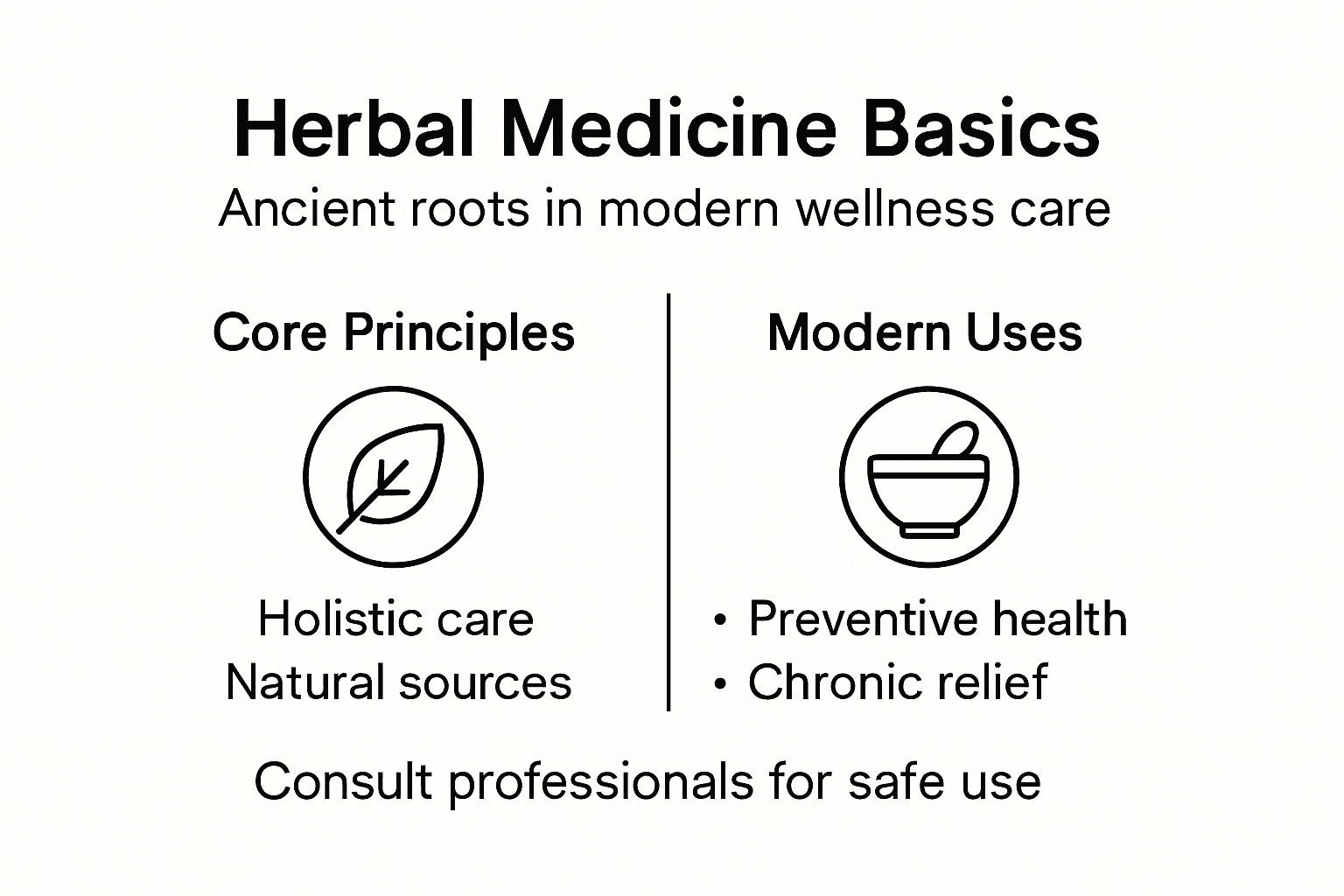
Herbal medicine represents an ancient healing practice with roots spanning thousands of years across diverse global cultures. Traditional medical practices reveal that approximately 80% of the world's population relies on plant-based treatments, demonstrating the profound historical significance and continued relevance of herbal approaches to wellness.
At its core, herbal medicine involves utilizing whole plants or specific plant components containing bioactive compounds to support healing and promote overall health. These natural remedies are typically prepared as powders, tinctures, teas, or liquid extracts, each leveraging the complex chemical compositions found within botanical sources. Integrative healing approaches balance traditional knowledge with contemporary scientific validation, creating a comprehensive framework for understanding plant-based therapeutics.
The fundamental principles of herbal medicine encompass several critical dimensions:
- Holistic healing perspective: Treating the entire body system, not just isolated symptoms
- Natural ingredient utilization: Leveraging whole plant extracts with minimal processing
- Individual variability recognition: Acknowledging that healing responses differ among individuals
- Evidence-based methodology: Combining traditional wisdom with modern scientific research
- Preventative health focus: Emphasizing wellness maintenance and proactive health strategies
Modern herbal medicine practitioners recognize the importance of rigorous scientific investigation. While traditional practices provide valuable insights, contemporary approaches demand systematic research to validate efficacy, understand potential interactions, and establish standardized protocols. This evolution ensures that herbal treatments meet robust medical standards while preserving their fundamental connection to natural healing traditions.
Pro tip: Before incorporating any herbal remedy into your wellness routine, consult with a qualified healthcare professional who understands both traditional and contemporary medical perspectives.
Common Herbal Medicine Types and Uses
Herbal medicine encompasses a diverse range of therapeutic applications, offering natural solutions for managing various health conditions and promoting overall wellness. These plant-based remedies come in multiple forms, including teas, extracts, tinctures, powders, and topical preparations, each designed to address specific health concerns through their unique biochemical properties.
Some of the most prevalent herbal medicine types include:
-
Immune Support Herbs
- Echinacea: Supports immune system function
- Elderberry: Helps prevent and reduce cold symptoms
- Astragalus: Boosts overall immune resilience
-
Stress and Relaxation Herbs
- Chamomile: Promotes relaxation and sleep
- Ashwagandha: Reduces stress and supports adrenal health
- Lavender: Calms nervous system and improves mood
-
Cardiovascular Health Herbs
- Garlic: Supports heart health and circulation
- Hawthorn: Helps regulate blood pressure
- Ginger: Reduces inflammation and supports circulation
Common herbal medicines target specific health conditions, ranging from chronic disease management to preventive wellness strategies. Practitioners often recommend these natural remedies for addressing issues like diabetes, cardiovascular problems, arthritis, and chronic pain. The versatility of herbal medicines allows for personalized treatment approaches that consider individual health needs and potential interactions.

Here is a quick comparison of herbal medicine forms and their typical applications:
| Preparation Form | Common Use | Absorption Speed |
|---|---|---|
| Teas & Infusions | Mild daily support | Fast (minutes to hours) |
| Tinctures | Acute symptoms relief | Moderate (minutes) |
| Powders/Capsules | Ongoing supplementation | Slow (hours) |
| Topical Extracts | Localized discomfort | Variable (site specific) |
While herbal medicines offer significant potential benefits, it's crucial to approach their use with informed caution. Different herbs interact uniquely with individual body systems, and potential side effects can vary based on personal health conditions, existing medications, and dosage. Professional consultation ensures safe and effective integration of herbal remedies into one's healthcare routine.
Pro tip: Always consult a qualified healthcare professional before starting any herbal treatment to ensure safety and appropriateness for your specific health profile.
How Herbal Remedies Work in the Body
Herbal remedies operate through complex biochemical interactions within the human body, utilizing a sophisticated network of bioactive compounds that interact with physiological systems. These natural treatments leverage secondary metabolites like flavonoids, alkaloids, and terpenoids to produce therapeutic effects across multiple biological pathways.
The primary mechanisms of herbal remedy interactions include:
-
Receptor Interactions
- Binding to cellular receptors
- Modulating signaling pathways
- Regulating cellular communication
-
Biochemical Pathway Influences
- Enzyme inhibition
- Gene expression modulation
- Inflammation reduction
- Antioxidant protection
-
Systemic Response Triggers
- Immune system enhancement
- Metabolic process regulation
- Neurological function support
Herbal compounds demonstrate remarkable synergistic capabilities, meaning multiple active agents work simultaneously to produce comprehensive therapeutic effects. Unlike isolated pharmaceutical compounds, herbal medicines contain intricate mixtures that can target multiple biochemical systems concurrently, potentially offering more nuanced and holistic healing approaches.
The body's response to herbal remedies depends on individual physiological characteristics, including genetic makeup, existing health conditions, and metabolic efficiency. These natural treatments interact dynamically with human biochemistry, often providing subtle yet profound healing mechanisms that support the body's intrinsic restoration processes.
Pro tip: Consult a healthcare professional to understand how specific herbal remedies might interact with your unique biochemical profile and existing health conditions.
Evidence, Safety, and Legal Regulations Worldwide
Herbal medicine safety requires comprehensive global evaluation due to significant variations in plant composition, manufacturing processes, and regulatory frameworks across different countries. The complexity of herbal treatments demands rigorous scientific scrutiny to ensure consumer protection and establish reliable therapeutic standards.
Key regulatory considerations for herbal medicines include:
-
Quality Control Challenges
- Inconsistent plant composition
- Variability in extraction methods
- Limited standardization protocols
-
Safety Assessment Criteria
- Toxicity screening
- Potential drug interactions
- Long-term health impact evaluation
-
International Regulatory Approaches
- Varying legal classifications
- Different approval processes
- Diverse scientific validation requirements
Scientific validation strategies for herbal medicines incorporate multiple research methodologies including phytochemical analysis, preclinical studies, and controlled clinical trials. These comprehensive approaches aim to bridge traditional knowledge with modern scientific standards, providing robust evidence for therapeutic effectiveness and safety.
Advancing technologies like artificial intelligence and biotechnology are emerging as powerful tools for improving herbal medicine research. These innovative approaches can potentially standardize quality control processes, enhance extraction techniques, and create more precise methods for evaluating herbal remedy efficacy across diverse global contexts.
Below is a summary of global herbal medicine regulations for better understanding:
| Region | Legal Status | Main Oversight Body |
|---|---|---|
| United States | Dietary supplement | FDA (limited regulation) |
| European Union | Traditional medicine | EMA & national agencies |
| China | Integrated medicine | National medical authority |
| Australia | Complementary therapy | TGA |
Pro tip: Always verify the regulatory status and scientific evidence of herbal remedies in your specific region before incorporating them into your health regimen.
Risks, Interactions, and Choosing Safe Alternatives
Herbal medicine risks demand comprehensive understanding to ensure safe and effective treatment. The variability in herbal composition presents significant challenges, with potential for unpredictable interactions and adverse reactions that can compromise patient health and treatment outcomes.
Key risks and safety considerations include:
-
Potential Drug Interactions
- Altering pharmaceutical metabolism
- Reducing medication effectiveness
- Causing unexpected side effects
-
Herbal Composition Challenges
- Inconsistent active ingredient concentrations
- Variability in plant sourcing
- Potential contamination risks
-
Individual Health Factors
- Genetic predispositions
- Pre-existing medical conditions
- Current medication regimens
Drug-herb interactions represent significant clinical concerns that require careful professional assessment. These complex interactions can fundamentally alter drug metabolism and pharmacodynamics, potentially creating dangerous health scenarios that demand heightened awareness and expert medical guidance.
Safe herbal medicine practices necessitate a proactive, informed approach. Consumers should prioritize consultation with healthcare professionals, verify product sources, and maintain transparent communication about all supplements and medications they are currently using. This comprehensive strategy helps mitigate potential risks and ensures more personalized, safer therapeutic interventions.
Pro tip: Create a comprehensive list of all current medications and supplements to share with your healthcare provider during consultation, enabling more accurate risk assessment.
Experience the Power of Herbal Medicine with Personalized Holistic Care
Understanding the role of herbal medicine in modern wellness highlights key challenges such as safely integrating natural remedies, navigating complex interactions, and finding trustworthy guidance. If you are seeking to embrace herbal treatments that honor both traditional wisdom and scientific evidence while ensuring safety and personalized attention, you are not alone. Many wellness seekers face the pain points of unpredictability in herbal efficacy and concerns over drug-herb interactions as explained in this article. Go Holistic offers a trusted solution by connecting you with certified holistic practitioners who specialize in herbal medicine and other natural therapies that harmonize your whole body and mind.
Begin your journey towards safe and effective herbal wellness today. Explore our curated provider directory to find experts who understand your unique health profile and goals. With AI-powered personalized recommendations and access to evidence-based treatment information, Go Holistic empowers you to make informed choices without guesswork. Don’t wait to transform your health with natural remedies supported by modern science. Visit Go Holistic now to unlock your path to integrative health.
Frequently Asked Questions
What are the core principles of herbal medicine?
The core principles of herbal medicine include a holistic healing perspective, utilization of natural ingredients, recognition of individual variability in healing responses, an evidence-based methodology, and a focus on preventative health strategies.
How do herbal remedies work in the body?
Herbal remedies work through complex biochemical interactions, involving receptor binding, modulation of enzymatic activity, and influencing various physiological pathways to produce therapeutic effects.
What are the common forms of herbal medicine and their uses?
Common forms of herbal medicine include teas, tinctures, powders, and topical extracts, each serving different purposes such as providing mild daily support, acute symptom relief, or targeted local treatment of discomfort.
What safety precautions should be taken when using herbal medicines?
Safety precautions include consulting a healthcare professional to evaluate potential drug interactions, verifying the quality and source of products, and being aware of individual health factors that may affect herbal remedy effectiveness.