

Tai Chi is a structured form of meditative movement often classed under the broader family of Qigong. If you want quick, repeatable breathing and energy work you can drop into anywhere, Qigong tends to fit better. If you're after progressive balance training, memorized forms, and a social class setting, Tai Chi usually wins. Both are backed by real research, and neither one is the "wrong" choice.
TL;DR:
- Qigong practice offers quicker, modular routines that can be learned in a single session and are suitable for seated or limited-mobility individuals.
- Tai Chi involves long, memorized sequences with a focus on martial arts roots, requiring more time and space to master but providing structured progress.
- Both practices improve body, breath, and mind regulation, often overlapping in research and classroom formats, especially with shortened forms.
- Qigong has been shown to significantly reduce perceived stress in recent studies, with benefits often felt immediately, unlike Tai Chi’s gradual strength and balance gains.
- For beginners uncertain about long-term commitment, starting with Qigong allows quick assessment of meditative movement benefits without the steep learning curve.
Table of Contents
- Qigong vs Tai Chi: What Sets Tai Chi Apart
- Qigong vs Tai Chi: How Qigong Practice Differs
- Similarities Between Qigong and Tai Chi
- The Real Differences: Structure, Purpose, and Learning Curve
- What the Research Says About Health Benefits
- Which Is Right for You: Matching Goals to Practice
- Getting Started: A Simple Two-Week Plan
- Safety, Contraindications, and Adaptations
- Why Many Teachers Combine Qigong and Tai Chi
- Find a Qigong or Tai Chi Instructor Through Goholistic
- Sources
Qigong vs Tai Chi: What Sets Tai Chi Apart
Tai Chi, or taijiquan, grew out of Chinese martial arts centuries ago. Its slow, flowing postures were originally combat techniques, softened over generations into a practice that trains balance, coordination, and calm attention instead of striking power.
Most health-focused classes today use short forms rather than the full traditional sequences, which can take years to learn. Yang-style short forms with a modest number of movements are common, and researchers often rely on these simplified versions precisely because they lower the learning curve without losing the health benefit.
A typical class looks like this:
- A short warm-up, often with Qigong-style breathing or gentle stretches
- A guided walk-through of a form, broken into individual movements
- Repetition of the full sequence, moving slowly from posture to posture
- A brief cool-down or seated breathing period
You can explore how these formats work in more depth on Goholistic's Tai Chi page.
Qigong vs Tai Chi: How Qigong Practice Differs
Qigong is less a single practice than a category. The name translates roughly to "energy work," and it covers medical Qigong used in Chinese hospitals, standing meditations, and dynamic flowing sets that share some DNA with Tai Chi.
Sessions tend to be shorter and more modular than a Tai Chi class. You might practice one standing posture for five minutes, or move through a set of eight repeatable exercises that combine breath, gentle motion, and mental visualization. Many forms can be done seated, which matters if mobility is limited.
Common elements include:
- Slow, repeatable movements you can practice in isolation
- Breathwork paired with visualization or intention
- Standing meditations like zhan zhuang, or "standing like a tree"
- Seated variations for people who can't stand for long periods
Because the pieces are modular, Qigong is often used as a standalone stress-relief practice or as a warm-up before a Tai Chi class. Goholistic's Qigong treatment page breaks down the major styles if you want a closer look.
Similarities Between Qigong and Tai Chi
Strip away the labels, and both practices are training the same three systems.
- Body regulation. Both use slow, controlled movement to build coordination, posture awareness, and gentle strength.
- Breath regulation. Both pair movement with deliberate, often diaphragmatic breathing.
- Mind regulation. Both ask you to keep attention on the present sensation instead of drifting into thought loops, which is why researchers group them under the same "meditative movement" umbrella.
The overlap runs deeper in practice than most people realize. A clinical review comparing the two found that many Tai Chi programs used in research are simplified short forms, which makes them operationally close to Qigong exercises. Qigong is frequently folded into Tai Chi classes as the opening warm-up, which is one reason beginners sometimes struggle to tell where one practice ends and the other begins.
The Real Differences: Structure, Purpose, and Learning Curve
The similarities explain why people confuse the two. The differences explain why you might pick one over the other.
- Structure. Tai Chi builds toward long, choreographed sequences you memorize and repeat in the same order. Qigong is modular: you can practice a single movement or breathing pattern on its own, without learning a whole form.
- Purpose. Tai Chi carries martial-art roots and rewards progressive mastery over months and years. Qigong is generally built around targeted energy cultivation or therapeutic movement, aimed at a specific outcome like stress relief or joint mobility.
- Learning curve. Qigong postures can usually be picked up in a single session. A Tai Chi short form takes several weeks of repetition before it feels automatic.
- Space and format. Tai Chi typically needs more room to move through a sequence. Qigong can be done standing in a small space, or seated, making it more travel- and office-friendly.
- Speed of felt benefit. People often report calmer breathing and lower tension within one Qigong session. Tai Chi's balance and strength gains build more gradually, over consistent weekly practice.
Pro Tip: If you're not sure which one you'll stick with, try Qigong first. It has almost no learning curve, so you get to judge how the "meditative movement" style feels before committing to memorizing a Tai Chi form.
What the Research Says About Health Benefits
The science on both practices is promising, though it comes with real caveats worth knowing before you set expectations.
A 2024 meta-analysis of nine randomized controlled trials found Qigong reduced perceived stress compared with no treatment at all (OR −0.60; 95% CI −1.02 to −0.17; p = 0.006). That's a meaningful signal, but the study's own authors flagged the need for more high-quality, multicenter trials before treating the effect as settled.
On the Tai Chi side, a VA evidence map pulling together systematic reviews from 2014 through 2024 reports clinically important benefits across conditions including:
- Falls risk and balance in older adults
- Hypertension and cardiovascular markers
- Osteoporosis and bone health
- Parkinson's disease symptoms and quality-of-life measures
NCCIH and the Cleveland Clinic both echo the same caution: the practices show real promise, but study quality varies widely, sample sizes are often small, and comparing results across trials is messy because programs differ so much in length and format. Treat the encouraging findings as a green light to try, not as a guarantee.
Which Is Right for You: Matching Goals to Practice
Your goal should drive the choice more than which practice sounds more appealing on paper.
- Want quick stress relief or a desk-break reset? Qigong's short, standing or seated routines fit into five to ten minutes without any equipment or space.
- Dealing with limited mobility? Qigong's seated and standing-meditation variations adapt more easily than a full Tai Chi form.
- Focused on balance, fall prevention, or steady progress you can track? Tai Chi's structured sequences and social class format build coordination over time, and Tai Chi's balance training is well documented in older-adult research.
- Managing a chronic condition or recovering from injury? Either practice can help, but loop in your physician or physical therapist first and choose the adaptation that matches your current range of motion.
- Evaluating a class or instructor? Ask about their certification background, whether the class uses a short form or full traditional sequence, how they pace instruction for beginners, and whether seated modifications are offered.
Getting Started: A Simple Two-Week Plan
You don't need special equipment or a studio membership to find out which practice suits you.
- Week one: Practice a 5 to 10 minute Qigong breathing and standing set daily. Look for a beginner-friendly video or a local class that teaches basic postures.
- Week one, in parallel: Attend one short-form Tai Chi class to get a feel for the sequence and pacing.
- Week two: Keep the daily Qigong routine and add short Tai Chi practice sessions three times a week, repeating what you learned in class.
- End of week two: Notice which practice you looked forward to, and which left you feeling calmer or steadier.
Pro Tip: Online videos work fine for basic Qigong breathing sets, but a beginner Tai Chi form is easier to learn correctly with an instructor who can correct your posture in real time. Look for certification through a recognized Tai Chi or Qigong association before booking.
Safety, Contraindications, and Adaptations
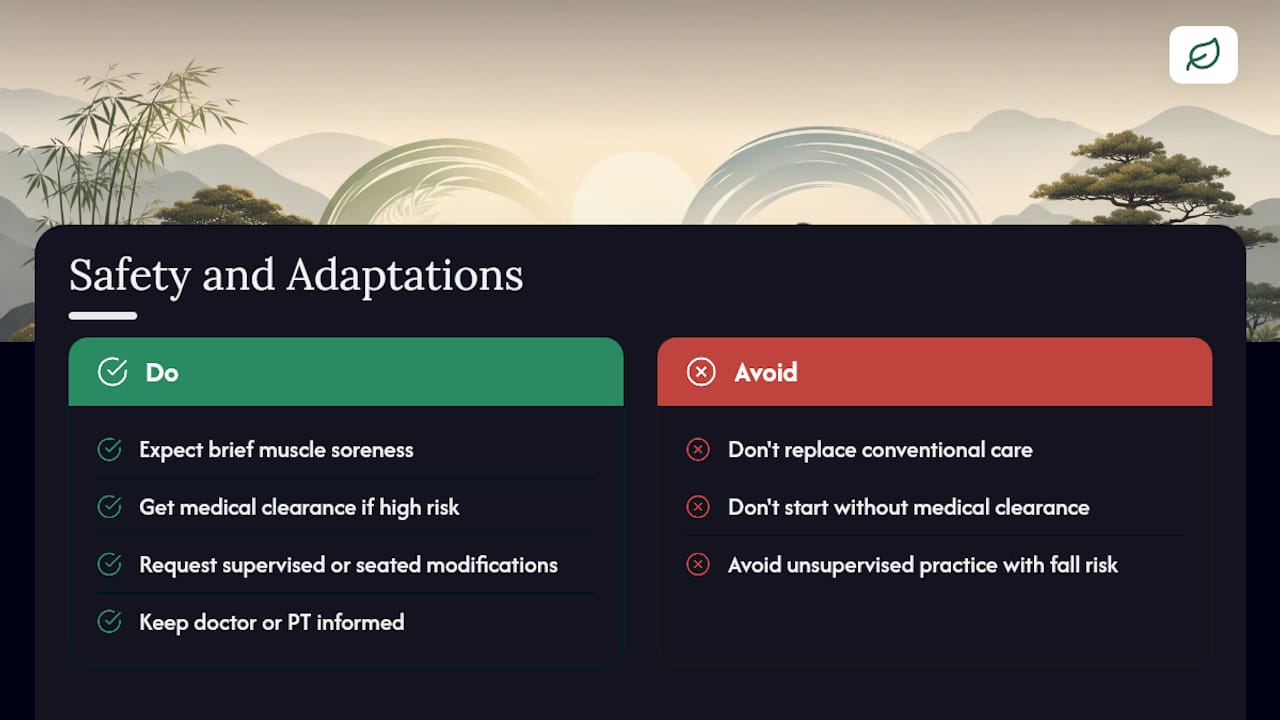
Both practices carry a low risk profile. Occasional muscle soreness from unfamiliar movement is the most common complaint, and it usually fades within a week or two of steady practice.
If you have a significant fall risk, a recent joint replacement, or a cardiovascular condition, get medical clearance before starting either practice, and ask about supervised or seated modifications. These practices work best as a complement to conventional care, not a replacement for it, so keep your doctor or physical therapist in the loop if you're managing an existing condition.
Why Many Teachers Combine Qigong and Tai Chi
Most instructors don't treat this as an either/or choice. Qigong makes a natural warm-up because it loosens the body and settles the breath before the more demanding memory work of a Tai Chi form. Combining both also supports adherence: beginners get an easy win early in Qigong, which builds confidence before tackling Tai Chi's longer learning curve. Give yourself permission to experiment with both before settling into one.
— Andrew
Find a Qigong or Tai Chi Instructor Through Goholistic
Reading about breath work and balance training only gets you so far. The provider directory lets you filter instructors by class type, experience level, and accessibility needs, so you can find a Qigong teacher who offers seated modifications or a Tai Chi instructor running true beginner-paced short forms.

The treatment library also includes dedicated entries on both practices, backed by research summaries, so you can compare formats before you ever set foot in a class. If stress relief is the priority, pairing Qigong with a broader look at holistic health coaching can help you build a routine that sticks instead of fizzling out after week two. Browse verified practitioners near you and book a first session directly through the directory.
This article is general information, not a substitute for advice from a qualified doctor. Consult a qualified healthcare professional about your own circumstances before acting on anything here.
Sources
- Meta-analysis on Qigong and stress (2024)
- VA evidence map: Tai Chi and Qigong
- Comparative review of Tai Chi and Qigong (PMC, 2010)
- NCCIH: Qigong — what you need to know
- Cleveland Clinic: Health benefits of Qigong