

Swedish massage is the gentler, relaxation-focused choice for calming your nervous system and easing everyday tension. Deep tissue massage uses firmer, sustained pressure to work through chronic muscle and fascial issues. If you're winding down from stress or want better sleep, Swedish is your friend. If you're dealing with a stubborn knot in your lower back that never seems to let go, deep tissue is built for that. Either way, tell your provider about any medical conditions before you book.
TL;DR:
- Deep tissue massage effectively reduces chronic pain and adhesions, especially in the lower back, neck, and postural issues, with clinical evidence supporting its benefits.
- Swedish massage primarily promotes relaxation through light to moderate strokes, making it suitable for stress relief, sleep issues, and gentle muscle tension.
- Deep tissue sessions tend to be more intense and may cause mild soreness for one or two days, requiring careful communication about pressure and contraindications like osteoporosis or pregnancy.
- Starting with Swedish massage is advisable for newcomers, and a blended approach can combine both techniques within a session for better comfort and results.
- Choosing the right massage depends on your specific problem, pain tolerance, and medical conditions; verified providers can help match you with the appropriate modality.
Table of Contents
- Deep Tissue vs. Swedish: What Makes Swedish Massage Feel So Soothing?
- Deep Tissue vs. Swedish: How Does Deep Tissue Actually Work?
- Which Is Better, Deep Tissue or Swedish?
- How Do You Decide Between Swedish and Deep Tissue?
- How Should You Prepare For and Recover From a Massage?
- How Goholistic Helps You Find the Right Massage Therapist
- What Actually Matters When You're Choosing
- Book Verified Massage Therapists Through Goholistic
- Sources
- FAQ
Deep Tissue vs. Swedish: What Makes Swedish Massage Feel So Soothing?
Swedish massage was designed for one purpose: to calm you down and get your blood moving. It relies on five classic strokes, effleurage (long gliding movements), petrissage (kneading), tapotement (light rhythmic tapping), friction, and vibration, layered together in a slow, predictable rhythm. That rhythm is the point. Your body reads it as a cue to relax, which shifts your nervous system into what's often called "rest and digest" mode.
The physiological payoff is real. Long, flowing strokes at light-to-firm pressure improve circulation and ease general muscle tension, according to Healthline's comparison of the two techniques. That mechanism explains why Swedish tends to work so well for:
- Chronic stress or anxiety that shows up as tight shoulders
- Insomnia or restless sleep patterns
- People with low pain tolerance who find deeper work uncomfortable
- Fibromyalgia, where lighter pressure avoids flaring sensitive tissue
Pro Tip: If you're new to massage entirely, book a Swedish session first, even if your real goal is deep tissue work later. It gives your therapist a baseline read on how your body responds to touch.
Sessions usually run 60 to 90 minutes. Expect to feel loose and a little sleepy afterward, not sore.
Deep Tissue vs. Swedish: How Does Deep Tissue Actually Work?
Deep tissue massage trades rhythm for precision. Therapists use slow, forceful strokes, often with a forearm or elbow, plus cross-fiber friction to reach muscle layers that Swedish strokes never touch. The target isn't just the muscle itself but the fascia surrounding it and the adhesions (bands of stiff, "stuck" tissue) that form after injury or repetitive strain.
There's actual clinical backing here, not just spa marketing. A randomized trial of 59 participants found that deep tissue massage reduced chronic low back pain, with results comparable to NSAID medication in that sample. That's a meaningful data point, though it's one trial, not a universal guarantee.
- Best suited for chronic back or neck pain, sports injuries, and postural dysfunction
- Sustained pressure targets deep muscle layers, fascia, and tendons
- Massage therapy also supports athletic recovery and performance, with session frequency shaping the outcome
Mild soreness for a day or two afterward is common and typically harmless. Skip deep tissue if you have acute injuries, blood clotting disorders, or certain bone conditions, more on that below. Sessions run 60 to 90 minutes.
Which Is Better, Deep Tissue or Swedish?
Neither wins outright. Each solves a different problem, and the right pick depends on what your body is actually asking for.
| Factor | Swedish Massage | Deep Tissue Massage |
|---|---|---|
| Pressure | Light to firm | Firm to intense, sustained |
| Primary goal | Relaxation, circulation | Chronic pain, adhesion release |
| Tissue depth | Superficial muscle, skin | Deep muscle layers, fascia |
| Pacing | Slow, rhythmic, flowing | Slow, concentrated, targeted |
| Aftercare feel | Relaxed, sometimes drowsy | Mild soreness for a day or two |
| Cost range | moderate price range | somewhat higher price range |
Clinical overviews note that Swedish techniques mainly engage superficial tissue and the nervous system, while deep tissue work zeroes in on myofascial adhesions and trigger points. That distinction is the whole ballgame when you're deciding which one to book.
Pro Tip: Deep tissue shouldn't hurt in a way that makes you tense up. Discomfort is normal; pain that makes you hold your breath means the pressure needs to come down, not up.
The biggest safety trade-off: deep tissue isn't appropriate for everyone. If you're pregnant, have osteoporosis, or have cancer that's spread to the bone, gentler work is the safer route. Recovery from Swedish is immediate. Recovery from deep tissue means a day or two of soreness before you feel the benefit.
How Do You Decide Between Swedish and Deep Tissue?
Start with your goal, not your preference for "stronger is better." A few questions make the decision almost automatic:
- What's the actual problem? Stress and poor sleep point to Swedish. A nagging, specific pain point (lower back, shoulders, hips) points to deep tissue.
- What's your pain tolerance? If firm pressure makes you clench up, deep tissue will fight your body instead of helping it.
- Do you have a medical condition? Osteoporosis, pregnancy, blood thinners, or recent surgery all change the answer. Say so during intake.
- Are you training for something? Athletes recovering from heavy training often benefit from deeper, targeted work.
When you book, ask your therapist about their training, how they check in on pressure mid-session, and how they screen for contraindications. A good provider adjusts within the same appointment.
Pro Tip: Unsure which to pick? Start with Swedish to warm the tissue, then ask your therapist to work deeper on specific tight spots. Many sessions blend both approaches without you needing to choose one exclusively.
If pain persists after a few sessions, or worsens, that's a signal to loop in a physician before continuing.
How Should You Prepare For and Recover From a Massage?
Preparation is simple but easy to skip. Drink water beforehand, skip a heavy meal right before your appointment, and tell your therapist about any medications, injuries, or conditions during intake, not halfway through the session.
- Communicate pressure in real time; a simple "lighter" or "a bit more" keeps the session therapeutic instead of painful
- Breathe normally rather than holding your breath through firm pressure
- After deep tissue, hydrate and move gently; light stretching helps more than sitting still
- Use heat for lingering tightness, ice only if there's noticeable inflammation
- Mild soreness for a day or two is normal; sharp or worsening pain isn't, and it's worth a call to your provider
If you have a heart condition, are pregnant, or have a bone density concern, get clearance from your doctor before booking deep tissue work specifically.
How Goholistic Helps You Find the Right Massage Therapist
Choosing between Swedish and deep tissue work gets easier when you're not guessing at a provider's training. The treatment library breaks down each modality, while the provider directory lets you filter by certification and specialty before you ever pick up the phone.
- Recommendations match your stated concerns to the right modality
- Provider profiles include credential details
- Direct booking removes the back-and-forth of calling around
When you fill out intake notes, mention your goal (relaxation vs. chronic pain), pain tolerance, and any relevant medical history.
What Actually Matters When You're Choosing
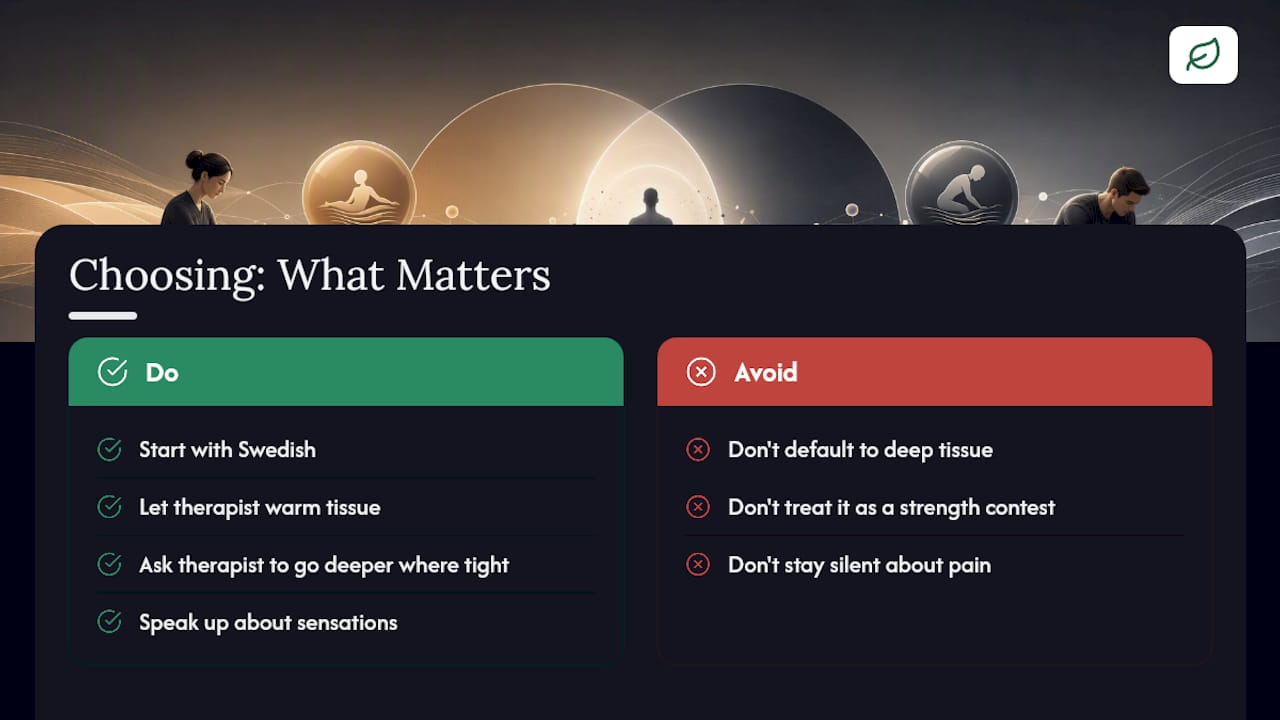
Here's what I think gets lost in most comparisons: people treat this like a strength contest, as if deep tissue is the "advanced" version of Swedish. It isn't. They solve different problems through different mechanisms, nervous-system calming versus structural tissue release, and picking the wrong one for your actual issue wastes your money and your time.
My honest recommendation: if you're not sure, start with Swedish, let your therapist warm the tissue, and ask them to go deeper only where it's genuinely tight. Say what you're feeling out loud. The best sessions I've read about all trace back to clear communication, not tougher hands.
Book Verified Massage Therapists Through Goholistic
Finding a therapist who's actually trained in the technique you need shouldn't require guesswork or a string of phone calls. Goholistic gives you a direct route to verified, credentialed massage providers, filtered by specialty, so you're not relying on a generic listing site or a stranger's five star review to gauge whether someone actually knows deep tissue work.
Every provider profile shows real certification details, and the platform's AI matching tool factors in your specific goal, whether that's stress relief or chronic pain, before suggesting who to book. Browse the full treatments directory to compare modalities side by side, or head straight to find a verified practitioner near you and schedule a session that actually fits what your body needs.
Sources
- What's the Difference Between Swedish Massage and Deep Tissue Massage? — Healthline
- Massage for chronic low-back pain: a randomized trial — PubMed
- Massage therapy effects on athletic performance and recovery — PMC
FAQ
Which Is Harder, Swedish or Deep Tissue?
Deep tissue is physically more demanding for the therapist and more intense for the client, since it requires sustained, forceful pressure through the forearm or elbow. Swedish massage is lighter and more rhythmic, making it the easier session for both sides.
Why Would Someone Choose Deep Tissue Over Swedish?
Someone would choose deep tissue when the issue is structural, like chronic low back pain, sports injuries, or tight fascia, rather than general stress. Clinical trial results show it can meaningfully reduce chronic pain in ways lighter techniques typically can't.
Is Deep Tissue the Best Massage Overall?
No single technique is universally "best." Deep tissue outperforms Swedish for chronic muscle and fascial problems, but Swedish is the better and safer choice for relaxation, sleep issues, or anyone with a lower pain tolerance.
How Does Deep Tissue Compare to Chiropractic Care?
Deep tissue massage works on soft tissue, muscle, and fascia, while chiropractic care focuses on spinal alignment and joint adjustment. Many people use both, but they're not interchangeable, and a persistent joint issue may need a chiropractor rather than a massage therapist.
Can I Combine Swedish and Deep Tissue in One Session?
Yes, many therapists open with Swedish strokes to warm the tissue before applying deeper, targeted pressure where you need it. This blended approach is common and often more comfortable than jumping straight into intense pressure on cold muscles.